
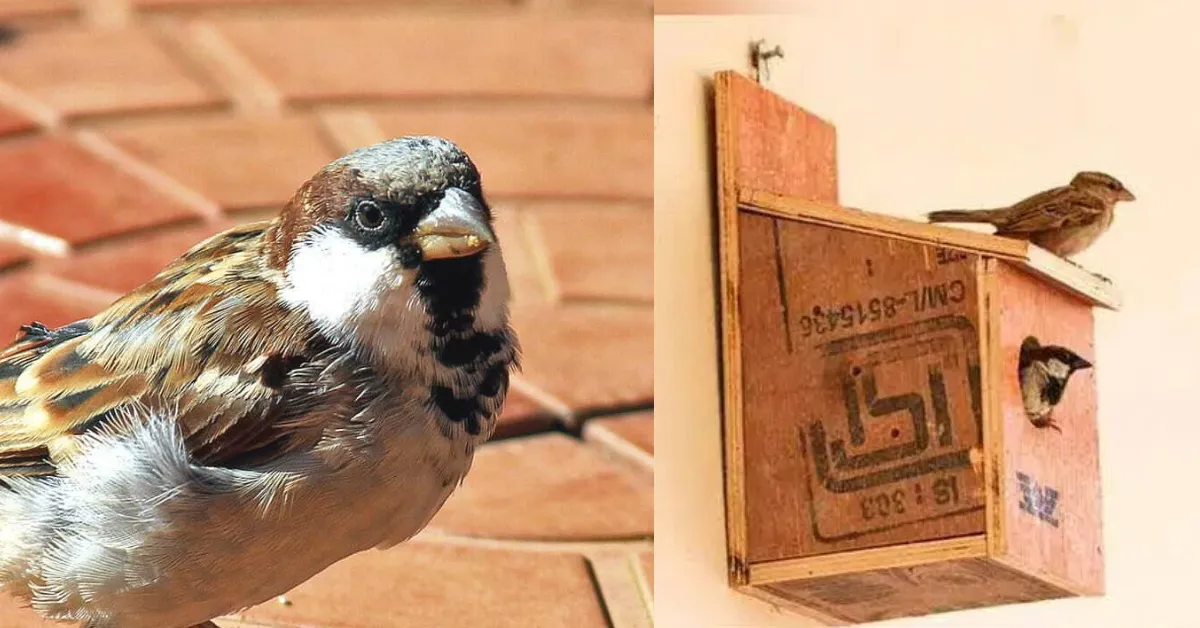
For generations, mornings across India began with a familiar chirping of house sparrows. Their presence was so ordinary that it rarely got any attention.
Today, their absence does.
A bird that lived with us
The house sparrow has never been a distant, forest-dwelling species. It evolved alongside human settlements, nesting in crevices of homes, feeding on grains, and thriving in close proximity to people. Its presence has long been considered a marker of environmental health.
This is why its decline has unsettled conservationists. Recent surveys in Thiruvananthapuram, for instance, have pointed to a sharp drop in sparrow numbers. Similar patterns have been observed in multiple urban pockets across India.
But why?
The urban paradox
According to bird researcher Sujan Chatterjee, the decline is not uniform. Sparrows continue to exist in many non-urban and semi-urban areas. The real crisis, he explains, is concentrated in cities.
“Modern architecture plays a decisive role here. Older homes, with their ventilators, tiled roofs, and small gaps, offered natural nesting spaces. Today’s glass-and-concrete structures are sealed, smooth, and inhospitable for the sparrow”, he tells The Better India.
Older homes, he notes, were unintentionally designed to accommodate bird life.
Chatterjee, who serves as the founder of West Bengal’s Birdwatcher’s Society and a reviewer for eBird India—a global ornithological database managed by the Cornell Lab of Ornithology—has dedicated years to studying regional shifts in bird populations.
From his vantage point, the crisis is real, but it is misunderstood.
“Sparrow populations haven’t collapsed everywhere. The sharper decline is largely visible in urban pockets.” According to Chatterjee, the disappearance of sparrows from cities is closely tied to how urban environments have evolved.
At the same time, urban living has reduced access to food, he says.
“Sparrows are seed-eating birds. They don’t feed on garbage,” he points out. “That’s where the difference lies. Species like crows have adapted because they are scavengers, they can eat almost anything. Sparrows cannot.”, he explains.
The shift in urban food chains has therefore worked against them. “Increased pesticide use has reduced insect populations, which are critical for feeding sparrow chicks. So, clean, sanitised cityscapes, while visually appealing, have removed the very resources that once sustained sparrows”, Chatterjee adds.
There is competition
“Pigeons have become aggressive competitors,” Chatterjee says. “They occupy nesting spaces and often damage sparrow nests. Besides, rising crow populations pose an additional threat.”
Unlike crows, which have adapted to thrive on human waste, sparrows cannot survive on garbage. They depend on specific ecological conditions, access to seeds, insects for their young, and safe nesting spaces.
This is exactly where pigeons, and crows outcompete sparrows for food, and nesting spaces.
Why small fixes don’t work
In recent years, well-meaning efforts, like placing water bowls or scattering grains have become common responses to the sparrow’s decline. But Chatterjee is cautious about their impact.
“These are temporary measures. They don’t address the core issue,” he says.
The real problem, he explains, lies in habitat design. “Urban landscapes today are built around control, controlled greenery, controlled pests, controlled aesthetics. Gardens are manicured, undergrowth is removed, and pesticides are routinely used to maintain “clean” environments.”
But in doing so, he says, cities eliminate the ecological complexity that birds depend on. “A decorative garden is not the same as a living habitat,” he says.
So what would it take to bring them back?
Chatterjee believes the answer lies less in restraint.
“We often say sparrows have disappeared. But instead of asking why, we should ask what kind of spaces we are creating,” he explains.
The solution, he suggests, is to allow nature to return. “Keep parts of your garden unmanicured. Let it grow. Leave some spaces undisturbed,” he explains. “Animals are not difficult to bring back, but you have to leave space for them.”
/filters:format(webp)/english-betterindia/media/media_files/2026/05/29/sparrow-2-2026-05-29-18-18-44.png)
This requires a change in mindset. Modern urban planning tends to prioritise visual order and hygiene. But ecological health, Chatterjee points out, does not always align with aesthetic neatness.
“Beauty and habitat don’t always go hand in hand,” he says. “If everything is trimmed, cleaned, and controlled, there’s nothing left for wildlife.”
Are interventions working?
Yes, in some parts of the country, the sparrow is making a tentative return. In Hyderabad, a grassroots effort has begun to show what targeted intervention can achieve. The ‘Bring Back Sparrow’ campaign, launched in 2016 by the Animal Warriors Conservation Society (AWCS), set out with a simple idea: if natural nesting spaces are disappearing, why not create them?
Over the past decade, the organisation has installed more than 1,600 nest boxes across areas such as Ameenpur, Gachibowli, Dilsukh Nagar, and Alwal. In addition, over 1,000 nest boxes are distributed each year to households, institutions, and community groups.
The approach goes beyond installation. Communities are actively involved in monitoring nests, maintaining them, and observing bird activity. This sustained engagement has created a network of micro-habitats across the city.
The boxes are designed to mimic the shaded cavities sparrows naturally prefer and were placed away from direct heat and predators.
But nesting spaces alone were not enough. Sparrows also struggled due to declining insect populations caused by pesticide-heavy gardening and shrinking green cover.
Residents were encouraged to place water bowls during summer, grow native plants, avoid excessive pesticide use, and create small bird-friendly corners around homes.
Communities also began informally tracking which nest boxes worked best, helping improve placement over time.
The initiative gradually turned into a low-cost, community-led urban biodiversity model — showing that restoring small habitats can help wildlife return even inside dense cities.
The results are measurable. Nearly 20,000 sparrows have returned to these areas.
What can be done at the policy level?
At a policy level too, Chatterjee suggests more bird-friendly infrastructure.
“It can begin with something as simple as rethinking our road boulevards, planting native, bird-friendly shrubs, and reducing plastic use. Birds and butterflies need dense shrubs and undergrowth as hiding and nesting spaces. If we keep trimming, cleaning, and manicuring everything in the name of beautification, we risk erasing the very habitats they depend on” he explains.
Sparrows are resilient.
As conservationists suggest, given the right conditions, they can return. The success in Hyderabad demonstrates that recovery is possible.
The bird, after all, has not gone far. It is waiting for space.
Disclaimer : This story is auto aggregated by a computer programme and has not been created or edited by DOWNTHENEWS. Publisher: thebetterindia.com



