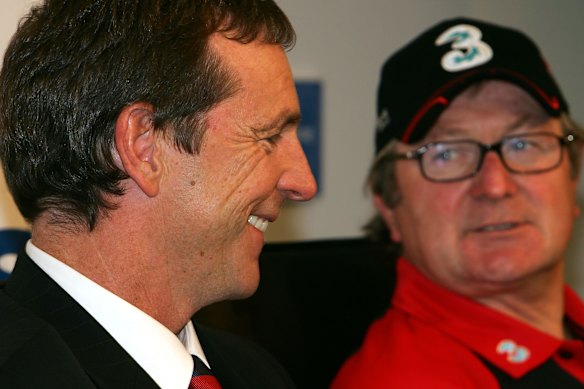

The story of how Essendon spurned Damien Hardwick, whose coaching presentation to the hierarchy was compromised by a malfunctioning computer, has become one of the innumerable what-ifs for the Bombers over the past 19 years.
Here’s a small sample: What if they’d drafted Joel Selwood (bad knee in his draft year) instead of Scott Gumbleton (perennially injured post-draft)? What if they’d never hired Stephen Dank? What if they’d coughed up two first rounders and landed Josh Dunkley when he wanted to become a Don?
Much as the non-hiring of triple premiership coach Hardwick has become folkloric for the frustrated red and black congregation – a section of which are lusting for the second coming of their Messiah – it is easily forgotten that another Essendon Person, or EP, was overlooked in the coach search that settled on Matthew Knights ahead of Hardwick.
Neale Daniher was a candidate to coach the club for which he starred for his first three years, and which he captained in 1982 without tossing the coin once due to the first of a succession of knee injuries that made him a James Dean figure for the Bombers, a gifted player cut down in his prime.
Daniher’s inability to secure a second crack at coaching is now accepted as an AFL industry failure; his record of six finals series in nine-and-a-half seasons, at a club with terrible facilities, scant resources and internal dysfunction, would come to be viewed as exceptional in the circumstances.
The British historian David Runciman recently rolled out an entire series of “counterfactuals” on his podcast, such as “what if the French Revolution had happened in China?” and “what if the Berlin Wall hadn’t fallen?”
Today, as Kevin Sheedy campaigns for James Hird’s contentious/redemptive return, arguing that the Essendon coaching position should be occupied by an EP, it’s worth considering another counterfactual that might have changed the course of Essendon history: What if the Bombers had hired Neale Daniher in 2007?
Sheedy favoured Daniher then, but the club board wanted to move past the marathon Sheedy era and into the future. As an Essendon board member from that time recalled on Monday, the hierarchy “wanted a younger coach to connect with young blokes.” Knights had coached their VFL affiliate, the Bendigo Bombers, which they felt was a good grounding.
There was a view that Daniher, whose stocks were not as high as they subsequently became – Melbourne’s repeated failures after 2007 forced a reinterpretation of his tenure – would be an authoritarian coach, not dissimilar to Sheedy.
But “the Reverend” Daniher’s authority was a standout trait that had made him relatively successful at the Demons. His command was more redolent of Hawthorn’s most revered figure, John Kennedy’s austere style than Sheedy’s artful cunning.
The players did not want to let him down, as Melbourne people from that time attest.
Cameron Schwab, the chief executive who hired Daniher in late 1997, said of the counterfactual of Daniher coaching Essendon: “I think it was their best chance.”
Schwab observed that Daniher had the advantage of being an Essendon Person, but one who had plied his coaching trade outside that club for 13 years, at first as an assistant at Fremantle and then the Demons. “He was his own man,” Schwab added.
Schwab had known Daniher was smart and knew the game, and could operate in a back room. But, as someone somewhat introverted, could he captivate the players when addressing the room, he wondered? “It would become something he was outstanding at.”
Daniher’s lustre at Essendon was enhanced by his role, an assistant coach, in the 1993 premiership, when he deconstructed Carlton’s centre square method for the grand final, and so helped the Baby Bombers run away from the Blues.
“He doesn’t leave much dust on the shelf, does he?,” Anthony McDonald, recruited from the Old Xaverians (along with his brother James), told Schwab, in 1998, when Daniher was making his first impressions on a playing group that would rise from bottom to the preliminary final.
Essendon’s reluctance to hire Daniher, in part because of an understandable wish to free themselves from the aegis of Kevin Sheedy, contains the most obvious of ironies: That they have struggled to overcome the Sheedy influence and era – much like Manchester United’s post Alex Ferguson problem – ever since they ruled out Daniher.
Whoever succeeded Sheedy faced a monumental shadow and task.
Knights did not last long. In the 16 seasons since he was sacked, the Bombers have changed coaches six times, counting Hird’s two stints (2011-2013 and 2015) and the Mark Thompson interregnum (2014).
“On reflection, it would have been a great appointment,” said Tim Watson, Daniher’s old teammate, following Neale’s passing last week.
Schwab has been a mentor/ professional sounding board for Michael Voss over the past couple of years, and believes that Daniher is an example of the AFL industry’s unwillingness to rehire coaches who’ve coached teams “in tough circumstances” such as those that the Reverend found at Melbourne, where the facilities were lacking and the playing list never stellar.
“Coaching Melbourne at that time is as tough as it gets,” Schwab says.
Following Sheedy has proven a tough act ever since Essendon shut the door on Neale Daniher, who spent two years as CEO of the AFL Coaches Association, then five seasons as John Worsfold’s football department lieutenant at West Coast, curtailed by his illness.
We will never know what Daniher might have done for Essendon.
What can be confidently asserted, though, from what he did subsequently in his ceaseless advocacy for a cure for MND, is that he would have given all that he had, and then some.
Keep up to date with the best AFL coverage in the country. Sign up for the Real Footy newsletter
 Jake Niall is a Walkley award-winning sports journalist and chief AFL writer for The Age.Connect via X or email.
From our partners
Disclaimer : This story is auto aggregated by a computer programme and has not been created or edited by DOWNTHENEWS. Publisher: www.smh.com.au