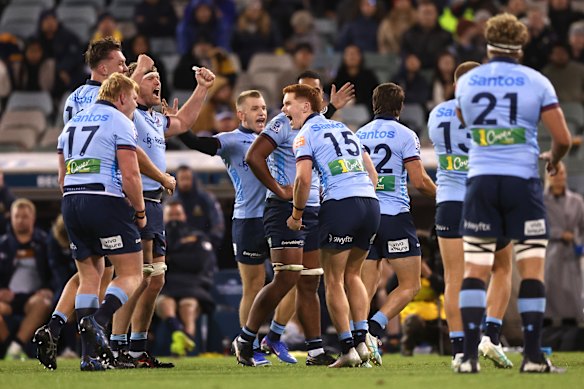

The Waratahs season has ended with a whimper, and without entry into the finals.
“What’s new?” you may rightly ask.
It is now over a decade since NSW claimed their only Super Rugby title in 2014, but since those heady days, mediocrity has been the Waratahs’ default setting.
In the 13 seasons since – covering the old Super Rugby, new Super Rugby and the COVID creations in between – the Waratahs have missed the finals nine times. In that period, the Brumbies have missed only three times, for a finals qualification strike rate of 77 per cent.
NSW’s strike rate is 30 per cent. Which is no great shock, given the Tahs produced an overall win rate below 50 per cent in each of those same nine seasons.
So while much has changed at the NSW franchise since 2014, including four different head coaches, the routine at this time of year remains depressingly familiar for loyal fans: trying to figure out what the hell happened … and wondering if things will be better next season.
The plan this year was to build on a 6-8 season in 2025 under new coach Dan McKellar. But in year two, the Tahs went backwards. They finished with one less win.
There were short bursts of optimism, with big wins over the Reds at home, and the Brumbies and Fijian Drua on the road.
But those glimpses of potential were mirages in the desert. The Tahs were well-beaten by all the New Zealand teams, and they dropped four games at Fortress Allianz.
The standard post-mortems and season reviews will be done and data will be pored over. In some areas, the figures will appear to show the Waratahs are a competitive side, able to keep statistical company with teams who are contesting finals.
But in many other areas, the numbers paint a grim and ultimately revealing picture of exactly where the Waratahs fell apart in 2026.
Red alert in the red zone
The frustrating yin-yang of the Waratahs season was best seen in their consistent ability to power strongly into the opposition’s 22m – and then mostly do nothing. They were among the best in getting into their rivals’ red zone, with 168 entries into the attacking quarter in 15 games. That was the fourth-highest of all Super Rugby Pacific sides.
But when in the red zone, NSW was the second-worst team in converting those entries into tries. They scored a try 29 per cent of the time. Only the Highlanders (28.6 per cent) were worse.
The Waratahs’ woes were best seen in their must-win game against the Brumbies last month, when they made 19 visits to the redzone (twice the comp average) but scored just 0.7 points per visit. The ACT side made 10 visits, averaged two points per visit and won.
Good teams generally average over two points per visit into the 22, and elite teams can do three or more.
The reasons for the Tahs’ red zone impotence? Varied, to the point of concern. McKellar said there were no patterns, with opportunities having been botched in a number of ways.
The data does show some rough patterns: 34 of the NSW entries ended with handling or kick errors, and they were held up six times, both competition highs.
Both point to an increasing desperation that only got worse as the problem grew, with snatched handling, pushed passes and good old white line fever.
Crucially, the Tahs’ already wobbly set-pieces (see below) also got worse in the red zone – the lineout win percentage dropped to 80 per cent (below the competition average of 85 per cent).
And the Tahs also lost more mauls on their throw (11) than any other side, meaning they couldn’t always rely on the rolling maul, which has long been a staple weapon of any McKellar team.
Death wobble at the set-piece
Though blessed with some of the best attacking backs in Australia, the worry at the Waratahs in the pre-season was whether their pack could survive at scrum-time without the departed Test front rowers, Angus Bell and Taniela Tupou. They mostly could not, as it turned out.
But scrum woes proved to only be half the problem, with the usually reliable Waratahs’ lineout – also dropping away badly late in the season.
The Waratahs had the second-lowest percentage of scrums won at 90.91 per cent, and lost seven scrums on their own feed in the season – also the second-most. The Waratahs were the most penalised scrum in the competition, at 2.71 penalties per game; nearly a full penalty higher than the competition average of 1.95.
Though helmed by experienced skipper Matt Philip, the Tahs lineout dropped from a regular 85-86 per cent range in recent seasons to 82.6 per cent in 2026. Eight not-straight throws (the second highest) didn’t help.
But crucially, the lineout effectiveness nosedived further when it was most needed: in the opposing red zone. There, the win rate dropped to 80.33 per cent, and it appeared teams had worked out the Tahs’ favoured options: when they threw to the middle in the red zone, the Tahs lost the ball 35 per cent of the time.
Throw in a maul operating at under 80 per cent effectiveness, and the Waratahs’ set-piece platforms were structurally unsound.
The art of discipline
Talk to any coach and they will talk about discipline – good and bad – being a by-product of other key areas. If you’re on top physically, chances are you won’t give away as many penalties.
But if you are getting overpowered in contact and on the backfoot, the penalties begin to pile up.
Via many contributing factors, the Waratahs’ discipline was another major problem. They conceded 140 penalties in the season, which was the second-most behind the Force (143). That was an average of 10 per game.
But it was when those penalties were conceded that mattered most. The Waratahs were well-behaved with the ball, but gave up 7.71 penalties per game when defending – the most in the competition – and they also led the league in most penalties in their own 22m (3.21 ppg).
The Waratahs’ most consistent penalty offence was arguably one they could control: offside. The Tahs gave up 2.7 per offside penalties – and two penalties per game at the ruck. They were also the most penalised side for maul offences.
Prop Dan Botha was the most penalised with 13, and fellow prop Tom Lambert (10) also got pinged often at scrum time. But centre Joey Walton (10), lock Miles Amatosero (9) and Charlie Gamble (9) were other culprits, without the engine room excuse.
Attack grinding to a halt
The Waratahs attack started brightly and with an adventurous mindset, with Max Jorgensen scoring sizzling doubles in the first two rounds. But the attack grew stodgier and more risk-averse as the season went on, and a contestable kicking strategy was too quickly relied upon to get them upfield.
The Tahs rarely threatened – or sought to threaten – on starter plays. Of 50 tries for the season, the Waratahs scored only nine tries on first phase, which was equal worst with the Drua and a staggeringly long way behind the best teams like the Chiefs (35 of 75 tries) and the Hurricanes (33/85).
This had the effect of the Waratahs having to grind their way through tiring multi-phase sequences when they got good attacking territory.
But slow attacking ruck speed – over 75 per cent were three seconds or longer – saw teams mostly able to set their defences, and the Tahs’ then struggled to penetrate with one-out runners.
They were the third-highest passing team (2267) and the fifth-highest carrying team (1883) but they only managed to beat 327 defenders – the third lowest in the competition. Their post-contact metres (1505m) were the fourth-lowest.
The Tahs’ sense of adventure returned late in the season but the connections had rusted.
Yet another season of indecision at No.10 arguably didn’t help with the attacking flow, with Lawson Creighton starting the season before veteran Jack Debreczeni held the job in the middle stages. Jack Bowen was finally given a run in the last three games.
Mountains of defence
Despite the Waratahs being a team that has worked hard on its defence – and built their win upon it in Canberra – the compounding problems at set-piece, unforced turnovers and with ill-discipline in defence meant they often had to do far too much tackling.
And against good sides, that inevitably leads to missed tackles and tries. Data providers Oval Stats say NSW missed 385 tackles this season – the third-highest – and had the fourth-lowest defensive effectiveness (77.8 per cent).
The Tahs were also among the worst in responding to quick taps, and gave up 10 tries directly this way.
 Iain Payten is a senior sports reporter for The Sydney Morning Herald.Connect via X or email.
From our partners
Disclaimer : This story is auto aggregated by a computer programme and has not been created or edited by DOWNTHENEWS. Publisher: www.smh.com.au