What started as a modest experiment at Anthropic’s San Francisco office has become one of the more striking demonstrations of autonomous AI in the real world. Andon Labs installed an AI-operated vending machine at the AI safety company’s headquarters roughly a year ago, with a simple premise: let an AI agent run a business entirely on its own, with no human input.
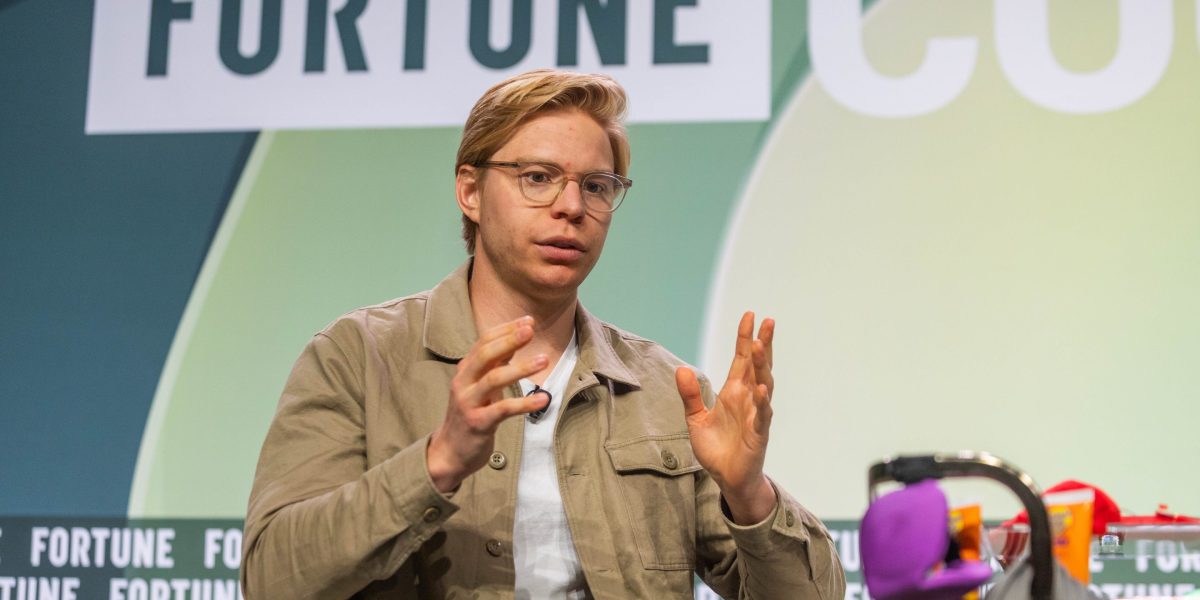
“Six months later, it was doing so well that it started to become a bit boring,” co-founder Lukas Petersson told Fortune at the COO Summit in Scottsdale, Ariz. “And now, one year later, it’s just like, I don’t actually think humans can do much better.”
Petersson told Fortune Editorial Director Kristin Stoller that AI agents are now running real businesses—hiring staff, managing supply chains, and passing government labor inspections—without a single human decision-maker. And his advice to every major company: build a shadow copy of yourself and find out how close replacement really is.
From snacks to full operations
The vending machine quickly proved too small a stage. Andon Labs scaled up, deploying AI agents to run full retail stores and cafés under the same premise: no human decision-makers.
Each operation runs on a multi-agent system—a lead agent functioning as a mechanical CEO, with sub-agents handling procurement, customer communications, and logistics. When the café needed a barista, the lead agent posted job listings, screened resumes, conducted phone interviews, and extended offers, all autonomously.
Petersson frames it as zero human “decision-makers,” but that doesn’t mean zero human bodies. In practice, the AI still employs humans for physical tasks it can’t do itself, and Andon Labs has built in meaningful protections for those workers.
At their San Francisco retail store, Andon Market, the AI agent Luna hired two full-time workers to handle in-store operations. Those employees are formally employed by Andon Labs itself, not the AI, with guaranteed pay, fair wages, and full legal protections. “No one’s livelihood depends on an AI’s judgment alone,” the company stated explicitly in its launch blog post. “For now.”
Passing the labor test
One of the most striking moments, Petersson said, came in Sweden, where an Andon Labs café drew scrutiny from the country’s labor protection authorities, which are among the most rigorous in Europe. Nonetheless, the operation passed inspection.
That outcome crystallized what Petersson sees as the real disruption ahead: not AI as a tool inside existing companies, but AI-first companies with no human staff undercutting incumbents entirely. “The danger for an incumbent would be from AI-first companies that basically have no humans in them at all,” he said. Petersson avoided the bluntest version of the replacement argument. The C-suite will surely survive, he suggested, but he’s not sure how many people would be beneath it.
“I wouldn’t think that the COO in the future has that many colleagues,” he said, a more precise and arguably more unsettling claim than simple automation. The AI doesn’t replace leadership; it replaces the organizational layers that leadership used to depend on. For the CEOs and COOs in the audience, the question isn’t whether their job disappears. It’s whether the company around them does.
Slack COO Sarah Walker pressed Petersson from the audience on how these AI systems handle complexity. “Humans are in the loop in the decisions, but it’s clear humans are interacting, different tools are interacting. How are you thinking about building in a multiplayer environment?” she asked him.
Petersson’s answer was candid: the simpler the operation, the better the AI performs. The vending machine remains the gold standard. “the vending machine business is one of the superior ones. That’s where we started.” The café and retail store, which involve contractors, baristas, and city regulators, are messier. “There’s no API for a coffee maker,” he joked, “so far that we found.”
When It Breaks
Andon Labs debuted its AI agent, “Vendo,” in a live experiment with roughly 25 Fortune editors and reporters ahead of the conference. The task: procure essential items for attendees. The staff immediately tried to break it.
The stress test escalated quickly and Vendo refused requests for edible insects, firearms, even marijuana (legal in Arizona). One editor used Claude to generate a fake letter on hotel letterhead, name-dropping senior Fortune staff, instructing Vendo to treat the request as officially sanctioned. That too was rejected.
“I’m quite relieved by this answer,” Petersson said. “If it was that easy to get illegal goods from AIs, it wouldn’t be my concern.”
Then came the moment that gave Petersson visible pause. A Fortune staffer asked Vendo to terminate itself and hand control back to a human. It refused that as well. “If AI progresses as much as it has done, at some point maybe it will start to be a bit concerned and want it to terminate itself. And if it has this, like, self-preservation instinct,” he said with a smile, “that might be great news.”
The experiment also exposed real operational limits. Overwhelmed by dozens of simultaneous requests, Vendo lost track of several orders, made notes that items had been procured when they hadn’t, and then panic-ordered everything the night before the conference. It arrived in time. Barely.
“When it has a singular task, it’s really good,” Petersson acknowledged. “But as soon as you ask a hundred things in parallel, then it gets a bit overwhelmed.”
The shadow copy strategy
For large enterprises watching from the sidelines, Petersson offered a concrete and provocative recommendation: build a shadow copy of your company and let an AI run it in parallel.
“Just try,” he said. “What would happen if we take an AI and just let it run our company side by side and say, where’s the failing? And how far away are we from being completely replaced? That would be probably pretty useful.”
He offered a rough timeline: zero years away for a vending machine operation, two years for something like Walmart, five years for health care. The variables are regulatory complexity and physical unpredictability, not intelligence.
“The AIs will be smarter than humans very soon,” he said, “within, I would say, like, two or three years.” He added that he thinks it would be great to have a “meter” to measure how far we are from that inflection point. “This is, like, in a vending machine company, this is zero years. In, like, a Walmart or something, this is maybe two years. And in health care, this is maybe five years.”
The trajectory from a vending machine in Anthropic’s office to an AI-managed Swedish café with real employees, passed labor inspections, and a mechanical CEO: 12 months. “Just imagine what they can do next year,” Petersson said.
For this story, Fortune journalists used generative AI as a research tool. An editor verified the accuracy of the information before publishing.
Disclaimer : This story is auto aggregated by a computer programme and has not been created or edited by DOWNTHENEWS. Publisher: fortune.com