
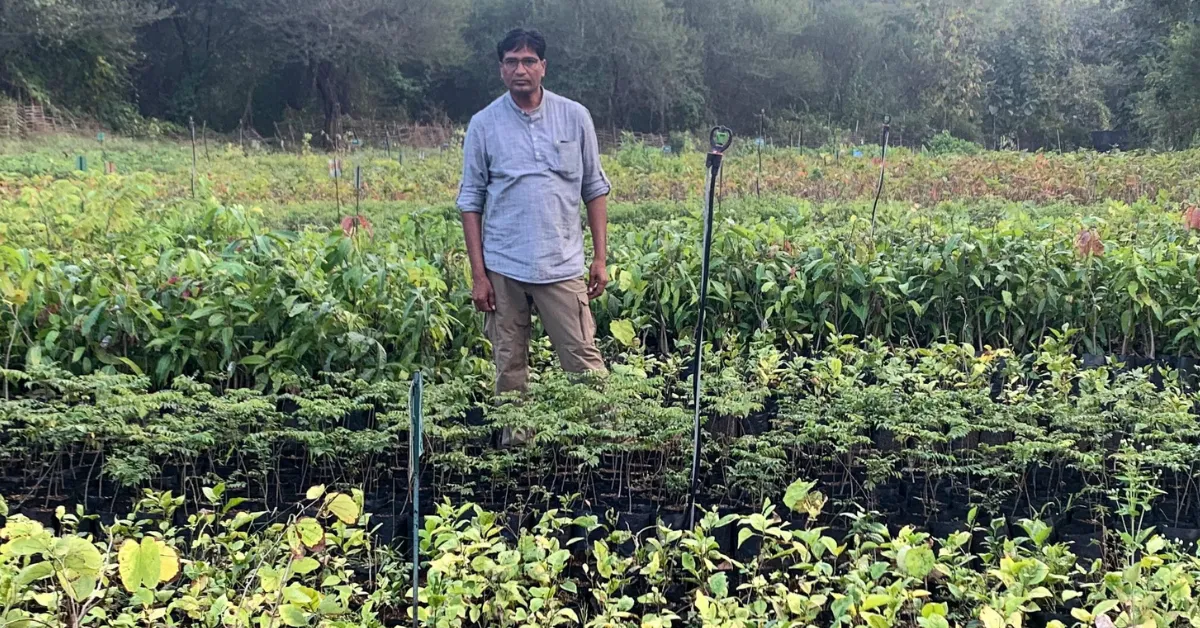
In the dry stretches of Maharashtra’s Vidarbha region, where farming depends more on hope than certainty, livelihoods have been influenced by loss.
“There were times when we had no cash for months together,” recalls Dinesh Sahebrao Shinde, a farmer from Vetale village near Pune. “I had reached a point where I was ready to leave my village and work in a factory in the city just to survive. Farming alone was not enough anymore.”
His words indicate an underlying crisis that has unfolded across rural India, where the disappearance of native ecosystems has weakened soil, water and biodiversity.
Native seeds, once central to farming systems, have been replaced by commercial varieties that demand more water, more chemicals, and more financial risk. In the process, the natural balance that supported agriculture has slowly eroded.
Anant Bhikaji Tayade, the man behind ‘8 Naturals’, often returns to this idea when explaining his work. “If native seeds disappear, everything else begins to collapse, from soil health and water cycles to birds, insects, and ultimately farming itself,” he explains.
A childhood tied to struggle and observation
Born in 1977 in Fuli village in Maharashtra’s Buldhana district, Anant grew up in a farming household where cotton cultivation was the primary livelihood. His earliest memories are not of abundance but of uncertainty, in which every season brought the fear of drought or crop failure.
“In Vidarbha, you grow up understanding that nature is not predictable,” he says. “But what we did not understand then was how much of that unpredictability was actually human-made.”
As a child, he was exposed to farmers cutting down native trees to expand farmland, believing it would increase productivity. What followed, however, was an invisible collapse. Birds that once controlled pests began disappearing. Soil began losing its moisture. Pest attacks increased, leading to heavier dependence on chemical inputs.
“We thought we were improving farming, but in reality, we were breaking the very natural system that kept it alive,” he shares with The Better India.
This early observation stayed with him, slowly moulding a lifelong commitment to ecological restoration.
Learning from the ground, not classrooms
Between 2000 and 2004, he worked closely with social reformer Anna Hazare, engaging in grassroots rural development work. That period, he says, became a turning point in how he understood social change.
“Working with Anna Hazare taught me that change does not happen overnight,” he explains. “It requires patience, discipline and absolute honesty. You cannot fake work at the village level. People see through everything.”
Those years exposed him to the realities of rural distress beyond farming alone, including water scarcity, unemployment, and migration. More importantly, they taught him that sustainable change must come from within communities rather than being imposed from outside.
“It is easy to design solutions in cities, but the real test is whether they survive in villages,” he says.
In 2008, he moved to Pune and began working closely with Dr Pravin Bhagwat of the 14 Trees Foundation as his personal assistant, a period that laid the groundwork for his understanding of ecological restoration.
From research to roots: The beginning of 8 Naturals
The conceptual foundation of 8 Naturals began in 2013 when he worked on ecological restoration projects under the guidance of Dr Pravin. This phase marked the beginning of intense research into native ecosystems, seed systems, and afforestation models.
/filters:format(webp)/english-betterindia/media/media_files/2026/06/02/anant-bhikaji-tayade-8-naturals-2026-06-02-18-51-37.png)
“I was learning everything from scratch,” he says. “From soil science to seed behaviour and germination cycles, it felt like a completely new world to me.”
Before any nursery was established, he spent years travelling across forests, studying indigenous species and working with environmental experts, including Ketaki Ghate and researchers from the Ecological Society. This period was less about building and more about understanding.
In 2018, the first physical step was taken. A small nursery was started in Vetale village near Pune with just two tribal workers and a handful of native plant varieties.
“It was extremely small, but it was the beginning of something we believed in wholeheartedly,” the founder explains. However, the real foundation work was happening behind the scenes. Between 2018 and 2020, the focus was entirely on seed collection and conservation.
“You cannot grow native plants without native seeds,” he says. “And those seeds were becoming rare.”
‘It was the result of years of preparation.’
In December 2020, 8 Naturals was formally registered in Vetale. By this time, a structured seed bank was already in place, built through extensive fieldwork in the Sahyadri region.
“This was not a sudden start. It was the result of years of careful preparation that slowly came together through continuous fieldwork, learning, and groundwork before anything formal ever started to evolve,” Anant explains.
The seed collection process involves tribal communities that possess traditional ecological knowledge passed down through generations. They identify mature trees in forest regions, carefully collect seeds, and guarantee biodiversity is not disrupted.
“They know the forest in a way textbooks never can,” he says. “That knowledge is our biggest strength.” Once collected, seeds are raised into saplings at nursery hubs before being distributed for plantation and restoration projects.
A model built on empowerment, not dependency
One of the most distinctive aspects of the organisation is its decentralised ‘nursery-preneur model’. Instead of centralising production, it trains rural youth, women, and farmers to grow saplings in their own spaces.
Dinesh Shinde, one of the earliest participants, describes the conversion transparently. “I went there asking for a daily wage job, but they refused to make me an employee. Instead, they made me an owner,” he says.
The model works through three simple steps. Participants receive seeds, training and basic materials. They grow saplings at home or in small village spaces. Finally, 8 Naturals guarantees a buy-back of the saplings.
/filters:format(webp)/english-betterindia/media/media_files/2026/06/02/anant-bhikaji-tayade-8-naturals-2026-06-02-18-53-27.png)
“It removes all risk,” the nursery-preneur explains. “We are not worried about selling, and we just focus on growing.” For many rural families, this has created a stable source of income without migration.
For tribal worker and supervisor Dinesh Vitthal Paradhi, the impact has been close to his heart. “I used to work on other people’s farms, but even then I would get work for only about three months in a year, and for the rest of the time I had to struggle just to survive,” he says. “Now I have a permanent job. I built my own house, and today my children can continue their education without interruption.”
He adds, “There is respect now in the village, and that is something I never had before.”
Women from the Vanrai Mahila Gat mirror similar sentiments. Sheela (name changed) says, “We were only homemakers earlier. Now we are running nurseries from our homes, and we are earning and contributing.”
She adds, “Sometimes you just need someone to show you that it is possible.”
Technology as a bridge between generations
While rooted in ecology, 8 Naturals has also embraced digital tools to connect younger generations to native biodiversity. One of its most innovative initiatives is a QR code system developed with the help of Aniket Tayade, Anant’s son.
“We wanted trees to have a voice,” Aniket explains. “When someone scans a QR code, they should immediately understand what the plant is, why it matters, and how it supports the ecosystem.”
Each QR code is linked to a digital profile containing botanical information, medicinal uses, plantation methods, and ecological significance.
“This is about accessibility. If young people are on their phones all the time, then let nature come to their phones,” he adds.
Anant adds, “Conservation must evolve. Otherwise, it will remain disconnected from the next generation.”
Growth, scale and recognition
From a small nursery in 2018, it has expanded into three key hubs located in Vetale, Fuli and Kanhewadi. The organisation now preserves over 350 native plant species and maintains a seed bank of more than 250 rare varieties. Its nursery systems collectively house over six lakh saplings.
In November 2023, the initiative was recognised by the Worldwide Book of Records for preserving the highest number of native plant species in a nursery. For the founder, the recognition was meaningful but not the destination. “Awards are not the goal. What matters is whether the ecosystem is healing,” he says.
The organisation measures its success through ecological recovery, community stability and emotional connection.
/filters:format(webp)/english-betterindia/media/media_files/2026/06/02/anant-bhikaji-tayade-8-naturals-2026-06-02-18-55-23.png)
Key outcomes include:
- Restoration of degraded land into a self-sustaining green cover.
- Increased groundwater levels in plantation zones.
- Stable income for over 22 tribal workers.
- Multiple rural women and youth are becoming independent nursery-preneurs.
- Large-scale adoption of native tree planting in villages and institutions.
But perhaps the most important change is emotional.
“When a child plants a tree and feels responsible for it, that is real success,” Anant says.
A vision that continues to grow
Looking ahead, the founder visualises a decentralised network of native seed banks across India, where every village becomes a centre of ecological restoration.
“We do not want to be the only nursery doing this work,” he says. “We want thousands of small nurseries everywhere.”
Aniket is already working on documenting species, building digital systems and expanding outreach. “This knowledge cannot stay limited. It has to be shared, studied and replicated,” he says.
In Vetale, Dinesh Shinde continues to tend his saplings, each one representing a small shift in a much larger ecosystem. “I no longer feel like someone struggling to survive,” he says. “I feel like someone building something meaningful.”
/filters:format(webp)/english-betterindia/media/media_files/2026/06/02/anant-bhikaji-tayade-8-naturals-2026-06-02-18-58-01.png)
Across villages, farms and households, a similar change is noticeable. As Anant puts it, “When we restore nature, it goes far beyond planting trees; it rebuilds dignity, strengthens livelihoods, and brings life back into balance.” And in that restoration, a new rural story is slowly being written.
All pictures courtesy 8 Naturals.
Disclaimer : This story is auto aggregated by a computer programme and has not been created or edited by DOWNTHENEWS. Publisher: thebetterindia.com



