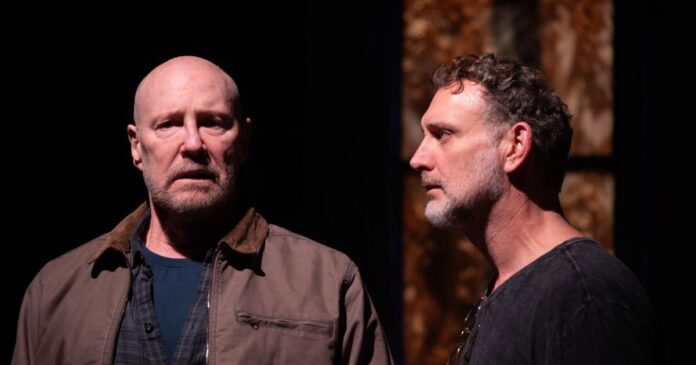
Jerry and Arnold, two estranged half-brothers, are forced by circumstances to be back in touch. Their mother, whom Jerry has been looking after, is dying, and there are medical bills that need to be straightened out.
Arnold, an artist living with his husband in the Netherlands, doesn’t know why Jerry is reaching out to him. He left Idaho a lifetime ago and would rather not have anything more to do with his abusive upbringing in podunk Grangeville.
Samuel D. Hunter, the bard of Idaho, where many of his plays are set, including “A Bright New Boise,” “The Whale” and “Little Bear Ridge Road,” grapples in a novel way with this territory in “Grangeville,” which is having its West Coast premiere at the Ruskin Group Theatre in a beautifully acted production directed by John Perrin Flynn.
The setting for this two-hander is more abstract than usual for Hunter, who is one of the theater’s outstanding American realists. But the geography is more mental than physical in a work that takes place largely through telephone and video calls.
Jerry (Jeff LeBeau), the older of the two brothers, has a guilty conscience. He was a bully to Arnold (Tim Cummings) when the two were growing up in a trailer park with their mother, who had a knack for choosing bad men. Arnold put an ocean between himself and his family, but his alienation from his past has drained all the color from his life.
His art has suffered and he finds himself at a creative standstill. The early pieces that established his reputation were dioramas of local spots around Grangeville, such as a tattoo parlor, a pawn show and a Dairy Queen. But then he turned to more abstract painting, and European interest in his work dropped off. It wasn’t long before he lost the thread of his inspiration.
Arnold has been having difficulties in his marriage. Bram, his husband, has a demanding job at a museum in Rotterdam and Arnold’s bitterness has grown wearying. Stalled in himself, Arnold wishes they could move back to Amsterdam, where “there’s a sense of history” and leave a city “that got leveled in World War II” and replaced with “shipping containers and Brutalist McDonald’s.”
The irony, of course, is Arnold has done his best to expunge his own personal history. His bombed-out inner life matches his description of Rotterdam so closely that it can’t help but seem like a projection.
Jerry isn’t faring much better. His wife, Stacey, has walked out on him, and he left a suicide note that his son found. He claims he would never have gone through with it, but he’s been seeing a therapist to deal with his mental health problems.
Getting back in touch with Arnold is part of Jerry’s recovery. Their mother made Jerry her health proxy and Arnold the executor of her will, forcing in effect their cooperation. But Jerry wants in his sputtering way to make amends to his brother for the cruel things he did to him when they were younger. But how do you bridge such troubled waters?
In his short story “Intimacy,” Raymond Carver uses the metaphor of “dead leaves” to describe the unresolved wounds between the narrator and his ex-wife. Upon leaving her house, where he knelt on the floor mutely asking for her forgiveness, he notices piles of leaves everywhere he looks. The story closes on this somber note: “Somebody ought to make an effort here. Somebody ought to get a rake and take care of this.”
Arnold uses different metaphors to describe his feelings about what lies between him and brother. “It’s like being stuck in a maze and no matter what path you choose there’s just black holes everywhere that you keep falling into,” he says before launching into a traumatic memory. Jerry has repressed much of his own violent behavior, but he knows that this belated reckoning can no longer be postponed.
I saw “Grangeville” last year in New York and wondered if Hunter had painted himself into a corner, dramaturgically speaking, in prolifically turning out plays that can seem like claustrophobic scene studies. Though well acted by Brian J. Smith and Paul Sparks (who was a late substitute for Brendan Fraser), the production was alienating in its overstylized cadences.
Detachment isn’t an issue in Flynn’s production, which keeps such a tight focus on the actors that the human drama fully emerges. This small piece, performed without intermission, takes on an impressive magnitude.
The staging could do without the underscoring that becomes heavy-handed in the play’s later stages. And when the action reaches its combustible Sam Shepardesque climax, Stephanie Kerley Schwartz’s transformed set leaves little room for the confrontation scene that Flynn directs at full throttle.
The setting, which changes from a blank Brutalism to a trailer-park-home installation suggesting one of Arnold’s cold-eyed dioramas, creates its own theatrical coup. But the bold aesthetic comes at the cost of the actors’ freedom in a play that otherwise seems perfectly at home at Ruskin Group Theatre Arts Center’s impressive new digs adjacent to the company’s old Santa Monica home.
Minor distractions notwithstanding, this hypnotically absorbing drama is acted with enormous skill. LeBeau never hits a false note as Jerry in a performance that has the rough vulnerability of a Shepard master class à la “True West” or “Curse of the Starving Class.”
Cummings has a wider range to traverse as Arnold, whose repressed rage eventually has to find an outlet. Although the brothers communicate from a distance, there’s no space between the actors. The connection between them is charged with feelings that evolve and surprise.
In one scene, Cummings is called upon to play Stacey and in another LeBeau is drafted to play Bram. And in both cases, these secondary characterizations are as insightfully wrought as the actors’ main roles.
Hunter turns his characters inside out in a play that powerfully illuminates a subject that has rarely been treated onstage with such unflinching honesty and sensitivity: How does one integrate a past that took everything to escape?
‘Grangeville’
Where: Ruskin Group Theatre Arts Center, 2800 Airport Ave., Santa Monica
When: 8 p.m. Fridays, Saturdays and Mondays, 2 p.m. Sundays. (Check for exceptions). Ends July 12
Tickets: Start at $25
Contact: https://www.ruskingrouptheatre.com/ and (310) 397-3244
Running time: 1 hour, 30 minutes (no intermission)
More to Read
Disclaimer : This story is auto aggregated by a computer programme and has not been created or edited by DOWNTHENEWS. Publisher: latimes.com