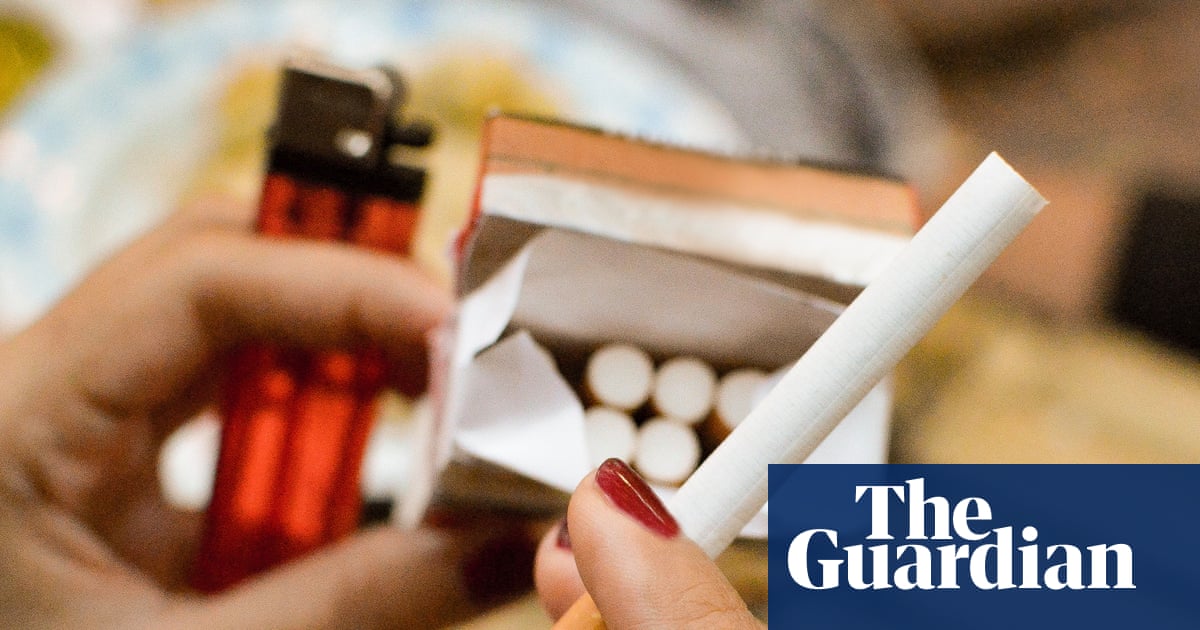
The new issue of the American Journal of Public Health focuses on ultra-processed foods, and reveals that big tobacco companies used strategies that helped them sell cigarettes to sell ultra-processed food products, including Lunchables, geared toward children.
The parallels between ultra-processed foods (UPFs) and cigarettes include not only how UPF products were formulated and marketed to drive excess consumption, but also the growing body of evidence linking UPFs to a variety of health risks. For UPFs, these include cardiovascular diseases, certain cancers and cognitive health decline.
During an AJPH press briefing on Tuesday, Cindy Leung, a public health nutrition professor at Harvard, said people whose diet contained high quantities of UPFs “had a 58% higher risk of developing dementia, a 46% higher risk of developing mild cognitive impairment, and a 47% higher risk of either of those two outcomes”. Leung emphasized that these findings are based on observational studies – clinical trials on nutrition are often impractical – but argued that they are both significant and “biologically plausible”, meaning that there are strong theories about why UPFs might cause these health conditions.
Leung and many other experts who contributed work to the AJPH issue spoke about their findings during the press briefing. Their work builds on a recent study published in Milbank Quarterly which described how tobacco companies like RJ Reynolds and Philip Morris used their cigarette playbook to sell ultra-processed foods after acquiring companies like Nabisco and Kraft. Those strategies include optimizing formulations of carbohydrates and fats for rapid delivery, maximizing “hedonic impact”, and creating products that “produce a quick hit of reward that fades” so people will come back for more quickly.
Tera Fazzino, a psychology professor and addiction researcher at the University of Kansas, said during the briefing that for her study, she “examined over 100 previously secret primary industry source documents” from the tobacco industry and concluded they “use the same strategies that they use to develop their international tobacco businesses to develop their international food businesses”. They not only repeated old strategies for product formulation and marketing, but also aggressively acquired small food companies.
“King-sized” food items imitated “king-sized cigarettes”. Fazzino also explained that they developed light cigarettes in an explicit attempt to retain customers who might otherwise quit smoking due to concerns about the health harms, and later used this strategy to develop “light” and “reduced-fat” UPF products to retain customers.
Lunchables, a beloved children’s food brand, were also developed using big tobacco strategies, says Laura Schmidt, a health policy professor at UC San Francisco. Philip Morris acquired Kraft in 1988, and launched Lunchables nationally shortly thereafter.
“Product designers at Philip Morris had a technique called consumer-driven product development, where they use psychological research on consumers to get under the hood and understand their unconscious wants and needs,” Schmidt said during the briefing.
Lunchables were designed to fulfil children’s “underlying drive for independence, autonomy and play”, said Schmidt.
Marion Nestle, a nutritionist and public health professor emerita at New York University, applauded the “Make America healthy again” (Maha) movement for bringing attention to UPFs, while acknowledging that Maha makes mistakes because it is more of a “feelings-based” movement than a science based one. Lindsey Smith Taillie, a nutrition professor at the Gillings School of Global Public Health, echoed Nestle’s sentiment and pointed out that Maha also deserves credit for “shifting this narrative away from personal responsibility and lack of willpower to the real culprit, which is the food industry that makes and sells and markets these products, especially to kids”.
Still, Nestle and others noted that the Trump administration has made policy changes that could exacerbate the problem, and have failed to direct policy changes that could help, like redirecting government corn subsidies towards whole fruits and vegetables. Corn subsidies have led the US to become heavily reliant on high fructose corn syrup, a key ingredient in many UPFs. The Supplemental Nutrition Assistance Program (Snap) also makes it possible for people to more easily afford whole foods, but Nestle pointed out the current administration is “trying in every way possible to reduce Snap enrolments. That’s going in the wrong direction.”
Since Kraft launched Lunchables under Philip Morris, it became an independent company that merged with Heinz to form Kraft-Heinz. Philip Morris has since rebranded as Altria.
Altria and Kraft-Heinz did not respond to the Guardian’s requests for comment.
Disclaimer : This story is auto aggregated by a computer programme and has not been created or edited by DOWNTHENEWS. Publisher: theguardian.com