To analyze NASCAR television ratings right now requires a little bit of arithmetic and critical thinking in equal parts.
Television ratings have become a bit of a divisive subject in NASCAR circles right now due to the advent of a new way that Nielsen Media Research captures audience shares. The new metric is called Big Data + Panel.
What does this even mean?
For a vast majority of this century, Nielsen measured television audiences based on a version of one tool, and that is people meters in household panels. Starting in September of 2025, Nielsen switched to a system called Big Data + Panel that combined the traditional measurements with a tremendous amount of data from cable (and satellite) boxes and internet connected smart televisions.
The traditional model was captured in a variety of ways — either through a manual process in which a household physically writes down what they watched and when in a journal of through a device that required a viewer to press a button that also knew who they were and their demographics.
This is how Nielsen had a rough idea, through 42,000 households and over 100,000 people, the approximate age, gender, income and ethnicity of a viewer for every quarter-hour on record.
Nielsen needed to project this out a little bit, however. If 100 males from the prized 18-34 demographic from the 42,000 households were watching a certain program, the working assumption is that 250,000 of them were watching overall.
This ‘Panel’ method is still being used, both independently, but also combined with ‘Big Data,’ which is of course combined to create the Panel + Big Data metric.
So what is Big Data?
Big Data is record viewership habits from cable boxes from Comcast, DirecTV and Dish Network customers but also from smart televisions produced by the likes of Roku, Vizio, LG and Samsung.
The boxes use ‘Return Path Data,’ which records what channel is being watched, when channels are changed and the amount of time spent on each channel. Return Path Data doesn’t recognize what’s on the channel but is just a log of what channel was on the TV. This is different than ‘Automatic Content Recognition’ from smart televisions which monitors the images and sounds on the screen to detail exactly what is being watched.
Unlike panel, Big Data knows what is on the television but doesn’t know or if anyone whatsoever is actually watching the TV.
Nielsen is using Artificial Intelligence to effectively try to smooth out any disparity between Panel and Big Data + Panel. Basically, Nielsen has 75 years of demographic probabilities learned from Panel only readings that it cakes into its algorithm.
The AI makes these probabilistic adjustments based on historical viewing patterns from the device, day of the week, ZIP code demographic profiles and the weather.
It’s still imperfect because Big Data, again, doesn’t know who is watching the television, which creates a need for an assumption if a household’s smart TVs are playing NASCAR, NFL and American Idol at the same time.
So AI is used to assume who, based on the above demographic probabilities.
Cable boxes are more likely to over-represent an older demographic and smart TVs are more likely to over-represent a younger demographics. NASCAR, specifically has an older demographic, so certain inferences can be made to how that affects the final tallies each week.
It’s also why, obviously, NASCAR was disadvantaged by Big Data on FOX and FS1 this spring but advantaged by Big Data on a streaming-exclusive platform like Prime Video. Big Data wasn’t implemented until September so year-over-year comparisons are kind of fruitless if comparing one metric to the other.
It’s a fair response from NASCAR to push back on making year-over-year comparisons between two different calculations until September.
So where does that leave NASCAR this week on Prime for the Cup Series and The CW for the O’Reilly Auto Parts Series.
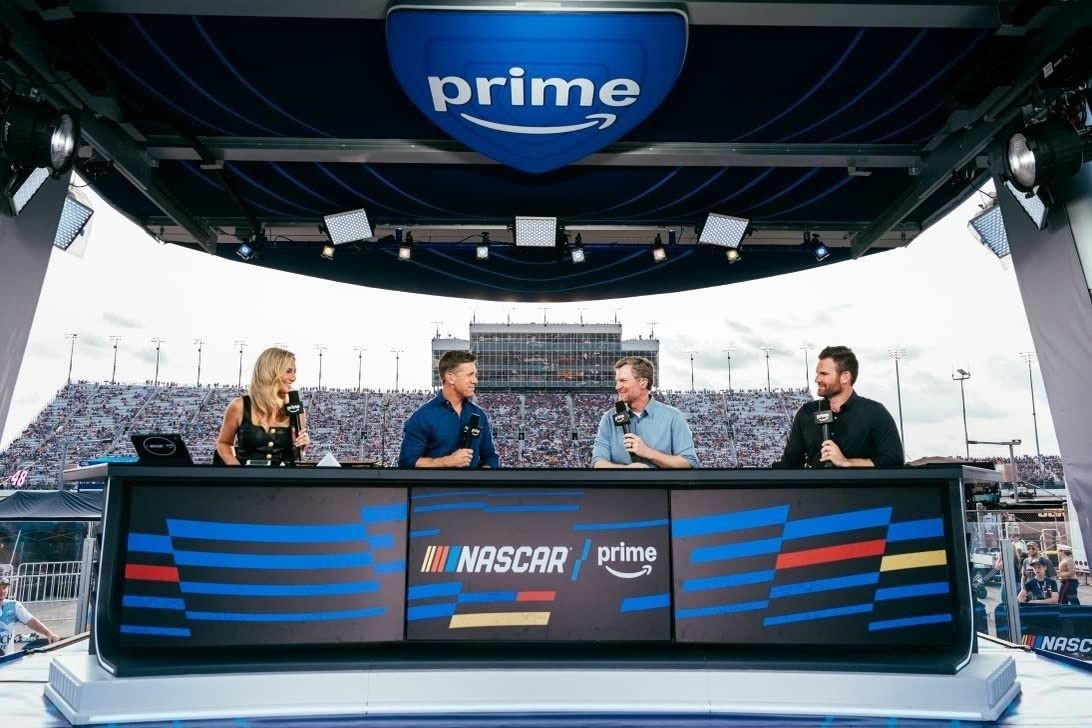
The NASCAR Cup Series race at Nashville Superspeedway on Prime Video earned 1.655 million viewers according to the Panel only metric, which is down 12 percent from the 1.9 million from last year. You also have to factor in that the 2026 race was delayed by almost 90 minutes due to rain.
There is no way to compare year-over-year, realistically, using Big Data because it was not rolled out until September.
However, the data is the data, so if you want to try to make comparisons, Prime has provided the following statistics:
- P18-34: 181K, up +1% (vs. 179K)
- P18-49: 611K, up +23% (vs. 495K)
- P25-54: 735K, up +5% (vs. 699K)
Prime also says it has a median age of 57.1, which is six years younger than the 63.1 average age watching on linear television this year.
So how about the O’Reilly Series on The CW?
According to Panel only, the only way to measure year-over-year accurately, the Saturday race at Nashville Superspeedway earned 1.123 million viewers, which was a 14 percent increase to the same race on the same weekend and network last year.
Viewership were the NOAPS race peaked at 1,335,000 total viewers from the 9:15-9:30 p.m. quarter hour.
When using Big Data + Panel, the NOAPS race earned 1.119 million viewers, which the CW says is an increase of 13 percent from last year on the same weekend, track network … which is also the most-watched race at Nashville for the series in six years.
Viewership, using Big Data + Panel, peaked at 1,292,000 from the same 9:15-9:30 p.m. ET quarter hour.
We want your opinion!
What would you like to see on Motorsport.com?
– The Motorsport.com Team
Disclaimer : This story is auto aggregated by a computer programme and has not been created or edited by DOWNTHENEWS. Publisher: motorsport.com