
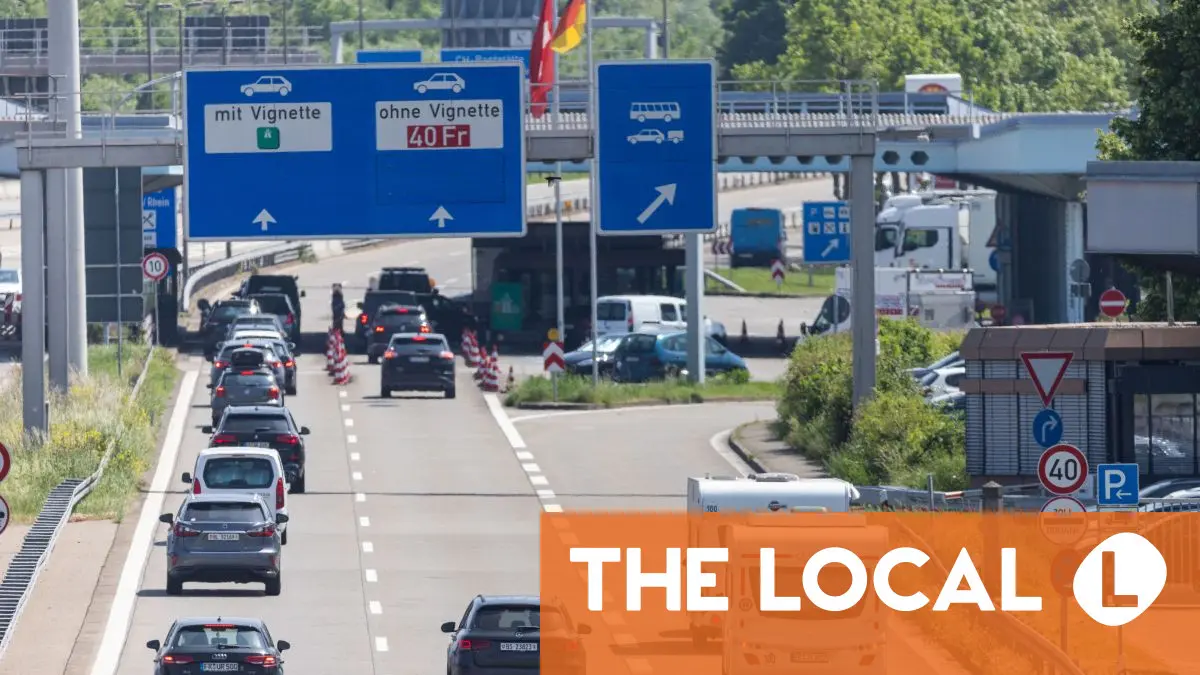
The Swiss parliament has approved a proposal to levy a tax on drivers passing through the country. Here’s how the measure would affect travellers from Germany.
Fed up with seeing its highways clogged by drivers from Germany and central Europe on their way to Italy or France for summer holidays, Switzerland is planning to introduce a new tax for through-drivers.
The fee would be in addition to the price of an annual vignette that all drivers must pay in order to drive on Swiss motorways.
The measure has been approved by the Swiss parliament but is reportedly not popular with all parts of the government. For this reason — and because enforcement would involve some complicated logistics — it is expected to be some time before the measure can be implemented.
How much would it cost?
The details are still being fine-tuned, but the German Press Agency reported that an average fee of around €23 (or 21 Swiss francs) has been discussed.
The idea is that the fee would rise and fall with demand, to try and persuade more holidaymakers to avoid travelling at peak times.
Currently, all drivers on Switzerland’s motorways need to purchase an annual vignette for just under €44 (40 francs).
For drivers from nearby countries who are passing through Switzerland on their way elsewhere in Europe, the annual fee effectively serves as a one-time toll. But for drivers who pass over Swiss motorways more regularly the annual price is comparatively cheap.
In Austria, a daily motorway vignette costs €9.60, and drivers headed from Germany to Italy are also charged €12.50 at the Brenner Pass.
READ ALSO: Austrian protest shuts key European highway
Foreign driver tax
According to the Swiss MP who made the proposal, Marco Chiesa from the Swiss People’s Party, through journeys on the country’s highways are “of no significant benefit” for Switzerland.
Figures from the country’s statistics office suggest that through journeys account for 31 percent of passenger traffic across the Swiss Alps.
Can it be implemented?
Switzerland has almost 700 border crossings, but long-distance drivers primarily take motorways and main roads, which number around 125.
Theoretically, cameras with license plate recognition technology could be put in place at these crossings.
But Touring Club Switzerland (TCS) has warned that the considerable effort required to monitor vehicles may not be worth the trouble.
“The TCS doubts that the effect of the drive-through tax would justify the considerable expenditure of resources,” said spokeswoman Vanessa Flack.
How are the plans being received?
From Brussels to Baden-Württemberg, German representatives have criticised the planned travel tax.
Andreas Schwab, a member of the EU Parliament originally from Baden-Württemberg, said, “Unilateral measures of this kind are not a step forward”.
“Border areas thrive on reliability, the simplification of rules and an open and smooth coexistence with neighbouring countries,” he added.
Felix Schreiner, who represents the Waldshut-Tiengen constituency on the border with Switzerland, shares the same view: “I am convinced that transport policy challenges in the heart of Europe can only be solved together. The right way is therefore not isolation, but more cooperation.”
Thomas Sauter-Servaes, Professor of Mobility Sciences at the Zurich University of Applied Sciences (ZHAW), who comes from Berlin, points out: “If every country thought like this and only wanted to cash in on foreigners, we would have a problem.
“Then governments would ask themselves: Why should Germans pay in Switzerland on their way to a holiday in Italy, but not Swiss people in Germany on their way to Denmark?”
In fact, CSU leaders in Bavaria had tried to implement a toll on the German Autobahn, along with a scheme to reimburse German drivers. But that scheme was shot down in 2019 by the European Court of Justice for breaching EU rules.
Disclaimer : This story is auto aggregated by a computer programme and has not been created or edited by DOWNTHENEWS. Publisher: thelocal.de



