
“Hi! I’m interested in buying peptides,” I wrote on WhatsApp. Two minutes later, I received a reply from a U.K. area code from someone calling herself Louise, whose profile picture was of a young woman with airbrushed skin. Louise shared a menu: testosterone boosters, synthetic growth hormones, weight-loss medications, and more.
Mindful of my expense account, I scoured the menu for a cheaper peptide, a term that describes a class of molecules that promise some type of wellness boost and include the popular weight-loss drug Wegovy. I settled on 5-amino-1MQ, a substance that one connoisseur later told me “makes a lot more sense for high-level competitive athletes,” not a first-time peptides buyer.
Louise quoted me a price of $49 for the medication, plus $60 for overnight shipping. She asked for payment, proposing the Chinese platform Alipay. Or, she said, I could send crypto. Eventually, I sent Louise $109 worth of USDC, a popular stablecoin whose price is pegged to the U.S. dollar. After I confirmed my shipping details, she responded with a heart emoji.
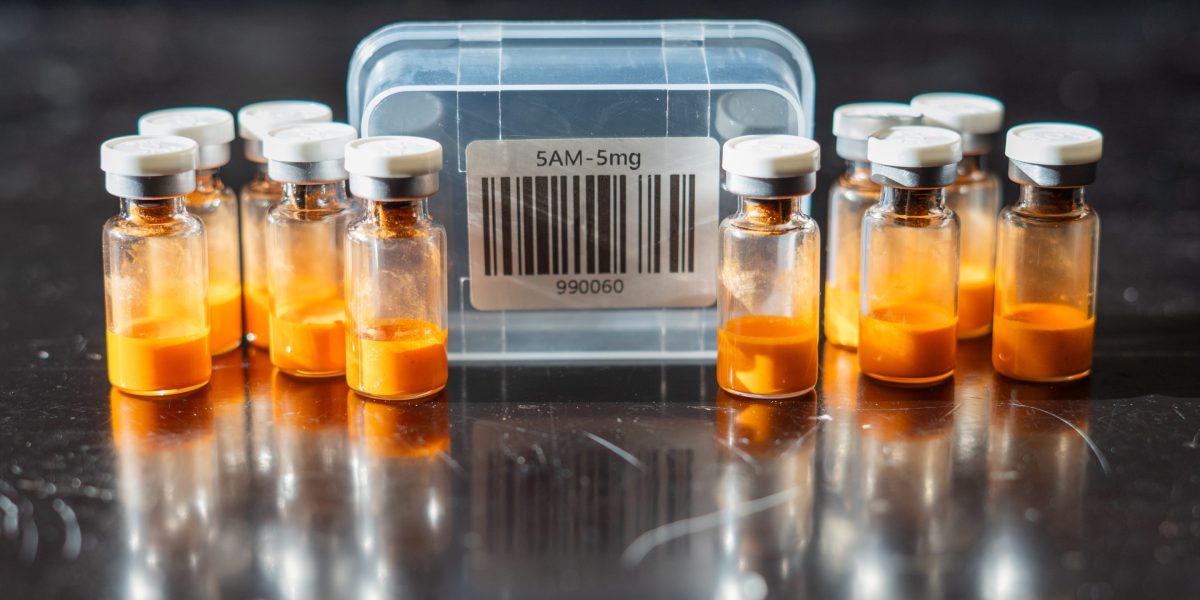
Two days later, in late May, a small package with 10 vials full of a bright-orange substance arrived at Fortune’s office from a facility in New Hampshire. I had successfully used crypto to buy peptides—and participated in a booming gray-market economy increasingly reliant on digital assets, according to data from the crypto analytics firm Chainalysis. “If this end[s] with you under investigation by a federal agency,” my editor messaged me, “I will swear it was in the name of journalism.”
‘I won’t tell you anything’
Since the launch of Ozempic and Wegovy in 2021, peptides have exploded in popularity. In fact, the “p” in GLP-1, the class of medications to which the blockbuster weight-loss drugs belong, is short for peptide, which are chains of amino acids.
But, more recently, wellness influencers and Silicon Valley biohackers have begun to experiment with what medical professionals say is a more unproven class of medications, including drugs that proponents claim promote blood vessel growth, improve sleep quality, or enhance collagen production. This uptake has also coincided with the rise of “looksmaxxing,” a viral trend on social media where young men inject themselves with peptides or submit to surgeries to make themselves more attractive. Even Health Secretary Robert F. Kennedy, Jr. has shown support. “I’m a big fan of peptides,” he told the podcaster Joe Rogan in February.
These drugs exist in a legal gray area. Some peptides are approved for medical use by the U.S. Food and Drug Administration. Others aren’t. And many buyers are purchasing drugs sold only for “research purposes” directly from manufacturers in China. “Generally, companies selling products to affect the structure and function of the body need FDA approval,” Joshua Sharfstein, a professor of public health at John Hopkins University and a former deputy commissioner at the FDA, told me.
Because of peptides’ shaky legal status, vendors who sell the drugs directly to consumers are at risk of losing access to U.S. banks and payments networks, said Olivia Chow, an advisor at the crypto consultancy Zero Knowledge Group, who has helped companies in high-risk industries get bank accounts.
“When you have these high-risk areas, the vast majority of banks—if you’re doing payment processing—any of the regulated entities just won’t touch it,” she said, adding that the card networks like Visa and Mastercard are especially risk-adverse.
Shuyao Kong, cofounder of the blockchain MegaETH, says this is precisely why peptide vendors are approaching her team. “A lot of peptides companies are already using crypto,” she told me. “When they look at crypto, they’re like, ‘This is like the most natural, logical payment rail.’”
A new report by Chainalysis, the crypto analytics firm, catalogues a recent explosion in peptide-related crypto flows. The firm found that, during the first quarter of 2026, peptides vendors received $32 million in digital assets, a 700% increase from the year before. If the trend continues, Chainalysis projects that peptides sellers will do more than $100 million in crypto volume this year.
For peptides distributors, crypto transactions involve no intermediaries. When I send USDC to Louise, banks aren’t able to decline the transaction. And wallets on blockchains are a jumble of letters and digits, not someone’s name or Social Security number. That pseudonymity is arguably behind Bitcoin’s early rise—although crypto payments are more traceable than many think. Before it was shut down in 2013, the notorious online black market Silk Road asked buyers and sellers to transact in Bitcoin.
“There’s been a longstanding thing of using crypto to buy drugs, right?” said Tori Pastore, who’s worked at multiple crypto companies and now has her own media and events business. (She’s used peptides and told me they were “life-changing.”)
As part of its analysis. Chainalysis found that a subset of vendors have changed course from producing fentanyl chemical precursors to manufacturing peptides. “They just rebranded,” said Sara Graham, a senior intelligence analyst at Chainalysis. “They pivoted to peptides because it’s less costly.”
I asked my peptides dealer Louise—who represents a company called Shanghai ERP Peptide Biotechnology Co., Ltd—why her firm accepts crypto. She declined to answer. From late January to early June, Louise’s company received about $3.6 million in digital assets, according to calculations from Chainalysis. (The analytics firm found no evidence that Shanghai ERP was linked to the fentanyl trade.)
“Honey, I won’t tell you anything,” Louise messaged me over WhatsApp. “I won’t risk sending my boss to jail.”
Prohibition party
After I chatted about peptides with Pastore over a video call, she invited me to a peptides-themed party she had organized near Wall Street. She described the dress code for the evening as “prohibition-underground-speakeasy-art-deco-bioshock-american dynamism,” and the event’s custom cocktails included a “Tirzepatini,” the “GHK-Mule,” and an “Oxytonic.”
At the party, I met Avery Haskell, the cofounder and CEO of Seedbox Labs, a startup that’s developing an at-home device to let men test the quality of their sperm. Recently, he sent his dealer about $900 in stablecoins for a potpourri of medications. They include NAD+, which adherents say improves longevity; MOTS-c, which scientists have found increases physical performance in mice; and Tesamorelin, a synthetic growth hormone.
As we discussed the explosion of crypto payments for peptides, a former quant trader attending the party listened in and interjected: “It’s Silk Road all over again.”
The next day, I called Haskell’s vendor, who says his customers include celebrities and claims he sources his drugs from a Florida university he declined to name. “There is such a bottleneck here,” the seller said, asking for anonymity because of the legal uncertainty surrounding peptides sales. “And, like, crypto is the solution at the end of the day.”
Disclaimer : This story is auto aggregated by a computer programme and has not been created or edited by DOWNTHENEWS. Publisher: fortune.com



