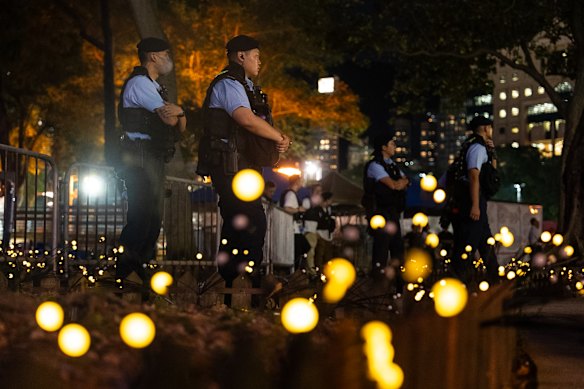

Hong Kong: Quietly, almost imperceptibly, they turned up to Victoria Park on Hong Kong Island, just as they had always done on the evening of June 4.
On the last occasion it was held in 2019, more than 100,000 people poured into the park for the annual candlelight vigil to remember China’s bloody crackdown in Tiananmen Square on June 4, 1989.
This year, there were just a few and, unless you knew what to look for, you wouldn’t have noticed them.
On a park bench, an older woman sat in silence scrolling on her phone, with the device’s torchlight switched on. Not a candle, but a discrete fluorescent beam pointed at the ground.
Nearby, a father briskly pushed his toddler in a stroller with one hand, his phone in the other. The torchlight on. Also walking through the park that evening was a woman in her 20s, chatting away with a gaggle of friends, loosely holding her phone with an open palm. The torchlight on.
Around them, the park teemed with uniformed and plainclothes police.
“I used to come here every year,” said a woman, aged in her 60s, who wished only to be known as “C”.
Speaking in a hushed voice, she said she has maintained the ritual “to say goodbye to those who can’t meet us any more because of their sacrifices”.
“We are grateful for what they have done. We are not allowed to do it publicly, but we still want to remember.”
Another person, clad in all black with a cap and a face mask, also sat silently on one of the park’s benches, with his arms folded, and stared straight ahead for several hours unflinching.
Black is the colour associated with Hong Kong’s activist movement, and he had clearly aroused suspicion from authorities. A plainclothes police officer wearing an earpiece sat on the bench next to him.
Thursday marked the 37th anniversary of the Tiananmen crackdown, when China’s army stormed into Beijing’s famous public square and turned their tanks and their guns on peaceful student protesters calling for democratic reforms.
The death toll is disputed, but eyewitness accounts have placed it between several hundred to more than 1000 dead.
China, meanwhile, has sought to scrub the incident from the country’s history books, while government censors assiduously erase any references that crop up on Chinese social media.
This year, Chinese authorities told relatives of the victims they would not be allowed to visit a cemetery in Beijing on the anniversary, the Associated Press reported citing a person with knowledge of the matter who spoke on condition of anonymity for fear of retribution. Relatives from a group called Tiananmen Mothers visited the graves for more than 30 years, reading memorial statements while police kept watch, Amnesty International said.
The Hong Kong vigil was the only place on Chinese soil where the Tiananmen victims could be publicly mourned.
Initially banned by authorities on COVID-19 safety grounds, the vigil never returned after Beijing imposed draconian national security laws on the city in 2020 following months of anti-government protests. Those laws silenced dissent and ended political assemblies.
Dozens of pro-democracy activists, political figures, government critics, and journalists were swept up in the laws’ dragnet and jailed for crimes of subversion and sedition. The act of wearing a shirt with a “seditious” slogan landed one activist in jail for 14 months.
Two of the organisers of the vigil, democracy activists Lee Cheuk-yan and Chow Hang-tung, were arrested in 2021 and are on trial for “inciting subversion” by promoting an end to China’s one-party rule.
For the past four years, a food carnival hosted by pro-Beijing groups has occupied the vigil site on June 4, showcasing cuisines and culture from the mainland.
At his bookstore in Hong Kong’s Kowloon district, Derek Chu is determined not to let the significance of June 4 anniversary fade. He is wearing a shirt emblazoned with the image of “tank man” – the lone protester who sought to obstruct a column of tanks in the aftermath of the massacre – and he is handing out electric candles to whomever wants one.
“Many people have told me that if I continued to give away the candle lights, I would get into a lot of trouble, but I just feel that this is a part I can’t let go,” says Chu, a former district councillor.
He adds: “It lies in the courage of ordinary people to confront authority or power. That’s what tank man means.”
Australia’s consulate in Hong Kong joined other Western countries in marking the anniversary on social media, while the US consulate displayed electric candles in its windows.
US Secretary of State Marco Rubio circulated a statement in Chinese on X saying “no amount of censorship can erase the past” and those who sacrificed themselves to defend free expression and peaceful assembly “will be vindicated someday”.
Chinese Foreign Ministry spokesperson Mao Ning fired back, accusing the US of smearing China’s political system and using “so-called democracy and human rights as a pretext to interfere in China’s internal affairs”.
At the Hunter bookstore, in Hong Kong’s Sham Shui Po neighbourhood, owner and former democracy campaigner Leticia Wong said she had decided to keep a lower profile around the anniversary than in past year.
The devastating inferno that tore through the city’s Wang Fuk Court complex last year, killing 168 people, has left her more discombobulated about the future.
“I’m more disappointed and more unwilling to know what to say,” but she added: “I think as long as we still worry about fading away, then Hong Kong will not fade away.”
Get a note directly from our foreign correspondents on what’s making headlines around the world. Sign up for our weekly What in the World newsletter.
 Lisa Visentin is the North Asia correspondent for The Sydney Morning Herald and The Age based in Beijing. She was previously a federal political correspondent based in Canberra.Connect via X or email.
From our partners
Disclaimer : This story is auto aggregated by a computer programme and has not been created or edited by DOWNTHENEWS. Publisher: www.smh.com.au