
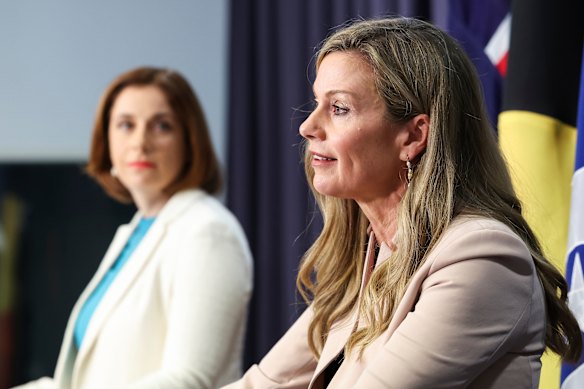
Australia’s eSafety Commissioner Julie Inman Grant has put herself at odds with the federal government over its under-16s social media ban, saying she was “not really keen on” it, and it was based on legislation drafted “very quickly”.
“It was very thin scaffolding,” she told this masthead. “I don’t have potent powers.”
Inman Grant is the public servant in charge of implementing the controversial under-16s social media ban, but she said she thought it was a “very blunt force approach”.
“If you’re going to take on the biggest technology companies in the world … it’s not like you’re sticking a pink parking ticket on a windshield,” she said.
“What I would say is a regulator is only as good as the tools and the resources that they’re given.”
Inman Grant’s unusually frank comments come as data shows the ban has not been very effective so far – about 70 per cent of children who held accounts on Snapchat, TikTok, Instagram, Facebook and YouTube before the ban are still using them.
Inman Grant has been the public face of the ban, drawing extraordinary criticism from big tech companies and the world’s richest man, Elon Musk, who has called her the “censorship commissar”.
In November last year, Inman Grant was called to testify before US Congress, with prominent US Republican Jim Jordan calling her a “zealot” whose implementation of Australia’s e-safety laws “threatens speech of American citizens”.
Inman Grant, a dual American-Australian citizen, refused to appear and Congress has no power to compel her.
“What you’re effectively asking us to do with this is fence the ocean,” she said of the Albanese government’s policy.
“We might be able to create some friction and some degree of safety, but it’s a futile exercise if you think you’re totally stemming the ocean.”
Inman Grant made the critical comments during a wide-ranging lunch interview with the Herald and the Age.
Opposition communications spokeswoman Senator Sarah Henderson said the implementation of the ban by Communications Minister Anika Wells had been “flawed and chaotic”.
The Coalition supported the ban and included a social media ban in its own policy platform for the 2025 election.
But Senator Henderson said Inman Grant’s comments indicated a “deteriorating relationship” between the minister and the public servant tasked with implementing the landmark government policy.
“We’ve seen platforms added at the last moment, confusion over the definition of an age-restricted social media platform, and widespread reports of circumvention of age verification,” Senator Henderson said in a statement.
“It is deeply regrettable that Labor’s poor design and implementation of the social media ban have badly let down so many Australian parents and their children.”
The social media ban for under-16s came into force in December last year. It placed the onus on social media giants, including Meta, TikTok, Google Kick and Snap, to withhold access to accounts for children under 16.
But six months after its commencement, most major platforms are not yet complying with the law, and a substantial share of Australian teenagers remain on apps they were meant to be locked out of.
The eSafety Commissioner is investigating Facebook, Instagram, Snapchat, TikTok and YouTube for potential non-compliance and has retained an external legal team ahead of possible enforcement action, but is yet to fine any company since the ban took effect on December 10.
The overall picture remains murky, but eSafety’s own data shows platforms removed, deactivated or restricted about 4.7 million accounts belonging to under-16s by mid-January, with a further 310,000 by early March.
Inman Grant told a Senate estimates hearing on May 27 the early account removals were “the low-hanging fruit” and the real test was whether platforms could stop children re-registering.
“What we really need them to focus on is preventing any sort of re-registration or circumvention of the systems that they have in place,” Inman Grant told the committee.
She said the number of under-16-year-old accounts on social media had fallen 37 per cent over three months.
“If you think about any other public health movement over a three-month period, that’s a very impressive reduction,” she told Senate estimates.
“We’re not just looking at numbers, we’re looking at harms reduction.”
However, independent data suggests that many teenagers never left.
About 70 per cent of children who held accounts on Snapchat, TikTok, Instagram, Facebook and YouTube before the ban were still using them, according to eSafety’s own compliance report, published in March, and Inman Grant conceded many “were never even asked to age verify”.
A survey of 1050 teenagers commissioned by suicide-prevention charity the Molly Rose Foundation found more than 60 per cent of Australian users who had accounts before the ban retained access to at least one platform.
During the Senate estimates hearing in May, Senator Malcolm Roberts asked Inman Grant how many of the 4.7 million accounts were confirmed active accounts of Australian children.
Inman Grant did not provide a figure, saying the numbers were “provided by the companies themselves through legally enforceable notices” and that eSafety was “interrogating those numbers”.
A spokesman for Minister Wells said the Albanese government had quadrupled the eSafety office funding.
“The social media minimum age law passed the parliament with bipartisan support, encouraged by enormous community concern about the harms of social media”.
“We make no apologies for listening to what families needed and acting swiftly.
“We have consistently said our social media minimum age law is a world first and needs to be flexible and adaptable.”
Google and TikTok declined to comment for this story. Comment has been sought from Meta, Kick and Snap.
 David Swan is the technology editor for The Age and The Sydney Morning Herald. He was previously technology editor for The Australian newspaper.Connect via X or email.
From our partners
Disclaimer : This story is auto aggregated by a computer programme and has not been created or edited by DOWNTHENEWS. Publisher: www.smh.com.au


