Samaan Lateef
Mumbai: The family of Dawa Sherpa were told that he had died while descending Everest, and that they should start preparing his funeral.
Last seen about 7500 metres above sea level, he had little food and no oxygen, and a helicopter rescue team could not see him. Ladders had been removed from the most treacherous routes down. The deadly climbing season appeared to have claimed its latest victim.
But then, nearly a week after he went missing, the Everest base camp clean-up team saw something remarkable.
The 52-year-old veteran guide was spotted crawling slowly towards them.
The drama had begun six days earlier when the guide, known to Nepal’s climbing community as Hillary Dawa Sherpa – after the mountaineer Edmund Hillary – had been climbing Everest with a Polish client in the final days of Nepal’s spring season.
On May 29, the client abandoned his attempt to reach the summit after suffering from frostbite and they hurried back to camp.
Somewhere between the death zone and Camp 3, the Polish client pushed ahead and joined another group of climbers on their way down to Camp 2.
Chris Thrall, a British former Royal marine who was in the same group as Dawa, saw him sitting down for a rest. “I turned and I said, ‘Hillary, are you OK, brother?’ He said, ‘Yes, yes, fine Chris, please go, go!’” Thrall said in an Instagram video.
It was the last time he saw him. Dawa found himself alone near the Yellow Band, a steep rock section above Camp 3, at about 7500 metres.
The other climbers, including the frostbitten Pole, made it down to Camp 2.
“It had been a long summit push. What should have been five days to the summit and back took us 11 days, that’s how challenging the conditions were,” Thrall said.
“So, do I go back for Sherpa, who’s probably going to rock up and be fine, as he has done hundreds of times before?”
A spokesman for Himalayan Traverse, Dawa’s employer, said: “They waited for Dawa until the next day, but he didn’t come.”
By May 31, other climbers had left the mountain. The spring season had ended and teams had removed the ladders that spanned the crevasses of the treacherous Khumbu Icefall.
Dawa’s 18-year-old daughter, Mendo Lhamu, said the family had begun preparing funeral rites. An emotional Thrall visited them and offered to launch a GoFundMe page to pay for her education.
He had posted a tribute to Dawa on Instagram, thinking he had become the sixth climber to die this year. More than 1000 reached the Everest summit this season, making it the busiest on record.
“The Himalayan Traverse company told us to do the funeral and that he had died,” Mendo said.
“We were gutted after hearing that, but somehow we believed he would be alive somewhere in the mountains.”
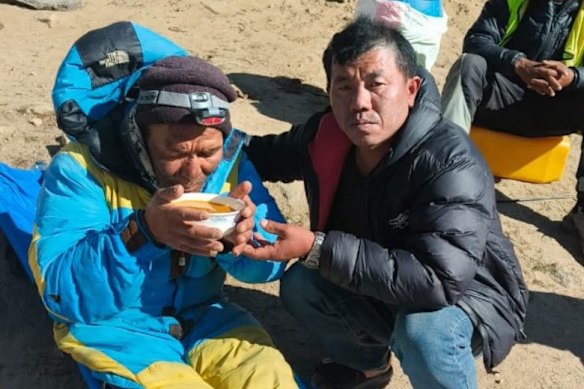
Remarkably, she was right. On Thursday morning, clean-up crews at Everest’s base camp saw a figure in a blue-and-yellow snowsuit crawling slowly towards them.
“Our officials saw him near the base camp and brought him 100 metres down. We couldn’t believe he was alive,” said Hemal Gautam, a senior official at Nepal’s tourism department. “They gave him food and first aid.”
Dawa was exhausted, having spent six days descending more than 2000 metres down Everest’s Southeast Ridge route without supplementary oxygen, crossing crevasses that are normally bridged by ladders and at times sliding on his backside.
“When I saw him … I could not believe my eyes that he is alive,” his daughter said. “I’m very happy to see him.”
Mendo said her father credited decades of experience on Everest for keeping him alive.
“He told me, ‘I have known this mountain for many years. I just kept moving down. If I had given up, I would not be here today.’ ”
She said thoughts of his family sustained him during the ordeal.
“He told me, ‘I did not think about dying. I thought about getting home to my family. That was what kept me moving.’ ”
Pemba Sherpa, director of 8K Expeditions, through which Himalayan Traverse obtained its Everest permit, said: “Dawa managed to survive against all odds for days. It’s nothing short of a miracle. As far as I know, no one has survived alone at that altitude on Everest so far. This is a miracle to have survived for six days alone and descended safe.”
The managing director of Himalayan Traverse, also called Dawa Sherpa, said extreme conditions on the mountain had made an immediate rescue effort impossible.
”He became separated from the team during whiteout conditions. In those conditions, you cannot see,” he said. “It’s easy to say a rescue should have been launched, but sending more sherpas into that situation would have been like sending them into a death trap.”
He said the company left food, oxygen, batteries, communications equipment and a tent at Camp 2 and kept part of the ladder system in place with the hope that, if he had survived, it would help him descend through the Khumbu Icefall.
“The miracle is how he came out of the crevasse,” he said. “We believe he was trapped in a crevasse in the icefall section near Camp 1 for nearly four days. Once he comes out of the hospital, we will know more.”
He said Dawa was an experienced guide who knew the route well and had survived previous accidents on the mountain.
Doctors treating Dawa in Kathmandu described his survival as extraordinary. Nishant Dhakal, head of emergency medicine at HAMS Hospital, said Dawa arrived with frostbite, dehydration and multiple injuries.
“He has frostbite in both feet as well as the fingers, hands more than feet,” he said. “He was quite dehydrated and has some superficial injuries.”
Dhakal said that Dawa had stabilised in intensive care. While reports initially suggested he survived without provisions, the doctor said he had carried limited supplies.
“He had some food, though little, and some supplies with him, so he was able to get by,” he said.
Even so, the doctor described the outcome as remarkable.
“It’s quite a feat that he was able to cope with only the injuries that he has at the moment,” he said. “He’s quite lucky, very lucky.”
The Telegraph, London
Get a note directly from our foreign correspondents on what’s making headlines around the world. Sign up for our weekly What in the World newsletter.
From our partners
Disclaimer : This story is auto aggregated by a computer programme and has not been created or edited by DOWNTHENEWS. Publisher: www.smh.com.au