
Inside the chairman’s room at Las Vegas’s Allegiant Stadium, billionaire businessman Sir Leonard Blavatnik was welcomed like royalty when he arrived for the NRL double-header there this year.
With a Steeden ball plonked in his hands, the owner of global sports streamer DAZN was escorted from the ground-level function area out onto the field by Australian Rugby League Commission boss Peter V’landys.
“It’s my first time at a rugby league game,” he said. “It’s fantastic.”
Three months later Blavatnik – a Ukrainian-born British-American tycoon whose net worth is estimated at $US34 billion ($47 billion) by Forbes – is making his presence felt as bidding for the broadcast rights to the NRL heats up.
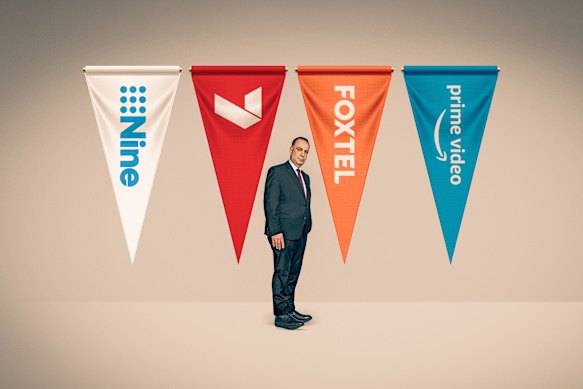
Foxtel, which was purchased by DAZN last year, has pitched for the game’s entire slate, as has Nine Entertainment, the owner of this masthead, which runs subscription service Stan Sport as well as its free-to-air television channels.
But experts are warning over the legality of Foxtel’s potential deal and its compliance with Australia’s anti-siphoning legislation, which ensures the public retain access to a certain number of games for free.
“It seems Foxtel is proposing to on-sell the rights to a free-to-air broadcaster partner after acquiring everything which is inconsistent with the spirit of the regime and possibly illegal,” Lachlan Gepp, partner at law firm Hamilton Locke and a sports rights and gambling expert, says.
The two companies leading the fight are the long-term incumbent NRL rights holders, with Foxtel paying about $270 million a year to show the rights behind its paywall and Nine $130 million a year under the $2 billion arrangement which runs out at the end of the 2027 season.
V’landys has long set his sights on surpassing the AFL’s seven-year $4.5 billion deal struck in 2022, a high watermark in Australian sport.
The speculated figure he is chasing is $4 billion, which over the NRL’s usual five-year rights period would amount to $800 million a season.
Opinions are split on whether he can get anywhere near the magic number, which would require the broadcast partners at least doubling their current outlay in a much weaker advertising market.
“The $4 billion number is hard to rationalise when you break it down,” Gepp says, with the ad market adding an even bigger mountain. “Even with the current split of rights between broadcasters, that would require Nine to pay $1.3 billion and Foxtel to pay $2.7 billion – that’s double the highest fee they’ve ever paid for NRL rights.”
But others believe the competitive tension may result in the price being driven up naturally.
“It is really game on and there is a very good chance that Peter V’landys might just get to what he said he would like to achieve or very close to it,” said Colin Smith, a sports broadcasting expert at Global Media and Sports.
What helps V’landys’ case have been reports that both Amazon Prime Video and the Seven Network are interested in a slice of the action, giving him the public bidding war he has desperately wanted.
“There is now true competitive rivalry. I was thinking the megadeal wasn’t possible. I think it’s becoming increasingly possible,” Smith said.
Such a windfall would be a major victory for the game, which has enjoyed unprecedented ratings and crowds despite apathy from players and clubs over controversial rule changes this year that led to blowout scores.
The issue is what cost it could have for the NRL-watching public.
Foxtel, through DAZN and Amazon Prime Video offer V’landys the lure of worldwide exposure, something he has been eager to obtain by taking games to the United States and planning a so-called global round with potential matches in cities such as London and Hong Kong.
But industry insiders question whether Australian viewers have the financial appetite for a fragmented rights landscape, as has been the case in the United States with its major sports for decades, particularly if asked to pay for two separate subscription services. Australia’s population is likely too small to sustain the financials of splitting the rights, they also say.
Should the rights either remain with Kayo or shift to Stan Sport, fans can likely expect a price rise. Stan raised the price of its Sport tier after acquiring the English Premier League rights, while Kayo lifted the price of its Premium tier to $45.99 this year, its second price hike since its new AFL contract kicked in last year.
In April, a Foxtel spokesperson ruled out introducing ads into its live play coverage in a statement to this masthead.
As for Amazon Prime, it has more than 5 million Australian subscribers and is part of $2 trillion retail behemoth Amazon, one of the biggest companies in the world.
But its bare-bones coverage of the men’s and women’s cricket World Cups, which didn’t get cut-through in Australia, is a cautionary tale.
V’landys said he had three guiding principles – “three Ps” in assembling the NRL package.
“The first one is we’re looking for a partner,” he said. “What that means is we want to grow the game – improve participation with junior football, pathways, women’s rugby league in particular … we want [broadcasters] to really promote the game in all its facets.”
The second point in V’landys’ criteria is the “price point” for fans. “In rugby league we pride ourselves on being a game for all … we don’t want to get the greatest media rights in the world and find out nobody can afford to pay the subscription,” he said.
His third P is price – the overall value of the deal. “Naturally, we want to maximise the amount of money in the rights,” he said.
The NRL would need to approve the on-selling of coverage by Foxtel to Seven or Network Ten in the event its bid for everything was successful.
Even so, Foxtel’s offer to buy the full set of rights and then sublicence the required games to a free-to-air broadcaster to satisfy anti-siphoning demands is problematic and raises questions about compliance with that regime, Gepp says.
“Those laws are designed to ensure at least some rights are sold to a free-to-air broadcaster if they want them,” he says.
The free-to-air rights can only be sold to a pay operator if all TV networks have passed them up, which Nine have not in this case.
Foxtel bought the rights to all Formula 1 races globally and then shared coverage of the Australian Grand Prix, as the only race on the anti-siphoning list, with Ten. But according to Gepp that analogy “doesn’t go very far”.
“That approach might work in a special case where there’s no free-to-air appetite for a sport on the anti-siphoning list, but not for NRL because Nine want the rights for free TV and would be motivated to challenge any non-compliant bid from Foxtel that is designed to cut them out,” Gepp says.
Foxtel declined to comment.
Offloading some games to Seven would also risk the NRL playing second fiddle to the AFL, which is already shown by the cash-strapped network and would have to fit it around its schedule.
That would be a tough pill to swallow for V’landys, who complained about Nine’s Today show promoting the AFL grand final last year but would have little ground to stand on with Seven given its deep-set affiliation with the rival code.
There is an additional game per round to sell this time with the Perth Bears becoming the competition’s 18th team next year – and eventually a further match with the PNG Chiefs joining in 2028. A 20th franchise is also being considered.
But while there are multiple suitors, two former television executives, speaking on the condition of anonymity, predict the status quo will largely be retained. The difference, one of them forecasts, is that Foxtel will pay a lot more for its slice of the pie, having got a sweetheart deal last time.
What is clear is how prized an asset the NRL is for Australian broadcasters.
The grand final was the most watched TV program in Australia last year while last week’s State of Origin thriller was a record, with a total television reach of 5.771 million.
But the sums behind any deal are complicated as television networks continue to contend with their greatest challenge: getting bang for their buck. While there is something of a viewership renaissance, the ad dollars behind those eyeballs continue to slip away and into the grasp of the likes of Google and Meta. The television sector fell by 25 per cent in April compared to 2025 alone.
This may explain Nine’s eagerness to take the paid rights too. It knows there is more money to be made through subscriptions and has shown that by investing in Stan Sport.
For Foxtel, which relies more so on subscriptions than advertising, the incentive is clear: not retaining the NRL could prove existential. It drives a major chunk of its Kayo subscriptions and media industry insiders say the economics of its AFL deal only work when you pair it with NRL, too. Losing the NRL would be at its peril, especially considering Blavatnik only bought his new toy 12 months ago. This fact alone is in V’landys’ favour.
Sweeping job cuts and falling profits show television continuing to head toward its reckoning, but the price of sports broadcast rights is the outlier that continue to deny that trend.
The colossal cost of having them is greater than it has ever been. The cost of not having them may be even more.
 Chris Barrett is a senior sports reporter for The Sydney Morning Herald. He is a former South-East Asia correspondent for the Herald and The Age.Connect via X or email.
 Calum Jaspan is a media writer for The Sydney Morning Herald and The Age, based in Melbourne. Reach him securely on Signal @calumjaspan.10Connect via X or email.
From our partners
Disclaimer : This story is auto aggregated by a computer programme and has not been created or edited by DOWNTHENEWS. Publisher: www.smh.com.au


