Letters from schools and park closures signal a growing summer hazard in Germany. Oak processionary moth cateroillar infestations can trigger rashes, breathing problems and widespread disruption.
Some parents in Germany – particularly in cities – may recently have received emails from their children’s schools warning about something called the Eichenprozessionsspinner.
According to one email seen by The Local, an infestation on the grounds of a high school in Berlin has led to cordoned-off areas and changes to playground use.
This is far from an isolated incident. Every year, usually from late spring onwards, the oak processionary moth caterpillar becomes a seasonal problem across parts of Germany, affecting parks, schoolyards and residential areas.
Entire sports facilities in Berlin have been temporarily closed as a precaution due to infestations, highlighting the practical disruption caused to daily life.
At the same time, health authorities warn that contact with the caterpillars’ tiny hairs can cause skin irritation, allergic reactions and breathing difficulties.
So what exactly are these creatures, and how concerned should residents be?
READ ALSO: Allergy season – What to ask for in German pharmacies
What exactly is an oak processionary moth?
Despite the alarming headlines, the Eichenprozessionsspinner itself is a relatively inconspicuous species of moth. The real issue lies with its caterpillars, which hatch in spring and feed almost exclusively on oak trees.
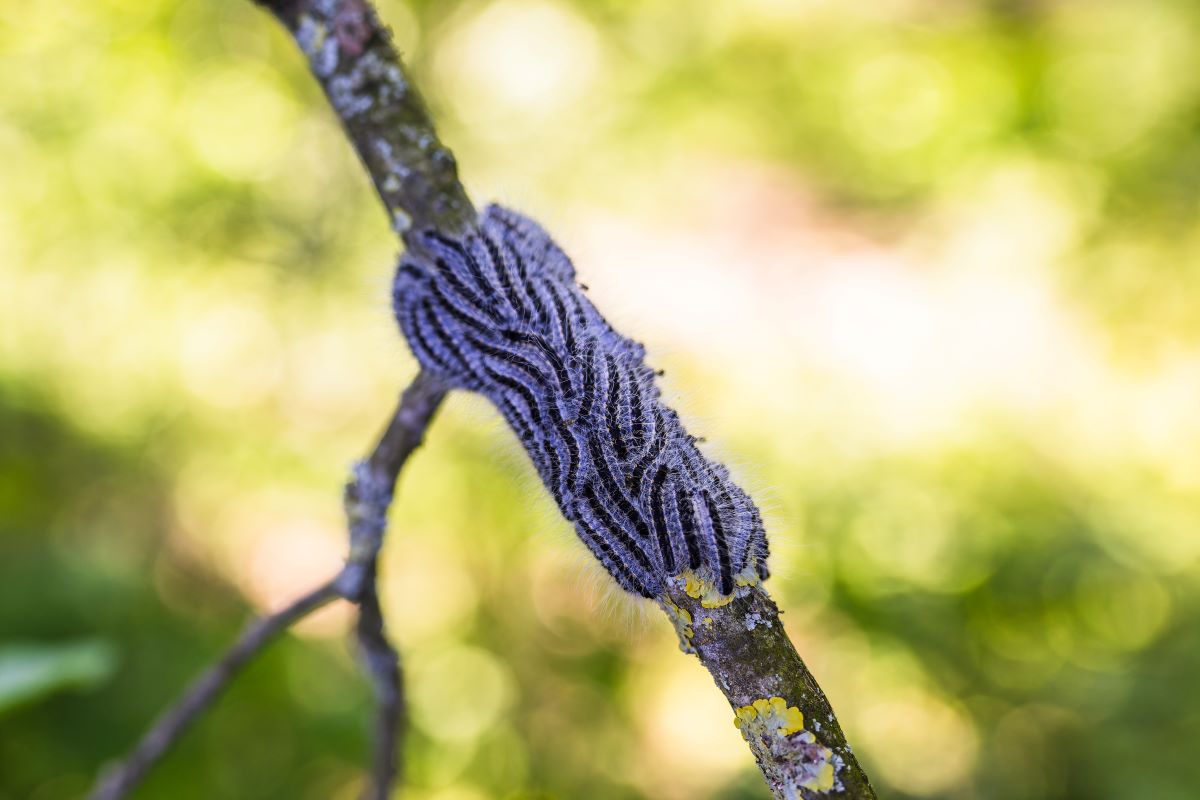
These caterpillars live and move in groups, often forming long head-to-tail “processions” as they climb trees to feed at night. They build distinctive white-grey, web-like nests on tree trunks or branches, which can range in size from a tennis ball to a football.
Oak processionary moth caterpillars ‘processing’ along a branch. Photo: picture alliance/dpa | Philipp von Ditfurth
Biologically, their impact is twofold. Left unchecked they can strip oak trees of their foliage, sometimes completely defoliating them.
But they’re also equipped with a defence mechanism in the form of hundreds of thousands of microscopic stinging hairs. A fully grown caterpillar can have around half a million of these hairs, and each one contains a toxin called thaumetopoein.
These hairs are extremely light and can be carried by the wind over distances of up to 200 metres.
READ ALSO: Ticks in Germany – How to avoid them and what to do if you get bitten
How dangerous are they really?
The primary risk posed by oak processionary moth caterpillars is to human health. Coming into contact with their stinging hairs or breathing them in can lead to a range of symptoms, including itchy skin rashes, redness and swelling, as well as irritation of the eyes and mucous membranes.
In most cases the symptoms are mild but some people may experience coughing, bronchitis or asthma-like symptoms.
More general symptoms such as fever, dizziness or fatigue have also been reported and, in rare cases, highly sensitive individuals can potentially suffer anaphylactic shock.
One other factor to bear in mind is that the danger doesn’t disappear once the caterpillars are gone. The hairs can remain active in nests and surrounding vegetation for several years, and can cling to clothing or shoes, potentially triggering delayed reactions.
At the same time, the caterpillars pose a longer-term ecological issue: by stripping trees of their leaves they can weaken or even kill oaks, especially during repeated infestations.
READ ALSO: The official German advice for how to stay safe in a heatwave
What residents in Germany need to know
Encounters with oak processionary moths are most likely in areas with oak trees – particularly in urban green spaces, parks, schoolyards and along roadsides. Trees in open, sunny locations are especially prone to infestation.
In Berlin and other regions, outbreaks are becoming a regular feature of German summers – but one that requires awareness rather than alarm, providing sensible precautions are taken.
As a result, residents may notice cordoned-off areas, warning signs or even temporary closures of public facilities during peak periods.
Beyond the warning signs, there are several tell-tales to watch out for, including partially eaten oak leaves and dense white-grey webbing on trunks or branches.
Experts advise avoiding any contact with the caterpillars or their nests and keeping a safe distance from infested trees.
Children in particular should be warned not to touch or climb affected trees. If contact does occur, it is recommended to shower, wash clothing and finally to seek medical advice if symptoms develop.
Disclaimer : This story is auto aggregated by a computer programme and has not been created or edited by DOWNTHENEWS. Publisher: thelocal.de