
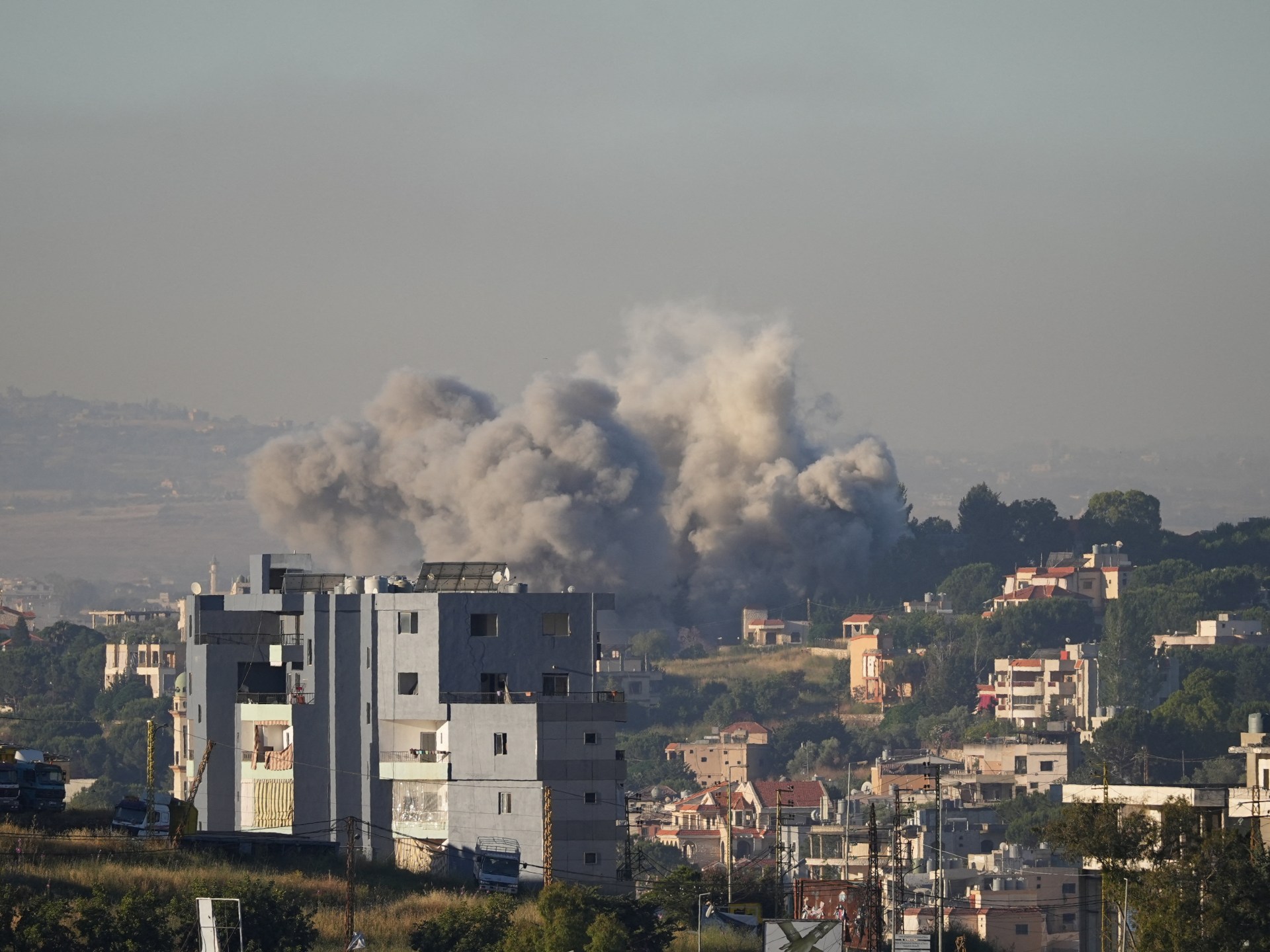
Israel has continued to launch attacks on southern Lebanon despite the two countries striking a new United States-brokered ceasefire agreement.
At least five people were killed as Israeli warplanes and drones struck several towns on Friday, Lebanon’s state-run National News Agency (NNA) reported. The Israeli military also issued new forced displacement orders.
Recommended Stories
list of 4 itemsend of list
The strikes hit residential areas, buildings and roads, while a major demolition was carried out in Bab al-Thaniya. Israeli warplanes also hit close to Jabel Amel Hospital, targeting the Bank Audi area.
Two people were killed in Habboush, including a doctor. In Doueir, a young man was killed and another suffered serious injuries due to an attack by an Israeli warplane.
A strike in the village of Qalawiya Tower killed one person and wounded another, while a drone killed a man sitting in a car in Kfar Reman.
The Israeli army issued two rounds of displacement orders covering nine towns and villages.
The attacks followed closely on news that Israel and Lebanon had agreed to a new US-brokered ceasefire.
The deal was announced by the Trump administration on Thursday, just weeks after a previous agreement to cease hostilities was announced on April 16.
In the interval, however, more than 600 people were killed in Israeli strikes across Lebanon, while the Israeli military expanded its presence in the south of the country. It now occupies about one-fifth of Lebanese territory.
The chance that the new deal will halt the hostilities appears highly unlikely, with the continued exchange of fire between Hezbollah and Israel appearing to bear out the pessimism.
‘Threat to Lebanese sovereignty’
Hezbollah leader Naim Qassem was swift to reject the deal, as he had the agreement in April, dubbing it a “surrender and defeat”.
Advertisement
The Iran-linked armed group said it had launched at least eight attacks against Israeli military positions in southern Lebanon between early Friday morning and Friday afternoon.
Hezbollah said its fighters launched several rocket salvos targeting Israeli vehicles and soldiers on the southeastern outskirts of Zawtar al-Sharqiyya, a municipality overlooking the Litani River in the Nabatieh governorate. It launched artillery shells and later and a rocket salvo at Yahmar al-Shaqif, on the northern bank of the Litani River in the Nabatieh District. It also used Ababil suicide drones against Israeli military vehicles at Tell al-Salaa in the town of al-Qantara.
Israel’s defence minister said his country’s military campaign would continue, and Israeli media outlet Ynet reported that Prime Minister Benjamin Netanyahu had yet to approve the implementation of the ceasefire.
Iran has insisted that a full ceasefire in Lebanon is necessary in order for it to agree to a broader ceasefire with the United States and Israel.
Both Iran and Hezbollah’s positions have earned criticism from Lebanon’s government.
Lebanese Prime Minister Nawaf Salam on Friday urged Iran to stop treating his country as a “bargaining chip” in its negotiations with Washington on the Middle East conflict.
“If I may address a word to Iran, it is this: have mercy on our south, stop treating it and its people as merely a bargaining chip to improve the terms of your negotiations,” Salam told a press conference for a UN aid appeal for Lebanon.
Earlier, politician Najat Aoun Saliba accused Hezbollah of acting against the government and called Tehran’s involvement in the conflict “a threat to Lebanese sovereignty”.
‘Diplomacy only viable path’
Andrea Dessi, assistant professor at the American University of Rome, told Al Jazeera that any agreement that excludes Hezbollah is destined to fail.
“Any deal that excludes or completely ignores the prerogatives of key actors on the ground, primarily Hezbollah, but of course also Iran behind Hezbollah, is unfortunately destined to fail,” Dessi told Al Jazeera.
He said diplomacy, nonetheless, remains the only viable path. “There is no military solution to all of these issues, including Lebanon, and therefore talks will continue.”
Israeli diplomat Alon Pinkas told Al Jazeera that Israel has no coherent strategy for Lebanon and its stated goal of destroying Hezbollah is not achievable.
“If the idea is to eliminate, annihilate, eviscerate, all those terms Netanyahu likes to use bombastically, then effectively you need to occupy the entire state of Lebanon.
Advertisement
“That’s not only not viable and immoral, it’s also just not practical.”
Disclaimer : This story is auto aggregated by a computer programme and has not been created or edited by DOWNTHENEWS. Publisher: aljazeera.com



