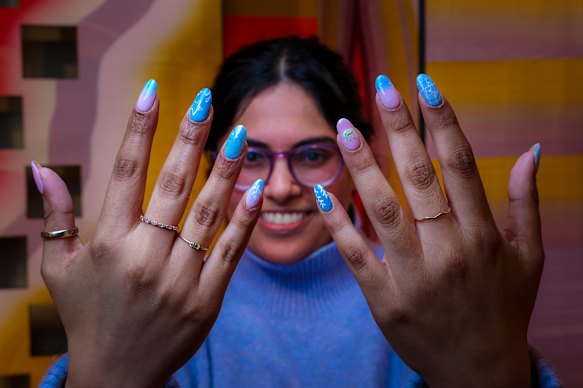

A row of white tables stretches from inside the door of Buff Nails’ Fitzroy salon, where nail artists sit bent over their clients’ hands, busily shaping and polishing.
Bookings are required in advance, and services range from bare manicures and pedicures to individual nail art with intricate designs and gems.
The aesthetically designed interior is in sharp contrast to many walk-in strip shop and shopping centre nail salons, where payment is cash in hand and equipment can be poorly sterilised – which can lead to fungal infections.
Emma Forrest, Buff’s founder, says she wants to shake up the sector, which is built on cheap prices and speed, and “kind of sitting at the bottom of the barrel in terms of standards”.
She gestures around the salon, which is staffed by trained employees with a focus on hygiene and nail health, and where a gel manicure costs $100, double the price of many walk-in salons.
“Everyone wants to get [nails] done cheaply and as quickly as possible – an in-and-out kind of approach – and I suppose we are a little bit of the antithesis to that,” Forrest says. “We don’t do a really quick … job; we take our time to make sure it’s done well and done properly.”
From Buff’s first store in Brighton, which opened in 2020, the business has expanded to six salons across Melbourne with a turnover of $4.2 million. Forrest has received a loan from NAB to back her plans to open another 20 salons around the country in the next two years.
Chelsea Bagan, the founder of Trophy Wife Nails, has a similar focus on quality and hygiene.
“Some people come in and say, ‘Why is it so expensive?’” Bagan says. “I think it’s undervalued compared to other services like make-up or hair.”
Bagan says employing well-trained staff at award wages is expensive, and the feedback from customers is often that Trophy Wife’s services are cost-effective because the quality products and techniques used are longer wearing.
“For the price that people expect to pay traditionally, the staff that are providing that service may be paid below minimum wage and may be bound to businesses that are housing and feeding them,” Bagan says.
Bagan says there can be an undercurrent of racism in Australia’s $1.3 billion nail industry, with wage theft and exploitation an ongoing issue in the sector, which is dominated by Vietnamese migrants.
“People will say things like, ‘I’m going to see the Asians’, things like that,” she says. “I think with a lot of people it is unconscious bias. I do have some of my team who are Vietnamese immigrants, and they have to definitely work harder to win people over – and that is really sad.”
The dominance of Vietnamese immigrants in nail salons around the world is often credited to Hollywood actress Tippi Hedren, who starred in Alfred Hitchcock’s The Birds.
After visiting a refugee camp in 1975, Hedren flew out her personal manicurist to teach the women a skill that they could use to support themselves in their new homes.
Lan Anh Hoang, professor in development studies at the University of Melbourne, says the nail industry provided an easy entry point for many Vietnamese Australians.
“Anyone could do nails,” she says. “You don’t need to speak very much English because even now in Australia, Vietnamese people are one of the three groups with the lowest English proficiency.”
Hoang says that while working in a nail salon is “low status”, it can be lucrative because payment is often in cash so not all income is declared.
“It’s also attractive because it can accommodate people without a legal migration status,” Hoang says.
A report called‘Off The Books’: Inside Australia’s Hidden System of Migrant Worker Exploitation, published in May, found migrant workers were consistently paid less than they were owed under Australian law.
The report found 71 per cent of employees in nail salons surveyed did not receive payslips or received payslips that recorded a lower number of hours than they worked.
Dr Tess Hardy, associate professor at Melbourne Law School, says nail salons are prone to significant non-compliance with Australian employment laws because they often rely on vulnerable workers with limited English skills.
“If they are working without a visa, or in breach of their visa conditions, they can be reluctant to complain, even where working conditions are dire,” she says. “It has all the red flags of lots of conditions that make it prone to exploitation.”
Hardy says it is interesting to see businesses such as Buff and Trophy Wife start to distinguish themselves in the market by being compliant with workplace laws.
NAB small business banker Nikola Nanayakkara, who has backed Buff to open two new locations, says that even with cost-of-living pressures, Australians are still finding small ways to treat themselves, with NAB’s latest spending data showing that spending on personal services is still growing, up 5.9 per cent on last year.
“What stood out with Buff was how differently they’re approaching the category,” she says. “They’ve shifted nail care into a more premium, wellness‑led experience, and that’s exactly where we’re seeing demand move.”
Start the day with a summary of the day’s most important and interesting stories, analysis and insights. Sign up for our Morning Edition newsletter.
From our partners
Disclaimer : This story is auto aggregated by a computer programme and has not been created or edited by DOWNTHENEWS. Publisher: www.smh.com.au