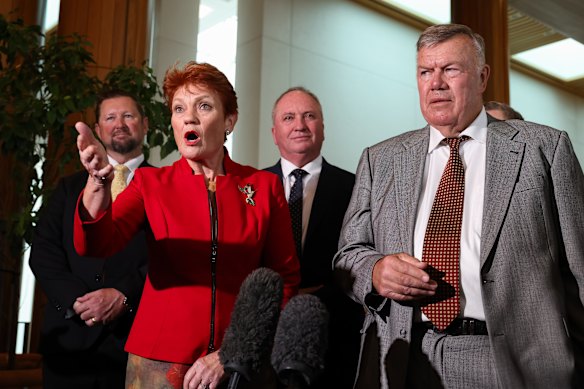
Peter Hartcher is right that desperation is driving voters toward Pauline Hanson (“One grievance above all is fuelling the rise of Hanson”, June 6). But desperation doesn’t make the destination a good one. Hanson’s voters want cheaper groceries, a home they can afford and a future worth working toward. What she offers are scapegoats – Asians, Indigenous people, Muslims – and blind devotion to a foreign leader who slaps tariffs on Australian goods. That is not a cost-of-living plan, that is a distraction dressed up as defiance. These voters are right to be angry but they’re wrong to think Hanson will fix anything. The Australia she would build would be more insular, more fearful and less prosperous – precisely the type of world her supporters are trying to escape. Desperation explains the surge. It doesn’t excuse it. Raj Kamath, Castle Hill
Peter Hatcher quotes the new member for Farrar, David Farley, on water issues in his electorate within the Murray Darling Basin. He says “circa 40 per cent of our productive food water has been retired into environmental objectives”. The latest numbers from the Murray-Darling Basin Authority for the Basin Plan put this at less than 20 per cent. Even if the 960GL of environmental water that existed before the plan is included, the basin-wide environmental water share is only 20.7 per cent – half Farley’s claim. There is no doubt that adjusting to these changes is challenging for the communities involved, but the changes are nowhere near as big as Farley suggests. Farley also says that Murrumbidgee General Security allocations for the coming year are zero (they are not yet announced) and that “the dams have a lot of water in them” (they are one-third full) and that it is “all environmental water”. In fact, the water is for both irrigators and the environment – probably about 80 per cent for irrigators and 20 per cent for the environment. If David Farley is to contribute constructively to the water debate, he needs to get across the detail first. Professor Andrew Western, University of Melbourne
Peter Hartcher notes that many women have switched to One Nation in desperation. These women might want to reflect on the serious risk of One Nation’s pro-life policies and its opposition to the decriminalisation of pregnancy termination. They risk desperation of a different kind. Leader Pauline Hanson has adopted former PM Tony Abbot’s perceived need to defend Western thought and white-Australia culture in education. One Nation was also strongly opposed to compulsory COVID-19 vaccinations. As Hartcher states, Hanson is not fit to lead this country. Anne Eagar, Epping
I’ve already circled the date on my calendar, June 17, when Pauline Hanson will speak at the National Press Club to enlighten us about a future under a One Nation government (“How Hanson became the de facto leader of the opposition”, June 7). No more Muslims, no more climate change or environment nonsense, no more NDIS fraud, no more Indigenous indulgence. Hand in hand with Gina Rinehart and Donald Trump, Pauline and her ilk will create a Brave New World just for us. Can’t wait. Nola Tucker, Kiama
Asked about One Nation’s housing policy, Nationals leader Bridget McKenzie responded: “I could have a view if I knew what One Nation’s view was” (“One Nation MPs caught in back-to-back ‘train wreck’ housing interviews”, June 5). Is this the same Bridget McKenzie who last month offered to support Pauline Hanson in a campaign for the federal seat of Blair? Graham Fazio, Cootamundra
One Nation is already faltering as its spokespeople struggle to explain its policies – and the scrutiny has just begun. Pauline Hanson is benefiting from the wave of populism and disaffection with the major parties, but that is unsustainable. Even Trump’s mighty MAGA base is starting to crumble. A party that fails to deliver the goods or has no goods to deliver has no future. Hanson said she hasn’t changed, as if that’s a badge of honour. She also said Australia was catching up with her. But you don’t catch up with Hanson, you only lower yourself to her level. One Nation is a one-trick pony – it’s a party of grievance. Racism, xenophobia and white supremacy appeal to the hatemongers among us, but they are no match for multicultural Australia. Graham Lum, North Rocks
Enough is enough. May I suggest that Australia declare a Hanson-free day? A day when we will not see, hear or read about anything this divisive woman or her rabble of a political party. Just one day. Is that too much to ask? Phil Peak, Dubbo
Renewables future
In the heart of Barnaby Joyce’s electorate is the town of Uralla (“Climate denial on steroids”, June 5). The town’s first major renewables project, New England Solar, while employing hundreds of temporary staff in its construction phase, will have about a dozen permanent staff, continue to function as a sheep-grazing enterprise, continue to substantially supplement the shire council’s finances for community support and provide cheaper electricity than fossil-fuelled generators. Regardless of its significant reduction in greenhouse gas emissions, it is providing indisputable benefits to a broad community. Despite this, Joyce and One Nation, with the federal Coalition scrambling to emulate them, are rejecting renewables and advocating new coal-fired generation. With the wave of enthusiastic support spreading for Hanson’s team, the benefits of renewables are being effectively overshadowed by their fossil-fuelled promoting policies. Their antagonism towards solar and wind farms, largely a function of political opportunism, will only spread unless challenged at every opportunity. Roger Epps, Armidale
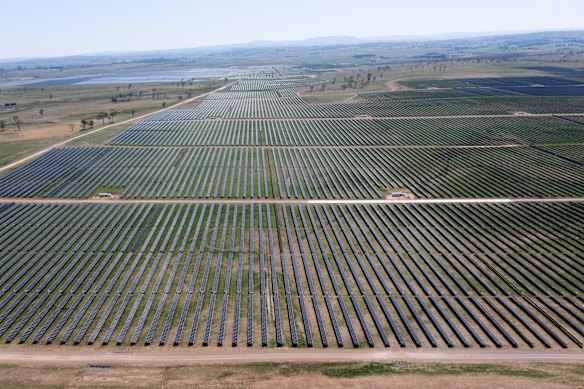
Barnaby Joyce was upset to see the demise of the Liddell coal-fired power station. He also appeared upset that renewables were putting downward pressure on east coast energy prices. Could it be that his opposition to renewables is ideological rather than based on evidence? If AGL thought coal was profitable, it would be the first to continue with it. Despite the Trump administration’s relentless efforts against renewables, a February forecast by the US Energy Information Administration shows that “generating capacity will reach record highs this year, with 93 per cent of new capacity coming from solar, wind and batteries”. If Mr Joyce wants to protect his “locals” from higher electricity prices, why not support uptake of solar panels and batteries? Fiona Colin, Malvern East (Vic)
Doctors undervalued
There was a surprising absence of letters in response to the article on the state of our emergency departments, where staff are overwhelmed and considering early retirement (“Wonder why emergency doctors are quitting? Spend a day in my shoes”, June 6). We need to do better to retain these valuable people. I experienced the National Health Service emergency clinics in England when I broke my ankle recently. It was not a bad break, but I waited hours after triage to be seen by a nurse, get an X-ray and be given a flimsy splint. At no time was I assessed by a doctor. Happily, I was able to return to the excellent medical care we have here. We need to support our amazing medical staff by giving them decent wages and conditions. This would respect their wonderful skills and enable lifetime careers in this field. Clare Sydenham, North Sydney
The article by the capable Dr Rachael Gill had my sympathy until the 2pm slot, when a junior doctor was demoralised and “upset” because a patient had called her “love”. Really? Perhaps the young doctor could have been counselled by Dr Gill as follows: “The patient seeking your attention is suffering. That is why they have come to hospital. The patient is not being rude, but is ill, requires help and does not know your name. Such a term is often used by the older generation, in whose time men doctors far outnumbered women. The patient has not sworn or threatened you, and in all likelihood intended the term in a friendly manner. So, be professional. Now is not the time to focus on your own feelings.” Just a thought. Sophie York, Sydney
Punishment to fit crime
What does a police officer actually have to do to be given a custodial sentence (“Historic sentence for Sydney cop who killed Aboriginal teen”, June 6)? Over the past several years we have seen several instances in which a police officer has overstepped the mark, resulting in the death of a member of the public. Time and again, noncustodial sentences are handed out – for a crime that causes loss of life. This is just a slap on the wrist and is certainly not a deterrent that would have our boys in blue thinking twice about the manner in which they perform their duties. Elizabeth Jean Henry, West Pennant Hills
Split incomes
Being able to afford to have a family on one income is admirable, but my concern lies with what happens if the marriage breaks down and the family splits (Letters, June 6). I doubt the unpaid stay-at-home mother would have superannuation or independent means, and would be reliant on the former partner’s benevolence. Rosemary Wolf, Mount Warrigal
Polo diplomacy
Should the Russian water polo team be excluded from the World Cup in Sydney (“Canberra urged to block Russian athletes over ties to sanctioned oligarchs”, June 1)? A simple “no” would only punish the everyday Russians who have no power to influence their government, but have to endure the misery and privations of war. Being shunned by the world won’t help gain peace between nations, but will foster further animosity. Would President Putin care? No, it’s not in his DNA. Any friendship formed by peaceful interaction may change the world. Further aggression certainly won’t. Wendy Crew, Lane Cove North
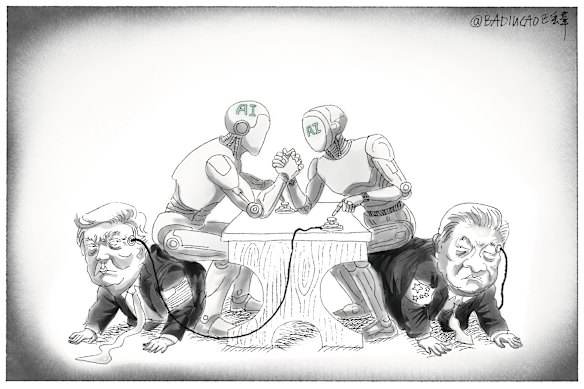
AI wars
Sub standard
David Shoebridge made clear on ABC’s Insiders that buying US submarines, new or used, is simply enlisting Australia as part of the American war machine, the main adversary of which is China. We are a small country. How could three or even six submarines possibly defend this huge continental island we call home? Bill Forbes, Medowie
Policy prism
The Murdoch media and conservative parties have run the tired line that this year’s budget is “the worst in 30 years”. I don’t think so. Labor’s tax policies will improve intergenerational equity and the fact is that super-wealthy people should pay their fair share of tax. These budget changes are effectively at the modest end of the spectrum. Ironically, Labor would have been lambasted by those same critics if the budget had not addressed this. This is not bad public policy. Real bad public policies, to remind everyone, were these: Howard’s Aged Care Act of 1997, widely seen as being responsible for the chronic shortcomings of the aged care system today; Rudd and Gillard’s disastrous mining taxes that delivered nothing like the revenue forecast; Morrison’s shambolic COVID vaccine rollout and his robo-debt fiasco. Possibly the worst public policy failure of all, though, is the political stalemate over climate change. In context, when you look at these disgraceful failures, you might change your perspective on this year’s budget. Bob Konig, Shell Cove
Trade up
John Kempler is correct about the need for more vocational training and apprenticeships (Letters, June 6). I know a young man whose HSC subjects included advanced mathematics, physics and engineering studies, and who is very happy as an apprentice motor mechanic. The benefit of young people choosing a trade over university is that society continues to get smart tradies. Peter Butler, Wyongah
Sage advice
Correspondent Ian Usman Lewis asks how long it will take this timid government to call out the behaviour of America and Israel’s so- called leaders (Letters, June 6). That question was answered long ago, by Voltaire in the 18th century. He wrote that “To learn who rules over you, simply find out who you are not allowed to criticise.” Sam Mahendra, Castle Hill
Twist in the tunnel
They’ve got to be joking (“Plan to ‘abandon’ nearly built motorway secretly explored”, June 6). It’s been reported that the CIMIC/CPB consortium opted for a cheaper, riskier tunnelling strategy until it all came unstuck. The problem belongs to the consortium. Perhaps Transport for NSW should rather use a Chinese contractor. A decade ago in Shenzen, I listened to a Chinese project manager describe his project – a 118-kilometre twin-lane dual carriageway including tunnels – originally with a time frame of four years until he was told to halve the time, which he successfully did. It makes the current consortium seem like amateurs. I await a satisfactory outcome for the public, not the consortium. They can’t expect to get out of this without losing skin. Denis Sullivan, Greystanes
Housing moaners
Who’d be a politician? The public and media bleat about housing affordability but when a politician actually attempts to do something to halt the skyrocketing costs, everyone jumps on them (“Tax firestorm sparks Labor plans to boost house supply”, June 6). Opponents must offer a better alternative than the developer-inspired build, build, build option, which is usually touted but doesn’t seem to lower prices. Paul Doyle, Glenbrook
Third-tier problems
It’s comforting to know our Herald and especially its Parramatta bureau chief, Anthony Segaert, are on the ball in relation to “the somewhat cosy world of the third tier of government” (“Council’s ills must be given public hearing”, June 6). More’s the pity there are not more Heralds and Anthony Segaerts to keep a watchful eye on our councils. Col Shephard, Yamba

No thanks, Clive
Clive Palmer is back. I just received one of his pamphlets in my letterbox. What a waste. If he spent his millions on good works he would be feted as a great Australian. Unfortunately, that’s far from the case. David Neilson, Uralla
- To submit a letter to the Sydney Morning Herald, email letters@smh.com.au. Click here for tips on how to submit letters.
- The Opinion newsletter is a weekly wrap of views that will challenge, champion and inform. Sign up here.
Disclaimer : This story is auto aggregated by a computer programme and has not been created or edited by DOWNTHENEWS. Publisher: www.smh.com.au