NEW YORK — Christian Pulisic looked exhausted as he stepped from a yellow cab on the edge of Manhattan’s financial district for a promotional event arranged by his shoe sponsor.
A day earlier, he had been booed off the field after going scoreless in his final 17 games with AC Milan. And as Pulisic’s private jet made its way from Italy to New York, the club’s coach, sporting director and two other top executives were sacked.
A day later Pulisic walked across a stage overlooking the East River to cheers during a sparsely attended rally in which the U.S. roster for this summer’s World Cup was announced.
The 24 hours between those two events — some of which were spent signing autographs for hundreds of school children as a dog in a red-and-white No. 10 Pulisic jersey looked on — would be the only respite from a hugely disappointing club season and the heavy expectations of the second World Cup played on U.S. soil.
If Pulisic hoped to turn the page from one to the other, he would have to do it quickly.
“There’s pressure,” he said. “It’s a World Cup. I understand people find ways to put pressure on the players.”
So Pulisic has tried to turn the burden into a gift.
“I’m really grateful to be in this position. It’s exactly what I wanted,” he said. “I have a chance to help my country to perform at a World Cup. I’m lucky.”
There’s a fine line between lucky and cursed, however, and Pulisic is straddling it. If the U.S. is to go deep in this World Cup, it will be carried there on Pulisic’s narrow shoulders. If it stumbles, Pulisic will get the blame.
“I don’t see it as a gamble,” said Jurgen Klinsmann, the coach who gave a teenage Pulisic his first appearance with the national team a decade ago. “It’s just a huge opportunity, and you want to jump on that opportunity. If he performs to his capabilities, he will play a fantastic World Cup.
“A lot of other pieces need to fall into place with his teammates, with entire team performances. But I look at this as a once-in-a-lifetime opportunity.”
One Pulisic, 27, seemingly has been preparing for his whole life.
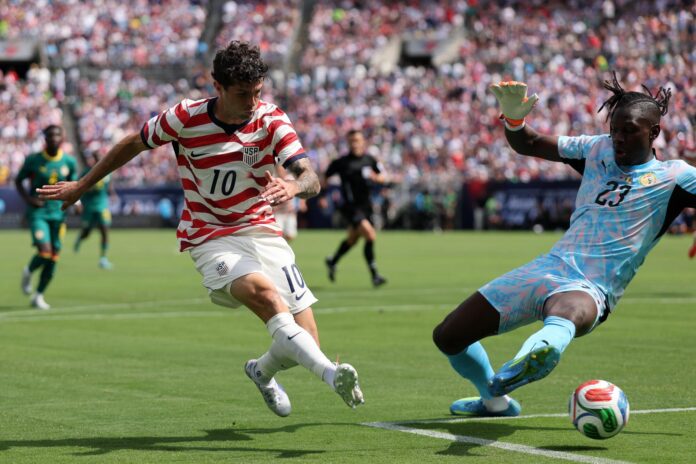
Christian Pulisic scores past Senegal goalkeeper Mory Diaw during an international friendly match on May 31.
(Jamie Squire / Getty Images)
“He probably more than anybody recognizes that this is a moment and a platform for him to not just perform well, but to kind of introduce himself to a lot of people that are still kind of meeting him for the first time.”
— Alexi Lalas, former U.S. soccer star, on Pulisic in the World Cup
The youngest of three children, Pulisic was raised on soccer. His parents, Mark and Kelley, both played in college, and his father went on to play professionally indoors before becoming a coach. Mark moved to Germany with his son when Christian, then 15, was invited to play in Borussia Dortmund’s youth system.
Two years later Pulisic became the youngest foreign player to score in a Bundesliga game. He went on to play for two more of the biggest clubs in Europe, becoming the first American to play in a Champions League final in 2021 with Chelsea FC and leading AC Milan with a career-high 17 goals in all competition four years later.
He made his first appearance for the national team the same spring he made his Bundesliga debut, becoming at 17 the youngest American to play in a World Cup qualifier and the youngest male to score for the U.S. in the modern era. But that qualifying campaign ended in disappointment a year later when a loss to Trinidad and Tobago kept the U.S. from going to Russia.
At the final whistle, Pulisic crouched on the field, covered his face with his jersey and cried.
He was the only teenager on a veteran team that fall, but over the next four years he became the youngest national team captain at 20 and now, at 24, the unquestioned leader of the second-youngest World Cup roster in U.S. history. It was his gutsy goal in Qatar — one that ended with Pulisic going to the hospital after colliding with Iranian goalie Alireza Beiranvand — that got the Americans out of group play at the last World Cup.
But Qatar was largely a dress rehearsal for this summer, when the World Cup will return to the U.S. for the first time in 32 years. Half of the 26 players on that roster are back, part of a young team carefully constructed to mature now.

U.S. forward Christian Pulisic controls the ball during an international friendly match against Senegal on May 31.
(Scott Kinser / Associated Press)
This spring, U.S. coach Mauricio Pochettino said the team could reach the semifinals, something it never has done in a men’s World Cup. And Pulisic is once again its leader.
“There is a level of expectation. But I think that it’s fair, it’s relative to what he has already done,” said Fox Sports analyst Alexi Lalas, a star of the first U.S. team to play a World Cup at home in 1994. “He probably more than anybody recognizes that this is a moment and a platform for him to not just perform well, but to kind of introduce himself to a lot of people that are still kind of meeting him for the first time.”
Toward that end, Pulisic is about to become omnipresent, pitching shoes, sports drinks, beer, hamburgers, yogurt and crackers, among other things, during the World Cup. In a cinematic ad for Michelob, he squares off with Lionel Messi in an impromptu match in the lobby of a luxury hotel while in another, shot for Fox Sports, he scores on a corner kick to beat Brazil in the World Cup final.
For the introverted Pulisic, who is far more comfortable on the field than in front of a camera, becoming the marketing face of the tournament has been uncomfortable.
“It’s not something I love,” he said. “I’m not the most outgoing guy. But you only have a World Cup in your home country once in your life. So I’m going to take advantage of these opportunities and I’m grateful I get to do this.”
There’s that word again, grateful. It’s one Pulisic has been repeating with increasingly regularity as the World Cup approaches.
But while he insists none of the additional responsibilities dumped on him have been a distraction, he returned to the U.S. last month having lost his starting spot with AC Milan and having gone more than five months without a goal for club or country, a career-worst 21-game drought. He snapped that with a brilliant first-half score in a May 31 friendly with Senegal; before that, his last score for the national team was in November 2024, in Pochettino’s second competitive game as coach.
Lalas, whose wild red hair and matching Vandyke made him the face of the U.S. team in 1994, said the players on that roster realized none of the work they did to popularize the game in the U.S. or achieve individual glory would mean anything if they weren’t successful on the field. And they were, becoming just the second American team to advance beyond the first round of a World Cup.
Now another U.S. team is straddling the same line separating fame from failure, and Pulisic figures to have a huge say in which side the Americans land on.
“These are players that, from a very young age, have been given absolutely everything in terms of resources and support,” Lalas said. “But with that comes higher expectations. This is your opportunity. This is your World Cup.
“I recognize that there may be pressure. But on the other side of this is an impact and a legacy. If they grab ahold with both hands, their lives will never be the same.”
Pulisic insists he’s grateful for the chance to do just that.
More to Read
Disclaimer : This story is auto aggregated by a computer programme and has not been created or edited by DOWNTHENEWS. Publisher: latimes.com