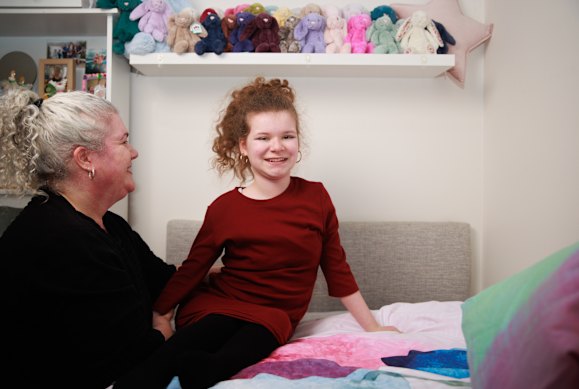

In the year after her daughter Bronte was diagnosed with amyotrophic lateral sclerosis (ALS), Bronwyn Cousins did not sleep.
Five years on, rest is just as scarce. Bronwyn sleeps with a monitor by her bedside so she knows when her daughter needs her.
Bronte, 14, wakes every hour, often in excruciating pain.
“She’ll wake up to be moved, or to have a drink, or have the doona pulled up around her shoulders, because she can’t do that, so I roll her from side to side,” the 53-year-old single mother of two says.
“One of the things I didn’t know about was that your hips can pop out of your sockets in neuromuscular disorders because they’re not being held tightly enough in their sockets, so when I roll her over, there’s this horrific dry crunch noise, which is her hips moving in the sockets, and she’s in a lot of pain, which is why she keeps waking up.”
ALS is a fatal, progressive disorder that attacks the motor neurons in the brain and spinal cord. It is the same disease that killed AFL great Neale Daniher last month.
Bronte is the only child in Australia living with the form of motor neurone disease, for which there is no cure.
Juvenile ALS is rare – it accounts for 0.1 per cent of ALS cases worldwide. There is a dearth of research.
There is no data on life expectancy. At night, when the world goes dark, Bronte is terrified of dying.
“I think, as she’s more aware of her deterioration, it’s happening quite rapidly; at the moment she’s having lots of panic attacks at night,” Bronwyn says.
The teen, who is whip-smart with a sharp sense of humour, has an obsession with English history. She wants to be a family lawyer when she grows up – dreaming of a future that may never come.
“Sometimes I’m like, I can’t believe I’m discussing this with my 14-year-old child … So I sit here, and I watch my kid dying, and I try and give her the best life I can,” Bronwyn says.
Sydney neurologist Nathan Pavey treats hundreds of patients with MND every year.
“It is universally fatal, and therefore universally devastating for families … And then that’s just amplified, of course, the younger people are.”
The chief executive of MND Victoria, Mary-Jane Stolp, says it is essential that friends and families of people with MND do not retreat because the situation is uncomfortable or confronting.
“Carers of people living with MND report a lower quality of life, which means community support is really important,” Stolp says.
More funding for research into the causes of MND is the only hope for patients, says Pavey. It is also the quickest pathway to finding a cure.
“We need to … focus on research into the underlying mechanisms and causes of the disease, as well as clinical treatment trials,” he says. “The main problem you’re going to run into with juvenile ALS is just how rare it is, and clinical trials need large numbers.”
Bronte is too young to be eligible for any clinical trials.
Earlier this month, the federal government announced priority aged care support for people living with MND, to reduce wait times from up to 10 months to less than one.
But the changes do not account for young people with MND. Federal Health Minister Mark Butler’s office has been contacted for comment.
When eating became too difficult, which is common among patients living with MND as muscles in the mouth, throat and chest rapidly waste away, Bronte’s weight declined. She had a feeding tube inserted into her stomach. This was one of the more painful procedures she can remember.
A Jellycat collection lines the shelf above Bronte’s bed. The items mark every major operation the 14-year-old has had since her diagnosis in 2021. There are 32.
FightMND was founded by Daniher in 2014, following his diagnosis, and has raised more than $157 million for MND research and support. It holds its annual Big Freeze on Monday, the largest fundraiser in Australia for MND.
Bronwyn hopes that renewed attention on MND because of the work of people such as Daniher, and the public diagnosis of South Sydney Rabbitohs player Jai Arrow last month, will inspire people to help the families whose lives have been forever changed by a diagnosis.
“I don’t want anyone to have this disease. I really don’t,” she said.
Be the first to know when major news happens. Sign up for breaking news alerts on email or turn on notifications in the app.
 Emily Kaine is a national news blogger at The Sydney Morning Herald.Connect via email.
From our partners
Disclaimer : This story is auto aggregated by a computer programme and has not been created or edited by DOWNTHENEWS. Publisher: www.smh.com.au