When is good news bad news? It’s when a new chair of the Federal Reserve, expected by the president who appointed him to deliver interest rate cuts, is confronted with a sudden surge in employment the week before his first meeting.
On Friday, sharemarkets were sold off heavily after US jobs data for May significantly exceeded expectations, with 172,000 jobs added in the month.
In the United States, the S&P 500 fell 2.64 per cent, the tech-heavy Nasdaq index 4.8 per cent and a group of the biggest tech stocks 3.8 per cent after the data was published. The Philadelphia Semiconductor Index, which had soared about 90 per cent this year, driven by the artificial intelligence boom, plunged more than 10 per cent.
The bond market also reacted to the data, with the yield on two-year Treasury notes jumping from 4.05 to 4.15 per cent and that on 10-year bonds rising from 4.48 to 4.53 per cent.
The apparently perverse market reaction was provoked by a realisation that the unexpectedly strong jobs data meant the interest cut the markets expected Kevin Warsh to deliver before the end of this year is almost certainly off the table, indeed the greater likelihood now is that there will be at least one, if not two, rate hikes later this year.
The US Federal Reserve Board has a dual mandate: keeping inflation under control while maximising employment.
With jobs not a concern at this point, its full focus will now be on an inflation rate that has been rising, initially because of Donald Trump’s tariffs but, more recently, because of his war on Iran.
At 3.8 per cent, the rate is well above the Fed’s targeted inflation rate of 2 per cent, and inflation data that is due on Wednesday in the US is expected to show it has risen again.
Whatever agenda Warsh may, or may not, have brought to the Fed when he was recently confirmed to succeed Jerome Powell as chair, he would risk a revolt from his colleagues on the Fed’s Open Market Committee (FOMC), which sets US monetary policy, if he advocated a rate cut in these circumstances.
Futures markets, which were until recently pricing in the near-certainty of at least one 25 basis point cut later this year, are now pricing in a 25 basis point increase, with the odds on a second shortening.
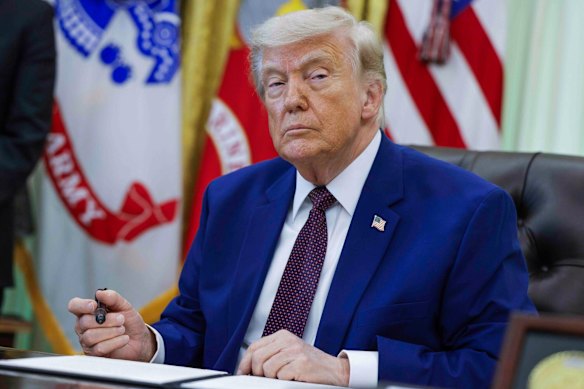
The dilemma confronting the Fed is lost on Trump, who said at the weekend that the US shouldn’t be “penalised by immediately raising interest rates” and that it was “unfair” that when the economy was travelling well “they” (presumably central bankers and economists) wanted to raise rates.
“We built this country by doing great and having rates low,” he said. “What they do when they raise interest rates, they try and kill success. I don’t want to kill success. We should actually lower rates.”
It is doubtful that the members of the FOMC will take much notice of his pleadings when they meet next week and probable that they will remove the “easing” bias that caused some contention at their last meeting to signal that the next rate move could be up.
That meeting might also be significant because Warsh has made no secret of his aversion to the Fed’s famous “dot plot” of its members’ projections for US economic data and to the forward guidance on monetary policy that it has provided since the 2008 financial crisis and which is a policy most of the major central banks have adopted to provide financial markets and the wider community some insight into their expectations.
A withdrawal of the dot plot and guidance could add volatility to a market that is vulnerable to volatility.
This week, Elon Musk’s SpaceX will list, at $US1.75 trillion ($2.5 trillion) to $US1.8 trillion, after raising $US75 billion to $US80 billion of new equity from investors, about 30 per cent of them retail investors.
At 100 times revenue and wracking up massive losses, SpaceX, at those valuations, capitalises Musk’s fantastical visions of data centres in space and the colonisation of Mars.
Like other tech companies chasing a vision of the revolutionary changes AI could make to the way we live and work – Anthropic and OpenAI plan their own $US1 trillion-plus initial public offerings this year – SpaceX’s value is reliant on generating extraordinary revenues and profits somewhere in the distant future.
The worth of those potential revenue and earnings streams today is heavily affected by changes to interest rates and interest rate expectations, and the discount rates applied to the companies’ future cash flows to calculate their current net present value.
Thus, the release of the employment data was untimely for the SpaceX float and its promoters, though there is so much hype – and forced investment by index funds – that it probably won’t materially affect the raising.
Most of the index providers, with one very significant exception, have changed their rules to fast-track inclusion of SpaceX (and other AI listings) in their indices, and to assign index weightings far greater than the 4 per cent of SpaceX’s capital that will be available to new investors. That ensures a tide of index funds will be chasing the shares.
The exception among the index providers was the S&P Dow Jones index committee, which deliberated long and hard and decided to retain its existing rules: IPOs have to be traded on exchanges for 12 months before they can be included in the S&P 500 and other S&P indices; they must have a “free float” of at least 10 per cent of their outstanding shares, and they must have had four consecutive quarters of positive net income from their ongoing operations.
It could be a long time, if ever, before SpaceX or other AI start-ups can meet the criteria.
That, with the decision of at least some of the index funds (Vanguard, in particular) to base their weightings and buying on the free float – the $US75 billion to $US80 billion – rather than the total capitalisation, will reduce the amount of forced buying of the stocks, either via the prospectus or in the aftermarket.
The modest size of the raising relative to the total capitalisation means that shouldn’t, however, dent Musk’s ability to raise the funds he’s seeking at the values he is attributing to the company.
Nevertheless, the prospect of rate rises – a prospect that swells the more tariffs Trump announces and the longer the war in the Middle East and its closure of the Strait of Hormuz continues and elevated energy prices feed into the grassroots of the global and US economies – represents a threat to the valuations of SpaceX and the values at which Anthropic and OpenAI might subsequently be floated.
More broadly, it represents a threat to an AI sector where valuations are in bubble territory, capitalising unknowable futures.
The dilemma confronting the Fed is lost on Trump.
The sector needs ever-escalating valuations to ensure its continuing access to equity and enable it to fund the $US750 billion that US companies are spending on AI this year and the $US1 trillion-plus investments expected in 2027 and beyond.
Even hyperscalers such as Google’s parent, Alphabet, are needing to tap the sharemarket for new equity, despite their pre-existing and vast cash flows and their access to debt market, such is the scale of the spending that is taking place.
They can’t afford for the music – the unconstrained enthusiasm for all things AI, regardless of valuation – to skip a beat.
If Trump had his way, the volume would be turned up, but that would make the sector, the overall market and the US and other developed economies even more vulnerable to even the slightest of setbacks or unexpected pieces of data, even – or especially – apparently positive ones, like Friday’s job numbers.
The Business Briefing newsletter delivers major stories, exclusive coverage and expert opinion. Sign up to get it every weekday morning.
 Stephen Bartholomeusz is one of Australia’s most respected business journalists. He was most recently co-founder and associate editor of the Business Spectator website and an associate editor and senior columnist at The Australian.Connect via email.
From our partners
Disclaimer : This story is auto aggregated by a computer programme and has not been created or edited by DOWNTHENEWS. Publisher: www.smh.com.au