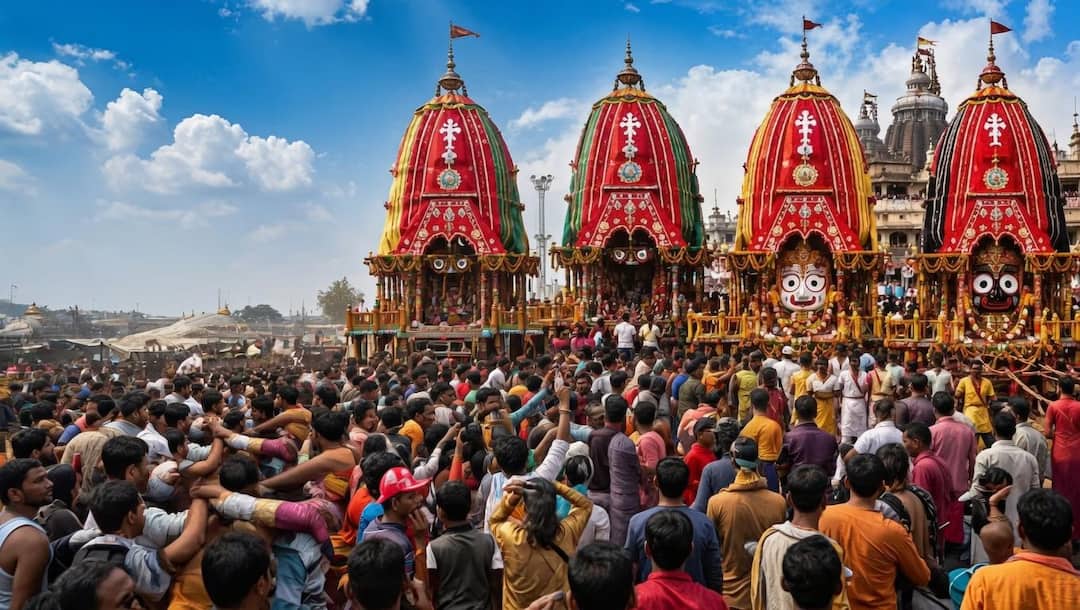
- Offerings include cooked meals, sweets, served six times daily.
Every day, inside the sprawling kitchens of the Shri Jagannath Temple in Puri, Odisha, cooks prepare a massive spread of 56 dishes for the Lord. Six times a day, this food is offered to Mahaprabhu and the moment it is placed before Vimala Devi and offered with Tulsi leaves, it transforms into something far more sacred than a meal. It becomes what lakhs of devotees travel miles to receive: the “Abaadha Mahaprasad.” But most people never stop to ask why this offering carries that particular name. The answer, rooted in both Sanskrit and an ancient tribal legend, says a great deal about what this temple truly stands for.
Name That Means ‘No Barriers’
The word “Abaadha” comes from the Sanskrit “a-baddha,” meaning that which has no obstacle, no bondage, no restriction. That meaning is lived out every single day at Anand Bazaar, the large food court within the temple complex where this prasad is served. Kings and paupers, Brahmins and those from the lowest rungs of the caste ladder have always eaten from the same vessel here. Even during times when untouchability ran deep in Indian society, the Abaadha knew no such rules.
READ MORE | Horoscope Tomorrow Sunday, June 08, 2026: Astrological Predictions For All Zodiac Signs (Aries To Pisces)
Tribal Legend Behind Prasad
Before Lord Jagannath took his present form in Puri, he was worshipped deep in the forests of Odisha by a tribal Shabara king named Visvavasu, as “Nilmadhava.” Visvavasu’s offerings were simple, roots, wild grains, no elaborate rituals, no strict Vedic codes.
When King Indradyumna built the great temple at Puri, the Lord is said to have appeared in his dream with a clear instruction: even though royal worship would now follow Vedic tradition, the first right over the temple kitchen would always belong to the descendants of Visvavasu. And the food would always be cooked and shared in the spirit of that original tribal simplicity, without discrimination. In honour of that divine command, the prasad was named Abaadha.
READ MORE | ABP Live Astro Analysis | These Everyday Signs May Point To Weak Planetary Influence
What Makes Up Chhappan Bhog
The 56 dishes fall into two broad categories. Shankhudi Bhog covers cooked main course dishes prepared in earthen pots, including Kanika (sweet yellow rice with ghee and jaggery), Dalma (toor dal with seasonal vegetables), and Khichdi cooked with pure ghee. None of these dishes use onion or garlic. Nishankhudi Bhog covers dry sweets, pithas and baked items. Khaja, layers of flour fried in ghee and soaked in sugar syrup, is the most popular dry prasad carried home by pilgrims. The six rounds of offering follow a fixed schedule, beginning with Gopal Vallabh Bhog at 8:30 am and ending with Bada Singhara Bhog at 11 pm.
Once the food passes before Vimala Devi, a Shaktipeeth inside the temple premises, it becomes tantrically sanctified and officially takes the form of Abaadha Mahaprasad. At Anand Bazaar, thousands sit on the ground every day to receive it, in the same spirit it has been offered for centuries.
Disclaimer: The information provided here is based solely on beliefs and general knowledge. It is important to note that ABPLive.com does not confirm or endorse any of the beliefs or information mentioned. Before acting on any information or belief, please consult the relevant expert.
Before You Go
Breaking News: US Naval Blockade Challenged as Multiple Ships Exit Iranian Ports Amid Hormuz Tensions
Disclaimer : This story is auto aggregated by a computer programme and has not been created or edited by DOWNTHENEWS. Publisher: news.abplive.com