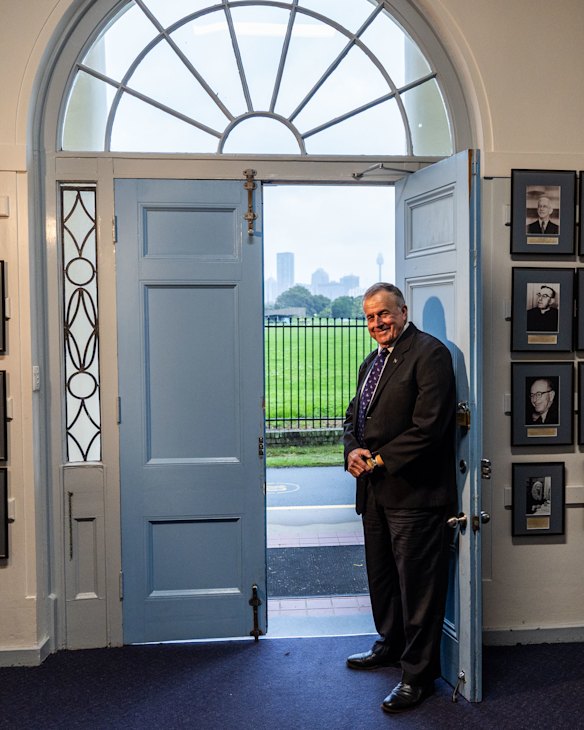
When parents come for the tour of Sydney Boys High School, principal Dr Kim Jaggar knows they can be categorised into a couple of groups. Some will look at the facilities, perhaps thinking they’re not as good as those at Shore or Sydney Grammar. “Which they aren’t,” says Jaggar.
But he’s noticed the smarter parents like to prod at other aspects of the school. “What they really do is want to talk to kids on an open day.” Their goal? To figure out the style of student the school produces.
Sydney Boys High School, or High as it is known, is in the middle of Moore Park but it is also in the centre of a bigger social Venn diagram, positioned between the wealthiest private and the most academically prestigious public selective schools in Sydney.
That’s because since 1906, it has been part of the elite Athletic Association of Greater Public Schools. Unlike other elite members, it does not charge in excess of $50,000 in fees. Instead, students must sit the public school selective test to gain admission.
It asks families to pay a voluntary contribution of about $3000 each year to run the extensive extracurricular program including 15 sports, ranging from rifle shooting to sailing, rugby, tennis and rowing.
“I say, if you don’t like sports, it’s probably not the place for you,” Jaggar says.
When the Herald visits, the front hallway of the school’s main building is lined with blue carpet and display cases filled with trophies, medals and sporting caps. Alumni include former Prime Minister Scott Morrison and Commonwealth Bank chief executive Matt Comyn. Convicted killer Chris Dawson is also a former student.
While the selective nature of the school means students focus on academics, Jaggar says sport is part of its DNA. He says fit boys perform better. And sport is also particularly valuable for students who spend hours after school in tutoring centres and who missed out on socialisation during their primary school years of the pandemic.
“A lot of the kids I’ve talked to have never seen the sea,” Jaggar says. “They know a lot about coaching colleges in Hurstville.”
He sees no point in offering individual sports, such as golf, because they do not offer the shared experience of winning and losing with a team. Playing in a team boosts communication skills. For smart children for whom academics come easily, it is character building to play sports in which they will encounter obstacles they must overcome. Students learn goal-setting, self-discipline and suffering for a cause greater than themselves, he says.
Sport is also a respite from academic concentration in which the “brain switches off and just goes into automatic mode to play a backhand or to pass a rugby ball”. Providing sporting opportunities usually found in private schools takes a Herculean effort with parents raising about $5 million every year. None of the money comes from the NSW government.
“The boys need a few things different to girls,” he says. “They need heaps of structure because they’re disorganised. They need to be tired every day. Tired, so they can be house-broken, so you can send them home tired and not jumping everywhere, so they can do their homework and come back the next day.”
Coaching colleges, where some students learn the mathematics curriculum in advance, creates its own problems, he says, leading to students who don’t concentrate in class and giving students “an arrogance that comes with pre-knowledge”. Plus, there’s the time lost to tutoring.
“It’s like having a second job, you work all week, you do your 40 hours a week, and then you go for another job for 10 hours.”
Jaggar himself cites studies which say external coaching does not significantly move the needle when it comes to academic performance. And he knows of plenty of students who were brilliant in primary school and stopped trying when they got to secondary school.
“The selective test does not measure the things that matter. The things that matter are: are you organised? Are you autonomous, self-disciplined? Are you conscientious? Are you going to do the work?”
‘We’ve got a new English head teacher, and he’s made a difference already.’Kim Jaggar, Sydney Boys High principal
“We have a terrific amount of kids here, [who are] just brilliant, but they just won’t do a lick of work. They didn’t have to do it in primary school, they’re not doing it now.”
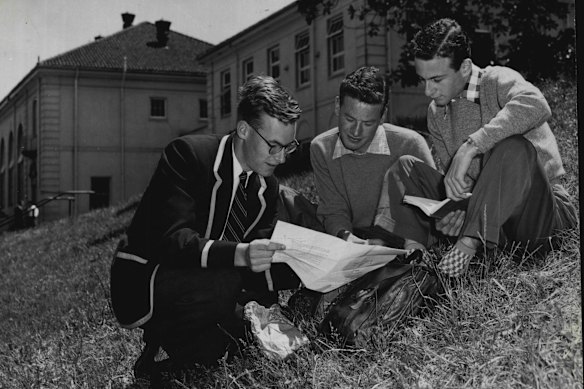
Sydney Boys was established in 1883 to send students to Sydney University. The school still offers Latin and classical Greek, which Jaggar says is “ruinously expensive” to run because classes can have as few as a couple of students. Students still do it because they wish to keep the school tradition alive.
Jaggar arrived at the school 25 years ago from Sefton High in Sydney’s west, which was one of the first partially selective schools in the state.
Selective schools have been a political football for decades. Rather than open more entirely selective schools, successive state governments opted to open selective streams.
“My personal view is the expansion has got nothing to do with pedagogy, it’s got to do with politics, and you keep on increasing the number of selective places to give the impression that public schools are looking after kids in all the suburbs,” he said.
Jaggar says partially selective, or bimodal schools, have their own challenges. The selective parents would financially contribute more but were more demanding than community parents. Meanwhile, staffing numbers made it difficult to offer elective subjects which appealed to both groups of students.
“It’s quite difficult to keep up the facade that there’s no difference between selective students or community students,” he said.
In 1996, 15,000 students sat for the entrance test. Three decades later, there were about 18,000, a 20 per cent increase. In that time, the NSW population has increased more than 40 per cent. Jaggar says the imbalance is because more students are opting for private schools, especially in the eastern suburbs.
Students come from 140 postcodes across the city to get to Sydney Boys. Jaggar has previously lobbied for schools like his to have a local intake.
On top of the selective system, the government revealed its flagship Inspire program for gifted and “high potential” students. There’s been money set aside for some science labs upgrades at a handful of schools and staff professional development. Schools themselves have not been given extra funding to run gifted programs.
Jaggar is sceptical.
“When you say people are high potential, what does that mean? It just means we want to do something for you. It doesn’t mean statistically that you are gifted,” he says.
It could be easy for Sydney Boys to lean on its long history, sporting program, its classical languages offering and stellar results in HSC subjects such as mathematics. But Jaggar is clear eyed that while parents are happy to contribute, there is a transactional element. And he’s aware that the weak spot is English.
“English can do it to you every time. English teachers talk a lot, and they also, they’re like herding cats. Trying to get them to do the same thing consistently is quite difficult,” he says.
As a former English teacher, Jaggar is perhaps in a unique position to criticise. He knows as principal that if English goes well, the school performs well. He hopes a recently installed head of English will soon lift results.
“We’ve got a new English head teacher, and he’s made a difference already. But it’s trying to get English teachers to care about competition and results,” he says.
“They want to develop the person. You know, like, come on. Parents are here so that you go to uni, they don’t want to know if you’re cultured, and you know about Shakespeare [or] can recite William Blake’s poetry.
“We have to be utilitarian about it. We have to do what it is the parents are paying the money for. They want us to send the kids to uni because that’s what we do.”
At the age of 78, and after leading High for a quarter of a century, Jagger knows his time at the school won’t continue forever.
“It’s been fun. You know why? Beautiful kids, beautiful parents. These kids are so smart, and the parents are so smart too.”
Start the day with a summary of the day’s most important and interesting stories, analysis and insights. Sign up for our Morning Edition newsletter.
Disclaimer : This story is auto aggregated by a computer programme and has not been created or edited by DOWNTHENEWS. Publisher: www.smh.com.au