As a kid I had a lot of trouble sleeping. My only coping mechanism was to give up trying and read. These were ancient times; we didn’t have the internet then, and I’d have got in trouble for turning on the (cathode ray) TV. My mum was substitute-teaching English and one of her schoolbooks was “Lord of the Flies.” It had a great name, it was bright orange and it had a pig’s head on the front. I started reading it at about 2 in the morning and I remember every sensation of it.
I think all of us in the art space have a moment when we feel suddenly seen. For me there were two characters growing up who made me go, to some degree, “That’s me.” One was Elliott from “E.T.” The other was Simon from “Lord of the Flies.” Kids who linger at the back of groups, desperate to join in, who yearn for understanding but perhaps don’t have the tools to elicit understanding, who spend as long staring into space as they do speaking. I remember pulling through the pages of the book going, “This is me, I understand the cruelty others are showing him, I understand his need for both distance and warmth.”
Then Simon was killed. In fact, when I was first reading it, I wasn’t sure whether Simon was killed. Because Golding’s account of his death was so deliberately confounding, I wasn’t sure what happened. Then Golding wrote, “Softly, surrounded by a fringe of inquisitive bright creatures, itself a silver shape beneath the steadfast constellations, Simon’s dead body moved out towards the open sea.” And my heart was pulled clear from my body. My Simon, and he felt like mine, was gone.
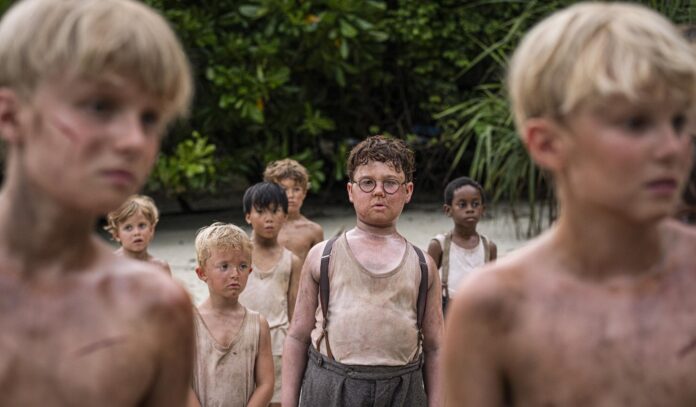
A group of boys find themselves stranded on a tropical island in Thorne’s adaptation of William Golding’s “Lord of the Flies.”
(J Redza / Eleven / Sony Pictures Television)
I love television, I love writing and adapting for television. But with adaptation the crucial question always is, What’s television got to give something? What has the medium got to give, with its vocabulary? The thing that I felt television had to give “Lord of the Flies” was simple. It was chapters. That’s what TV can do that film can’t, that theater can’t. It can make decisions on how to use its chapter structure.
And here’s the other thing about “Lord of the Flies.” I didn’t just read it when I was 11, I went back to it when I was in my teens, in my 20s, then twice again in my 30s. And each time I took something different from it. In my 20s I realized that Simon was both smarter and kinder than me (the 20s were an acute period of self-hatred); in my 30s I realized that I finally understood Jack. Jack, a kid I’d hated, a kid that I considered a psychopath. I grew up to see the tenderness with which Golding wrote Jack, and started to see him tenderly myself.

Thorne at home in London.
(Hannah Cosgrove / For The Times)
In pitching to the estate, including crucially William’s daughter Judy, we talked about how our chapter structure could help us. By giving an episode to each of our lead four characters, we could use their view of the island to make sure the complexity of Golding’s telling shined. I described it as a relay race: We start with democracy and Piggy, then comes cracking of civility and Jack, then chaos with Simon, and finally war with Ralph. It suited the structure of the book — the key incidents fitted perfectly — but I hope more than that it allowed us to care about the boys. To be taken into their struggle. Understand Jack and you might be able to understand what happens on the island. You may be able to see the seeds of its destruction.
Ask anyone what “Lord of the Flies” is about and you’ll get a passionate response. There are those who think it’s about man in a state of nature, what we are capable of when society is made primal around us. There are those who claim it’s specifically about British boys in the 1950s, and those who claim it’s about all men. For me, I choose the specific. With “Adolescence” we told a story about a small family in a Northern town and the whole world leaned in. By seeing the specific we see ourselves. I see myself in “Squid Game,” just as I see myself in “Running Point.” Jack, Ralph, Simon and Piggy are products of their time. They have been socialized in the war, they are children brought up in division and hate. They only reflect the now because we give them that precision.
“Lord of the Flies” was a glorious show to make. We got so lucky with such an extraordinary cast, and Marc Munden is an exceptional director. We were honored to be able to bring Golding’s story to the TV screen. I hope we leaned into his complexity and our show makes you return to his incredible book.
More to Read
Disclaimer : This story is auto aggregated by a computer programme and has not been created or edited by DOWNTHENEWS. Publisher: latimes.com