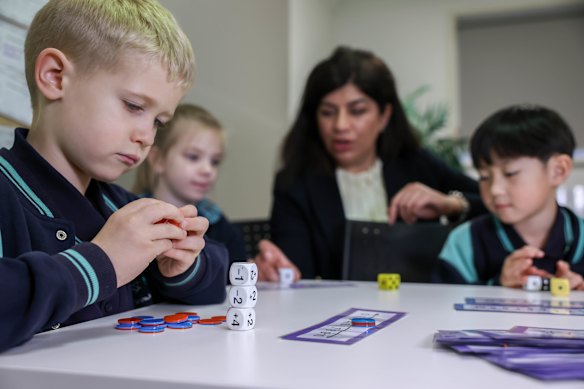
More than 400 Victorian primary schools will roll out a new year 1 numeracy checks next term as the state expands its screening programs designed to identify students at risk of falling behind in maths.
The rollout will coincide with the first year 2 reassessment of children who did not reach the benchmark in last year’s phonics check, giving schools new data on students who may need extra help with literacy and numeracy.
The year 1 numeracy check, which will become mandatory in all public primary schools from next year, is being piloted and will help assesses what experts describe as a child’s “number sense”.
But some principals will wait until it is mandated, claiming the check is a strain on resources given they already implement several other tests.
The evidence-based numeracy check is aligned with Victoria’s revised curriculum. It tests how a child orders, compares or recognises a collection of numbers, rather than only their counting or calculation skills.
It will complement a phonics screening check introduced for year 1 students last year, which is now being followed by a year 2 check for students who did not meet the benchmark.
A Grattan Institute analysis published last year found one in three school students failed to achieve proficiency in maths, and that in Victoria and the ACT, nearly 30 per cent of students were not proficient in NAPLAN numeracy.
Kelly Norris, manager of early numeracy research at the Centre for Independent Studies, said the checks were a “strong first step”.
“However, identifying children at risk is not enough on its own. It’s what we do next that really makes the difference – whether that identification leads to timely and effective support for those children,” she said.
Norris said there was a problem with maths proficiency in Australian schools.
“Victoria does perform relatively well compared with many other Australian states and territories, but Australia’s overall performance in international assessments has declined over the longer term,” she said.
She said early identification and intervention was important.
“The goal is not just to find students who are struggling, but to provide support early enough to prevent small gaps in number sense from becoming entrenched achievement gaps later on,” she said.
Norris said numeracy checks had the potential to be less time intensive than assessments used in the past, but individual administration was still a costly choice.
“The goal with a numeracy check, ideally, is to get the most useful information in the least practical time,” she said. “It will be interesting to see how well the Victorian year 1 numeracy check achieves that goal.”
Students at Maramba Primary School were among the first in the state to do the numeracy check last month.
In the past three years, the school stopped doing voluntary online interviews with students for maths and English, meaning there was no standardised check to ensure they were meeting state or national expectations until year 3 NAPLAN.
Principal Moniba Ehsan said the numeracy check, along with last year’s phonics check, had helped identify students who could benefit from extra support from staff throughout the year.
Each check has identified about 10 students from a cohort of 30 who could benefit from varying levels of extra support, while also identifying a handful of high-achieving students.
“The teachers noticed some of the questions the kids were having difficulty with, so they’ve incorporated that in their daily [revision exercises],” Ehsan said of the numeracy test.
“We noticed there were some things that the teachers assumed that the kids knew and understood, but when it was phrased in a particular way, the kids were baffled.”
The school’s NAPLAN results are tracking close to average when compared with schools of similar backgrounds. The national testing highlighted reading in year 3 as an area for the school to work on.
“We’re expecting by the time they get to year 3 and 6 our NAPLAN results should be better. It should reflect all these checks and balances that are in place in foundation, then year 1 and year 2,” Ehsan said.
However, schools that already rely on other assessments have delayed the introduction of the numeracy check as they believe it could strain resources.
Brandon Park Primary School principal Kate Buck said the check, which is one-on-one and takes about 15 minutes per child, would mean the school would need to employ casual relief teachers for six days to test their year 1 students.
“When you look at it business-wise, you’re talking about money as well … I’m sure that the department will say they’ll cover CRT costs, but is that a valuable way to spend money with those kinds of other assessments that you could use to get the same data?” she said.
She said the numeracy check would give a comparison across Victorian schools, but said her school already used PAT maths testing and assessments via Acadience math. These tests, she said, were quick and used as universal screening tools.
“They show us what we need, so we didn’t really see a need for numeracy screening,” Buck said.
For schools that weren’t already doing assessments, she said, the new numeracy check would be beneficial. Testing, she said, had made a huge impact on their teaching.
“Maybe it’s a starting point for other schools,” she said.
The school is doing the year 2 phonics reassessment, which involved only a few students who either didn’t do the previous test or didn’t pass. “It really doesn’t take very long to administer per child,” Buck said.
Education Minister Ben Carroll said the state government had mandated the checks to give every child the best chance of success.
“The evidence shows that explicit teaching and systematic synthetic phonics instruction gets results — and we’re backing those results with real investment.”
Start the day with a summary of the day’s most important and interesting stories, analysis and insights. Sign up for our Morning Edition newsletter.
 Nicole Precel is an education reporter at The Age. She was previously an audio video producer. She is also a documentary maker. Get in touch at nicole.precel@theage.com.auConnect via X, Facebook or email.
 Jackson Graham is an education reporter at The Age. He was previously an explainer reporter.Connect via email.
From our partners
Disclaimer : This story is auto aggregated by a computer programme and has not been created or edited by DOWNTHENEWS. Publisher: www.smh.com.au