Donald Trump “loves” inflation. Most American households would probably beg, loudly, to differ.
Trump’s response to the highest US inflation number in more than three years was bizarre and his rationale, at best, premature.
After the release of the latest inflation data for the world’s largest economy, which showed the US Consumer Price Index rising at an annual rate of 4.2 per cent in May, up from 3.8 per cent in April, Trump was asked whether he was concerned.
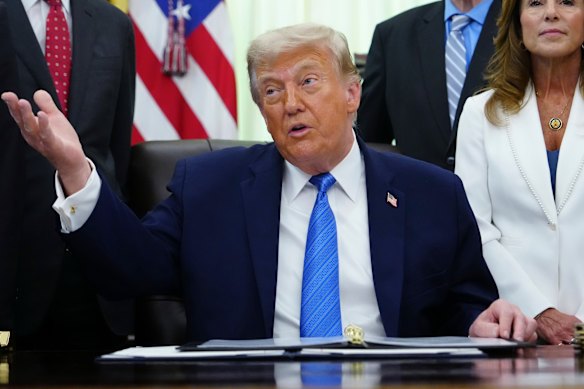
“No, I love it,” he said. “The numbers were great. You know what I really love? I love the inflation. You know why? Because as soon as this war (the war in the Middle East) is over …”
He went on to say that the US had been taking “millions of barrels of oil” through the Strait of Hormuz and “that’s why oil is at $US85 a barrel.” (It’s actually at $US93 a barrel).
“I love the inflation numbers because of what I’m talking about,” he later told The New York Post, saying his earlier comments had been taken out of context.
‘The numbers were great. You know what I really love? I love the inflation.’
Donald Trump
“The numbers are going to be phenomenal because what’s showing is that, despite the fact that we’re in a war, the numbers are much lower than anticipated and, when we’re out of the war, the numbers will be at lower numbers than they were even before it started.”
In January, the month before Trump launched the attack on Iran, the inflation rate was 2.4 per cent and oil was trading below $US70 a barrel.
In a post on Truth Social, Trump wrote that the “wildly successful” passage of commercial ships through the Strait of Hormuz was because the US, not Iran, controlled the strait.
“Their military is defeated, and their economy is lost. It’s over for Iran,” he posted.
At last count, he has declared the war won nearly 40 times – yet, in the middle of a supposed ceasefire, none of the US, Israel or Iran have ceased firing.
Traffic through the strait is, despite Trump’s claim that the US had shepherded 22 ships through the passage “the other night,” a long way short of the average of 138 vessels that used to pass through it every day before the war, carrying about 20 per cent of the world’s oil supply.
So far, the full impact of the war on oil prices has been blunted by the release of up to 400 million barrels of oil held within strategic reserves, including America’s, and by oil that was already at sea before the conflict.
Those reserves are depleting – the US strategic reserve is back to levels last seen in 1983, when it was still being built up – and therefore the capacity to keep some sort of lid on prices hinges on the war ending and the strait fully reopening before they are exhausted.
Like the war in the Middle East, so much damage has been done by the Trump administration’s policies for so little, if any, gain.
Oil industry executives have said the price could jump to $US150 a barrel or more within weeks if the war drags on and that, when the war does end, it could take a year for global supply chains to normalise.
Contrary to what Trump said, the inflation numbers weren’t great or better than expected – they were in line with expectations, although they could have been worse.
The majority of the increase in inflation –more than 60 per cent – is being driven by the war in the Middle East, which has forced US gasoline prices up from an average of $US2.93 a gallon to $US3.64 a gallon today, and diesel prices up from $US3.52 a gallon to $US5.30 a gallon.
Core inflation, which excludes energy and food prices, rose 0.2 per cent from April and is running at 2.9 per cent, which might suggest that inflation outside those segments isn’t as rampant.
More subdued price rises, and even some falls, in food, housing, clothing and consumer goods could also suggest that the price rises from Trump’s tariffs have now been passed through and that, perhaps more significantly, the war’s impact on fuel prices hasn’t bled into supply chains and the wider economy.
The US Supreme Court’s striking down of Trump’s “Liberation Day” tariffs might have moderated the pass-through of tariff-related price increases (although he’s recently announced their replacements) and it is almost inevitable, if the war drags on, that the elevated energy costs will start to seep into industries’ transport costs and into end-prices for consumers.
In the meantime, the inflation that Trump loves is eroding most Americans’ standards of living.
Real wages shrank 0.7 per cent in May, on a year-on-year basis, accelerating from the 0.3 per cent rate of decline experienced in April. Eighteen months of wage gains have evaporated in the biggest fall in real average hourly earnings in three-and-a-half years.
Trump can brag as much as he likes about his “successes” in the war and that the big spikes in oil and gasoline prices are less than they might have been, but US households are being squeezed ever harder by the war and his tariffs.
Trump, of course, has always pointed to the sharemarket as a barometer of his success.
Wall Street’s S&P 500 fell 1.6 per cent overnight in response to the CPI data and Trump’s threat of even more strikes on Iran. The technology-oriented Nasdaq index was down 2 per cent.
Since it reached its most recent record on June 2, the US sharemarket has fallen 4.5 per cent as the war has meandered on and doubts about the sustainability of the hype-inflated valuations of the companies developing artificial intelligence have crept in.
The latest inflation data isn’t going to shift the Fed. It doesn’t provide the evidence of slowing inflation that new chairman Kevin Warsh would need to deliver the rate cuts Trump, who appointed him, wants.
The disparity between headline and core inflation, however, will provide pause for thought at next week’s Fed rate-setting meeting for those who might want to head off the threat of higher inflation with an early rate rise.
There was no expectation in financial markets that there would be any change to the Fed’s policy rate next week, so the data essentially changes nothing at this point, although markets – self-evidently less optimistic than Trump – responded to the inflation data by continuing to price in at least one rate rise before the end of the year.
The run-down in America’s oil reserves may have helped reduce the increase in the inflation rate, compared to what it might have been. It has also helped out in another of Trump’s less-than-successful wars.
US trade data this week showed the trade deficit in April was more or less stable, down 1.2 per cent from March at $US55.9 billion. A $US6.4 billion increase in oil exports more than offset the AI-related $US2.2 billion increase in computer imports and a $US1.7 billion rise in semiconductor imports.
Without the war-driven record level of oil exports, that deficit would have increased materially and been beyond the $US72 billion monthly average trade deficit of Joe Biden’s term. To date, during Trump’s second stint at the presidency, the average deficit (there are seasonal influences on the monthly numbers) has been about $US70 billion.
After all those tariffs from Trump’s trade war on everyone, justified by his administration’s claiming of unfair trade – America’s trading partners were ripping it off! – there has been no meaningful change in the deficit.
Like the war in the Middle East, so much damage has been done by the Trump administration’s policies – to America and Americans as well as their perceived foes – for so little, if any, gain.
The Market Recap newsletter is a wrap of the day’s trading. Get it each weekday afternoon.
 Stephen Bartholomeusz is one of Australia’s most respected business journalists. He was most recently co-founder and associate editor of the Business Spectator website and an associate editor and senior columnist at The Australian.Connect via email.
From our partners
Disclaimer : This story is auto aggregated by a computer programme and has not been created or edited by DOWNTHENEWS. Publisher: www.smh.com.au