
Good morning. Who is safe on Britain’s streets? Two acts of gross violence – the murder of Henry Nowak in Southampton and the stabbing of Stephen Ogilvie in Belfast – have been ruthlessly exploited by the far-right and now the spaces we all share are contested.
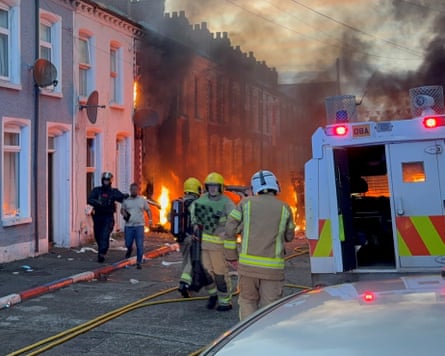
It is an entirely human response to feel unsafe when we watch a clip of an assailant wielding a knife over his victim, or police officers handcuffing a distressed, dying young man. Much as it is when we see ethnic minority families fleeing burning homes in Belfast, or a menacing crowd in Glasgow setting about black people as they pass.
Tensions have escalated sharply, but how safe people feel wearing a hijab or a kippah, holding hands with a same-sex partner or driving a wheelchair, has been eroding for years.
Today, I speak to our community affairs correspondent, and erstwhile First Edition writer, Aamna Mohdin about how the mood at street level has changed for visible minorities, and set out some very practical steps for what we can all do to make our shared spaces safer. First the headlines.
Five big stories
-
Middle East | The US launched new strikes against targets in Iran for the second consecutive day after Donald Trump promised to “hit them hard again” as a two-month-old ceasefire appears close to collapse.
-
UK politics | Keir Starmer’s closest aides are “war-gaming” how to win a leadership contest ahead of Andy Burnham’s much-anticipated return to Westminster if he wins the Makerfield byelection, the Guardian understands.
-
Belfast | Elon Musk’s X will face no action to remove a mass of posts inciting violence in Northern Ireland for at least two months, despite widespread condemnation of the platform and its billionaire owner.
-
Environment | Temperatures in the Antarctic climbed above 15C this month, shattering the previous winter heat record for the usually frozen region and raising concerns about the speed of climate breakdown.
-
UK news | One of the government’s key contractors has launched an investigation into allegations of racism, antisemitism, Islamophobia and hate speech among staff working in immigration removal centres, the Guardian has learned.
In depth: ‘Hostility has become increasingly normalised and we’re seeing the consequences’
On Monday evening, Stephen Ogilvie was stabbed on a Belfast street. Sudanese asylum seeker Hadi Alodid has been charged with his attempted murder. Horrific footage of the bloodied attacker straddling his victim circulated on social media, and was seized on by far-right agitators, who escalated local shock and exhorted people on to the streets.
On Tuesday evening, some did, and their protest erupted into violence, as masked crowds blocked roads and burned vehicles, houses and shops. Families were forced to flee their homes. And on Wednesday, police used water cannon to disperse a crowd of about 300 people who burned a truck and reportedly planned to target a nearby hotel that was believed to host migrants.
Yesterday, Ogilvie’s family stated: “We do not want this terrible tragedy to be used to divide people or fuel hostility.” Their plea was strikingly similar to that of the father of Henry Nowak, who was murdered by Vickrum Digwa, a British Sikh, last December. Both calls were ignored as Reform politicians, Rupert Lowe, and far-right actors including Elon Musk and Tommy Robinson, co-opted these dreadful losses for their own cynical ends.
Aamna and I started discussing this last month, while working on a story about how minority communities were braced for a surge in racism following Reform’s historic election success.
Four weeks later, it’s clear that the fear has intensified. “But many Black, Muslim, Jewish, LGBTQ+ and disabled groups describe this worsening atmosphere that stretches back years, not weeks,” Aamna tells me. “It feels a very hostile time.”
For her, the starting point was Brexit, in particular the language and intention of the Leave campaign in the run-up to the 2016 referendum. “There was a shift in the way politicians and the media talked about these communities,” she says. “This hostility has become increasingly normalised in mainstream discourse and we’re seeing the consequences at street level.”
Political rhetoric doesn’t stay in Westminster. “It filters into conversations that people are having at work, on buses, in schools,” she says, “and it explodes in the race riots we saw in the summer of 2024 and now on the streets of Belfast.”
While Home Office data indicates a long-term decline in violent crime, hate crimes have increased steeply in recent years; racially and religiously motivated offences in particular.
And crime is now often seen through a racialised lens, “so if a person of colour commits a crime an entire community is held in collective punishment” – as British Sikh and Sudanese communities have described to our reporters.
What’s the reality at street level for visible minorities?
While reports of physical assaults and attacks on places of worship are now shockingly familiar, some of this on-street hate takes more insidious forms: dirty looks, muttered comments, shouted slurs, vocally discussing how a person might have arrived in the UK or whether they’re entitled to a disabled parking space. “Muslim women, particularly hijabi-wearing women, often take the brunt of this,” says Aamna.
Incremental attacks affect people’s daily decision-making. “They don’t go to certain streets,” Aamna tells me. “They don’t go to certain public facilities. They will do a lot more research before meeting up with friends.”
“Parents are increasingly thinking about how their children experience public space,” she adds. Youngsters are missing out on normal rites of passage like travelling home from school unaccompanied. “I spoke to one rabbi who won’t allow her children to wear any shirts with Hebrew lettering because of the danger she feels that it might put them in.”
Who is pushing division?
Aamna references Glenn Gibbins, a newly elected – and now suspended – Reform councillor who complained in a 2024 social media post about “the amount of Nigerians in town”, suggesting: “Should melt them all down and fill in the pot holes!!” He has since apologised.
“When Richard Tice, Reform’s deputy leader, was asked about this, he not only refused to condemn it,” says Aamna, “he then turned towards his supposed support for the Jewish community as protection.” (Tice labelled the allegations sneering and smearing.)
“What’s worrying me about the rise of Reform and other far-right parties is that we’re increasingly seeing a divide-and-rule approach to race and identity. Certain minority communities are told they matter. Others are treated as suspect. Some groups are encouraged to see themselves as victims of multiculturalism, while others are portrayed as a threat to it.”
The result, says Aamna “is that minority communities are encouraged to fear and distrust one another … it doesn’t only make life harder and less safe for everyone, it weakens the possibility of collective action.”
“The most successful anti-racism movements in British history have been based on broad coalitions, bringing together people of different races, faiths, and backgrounds . If we allow ourselves to be divided into competing grievances, this becomes harder to achieve.”
Keeping each other safe
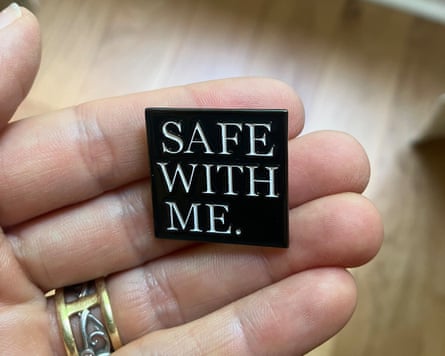
I’ve been down at the Guardian’s London headquarters this week, and this badge I wear prompted a few conversations. It says “safe with me” – a campaign by the Glasgow-based charity Refuweegee that asks friendly local cafes, shops and individuals to identify themselves. Maybe it’s the kind of virtue-signalling you’d expect from this white, middle class correspondent but for me, living in a city where asylum seekers were targeted in the run-up to the Scottish parliament elections, it represents a commitment I’ve made: if I see someone being hassled or harassed, I’ll do my best to make them comfortable, or a wee bit safer.
After crowds of black-clad young lads streamed through Glasgow on Tuesday evening, injuring three people of colour, I checked in with Selina Hales, who runs Refuweegee. On an individual level, she says, being a helpful bystander is sometimes as simple as being present. “No words need to be exchanged. It’s that you’re standing alongside that person.”
As for the businesses now displaying the poster: “It’s not about direct confrontation, it’s about holding a safe space and loudly and proudly announcing our solidarity.”
Her advice is based on classic bystander intervention developed to counter playground bullying in the 1990s, built around three actions: direct (ask the person engaging in harmful behaviour to stop), delegate (if that’s not safe, find someone whose job it is to help,) or distract (ask for directions, change the subject, remind the aggressor that they’re in public and being observed).
A similar Transport for London campaign suggests straightforward ways to interrupt harassment without putting yourself in danger, by connecting with the victim, like asking if you recognise them from a recent sports game or complimenting their trainers.
And if you don’t feel able to intervene in a direct way, even checking in with someone in the aftermath of an incident can help: “These small acts of solidarity matter,” says Aamna, “because this level of hostility really thrives when people feel isolated.”
Incredible things happen when different communities work together – like when trade unions stepped in to replace funding cut by Reform for this year’s Durham Pride, and train drivers marched together with drag queens.
Watching the violence unfold on the streets of my city, and elsewhere, it’s easy to feel helpless. But I’m not. We’re not. As Aamna says so beautifully: “All of us can shape the atmosphere around us.”
What else we’ve been reading
-
Sammy Gecsoyler has spoken to some of the 82,000 under-25s who have been unemployed for more than a year in the UK about how it is affecting their lives. Patrick
-
Martin Belam makes sense of where the Dr Who franchise might go next and why the BBC doesn’t quite know how to make it work for the 21st century. Libby
-
Our Latin America correspondent Tom Phillips has been in Caracas writing about how former Venezuelan dictator Nicolás Maduro is being erased from public life. Patrick
-
Ben Quinn’s analysis of how far-right agitators use online “trigger events” to mobilise off-line disorder is essential reading. Libby
-
We are almost halfway through the year, and the culture desk has put together this list of the best films of 2026 so far. Patrick
World Cup 2026
On the pitch
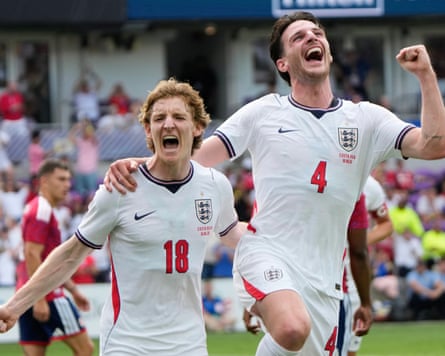
England warmup triumph | Thomas Tuchel’s side finished their final pre-tournament prep with a warm-up game against Costa Rica. The 3-0 win, thanks to Declan Rice’s strike, Anthony Gordon’s penalty and a late third from Ollie Watkins, sets up the England team nicely ahead of their first group stage match against Croatia on Wednesday.
Portugal prepped | Cristiano Ronaldo is preparing for what must surely be his final World Cup. The 41-year-old is the second oldest player at the tournament, and his nation Portugal are tipped to go far in the competition. Last night, their 2-1 win against Nigeria saw goals from Pedro Neto and Francisco Conceicao.
Field festivities | Tonight, Mexico City’s Azteca stadium hosts the first of three opening ceremonies, likely to feature Bad Bunny and Shakira, at 18:30 BST. The Canadians hold theirs tomorrow at 18:30 BST, and the Americans at 12:30 BST ahead of their respective opening matches.
Off the pitch
USA | Ahead of the co-hosts first game against Paraguay, Sid Lowe sat down with head US coach Mauricio Pochettino. They discuss his strange path to managing the US – and how far the former Tottenham manager can take them in the competition.
Predictions | Who will be the breakthrough star of the tournament? Who is going to win it all? The Guardian’s sports writers have made their final predictions.
Fifa | Gianni Infantino told football fans to “chill and relax” on the eve of the World Cup, while Fifa faced criticism from the United Nations over the immigration issues that have overshadowed the buildup to the tournament.
Today’s Fixtures
Mexico v South Africa, 20:00 BST, Mexico City
South Korea v Czechia, 03:00 BST Friday, Guadalajara
The front pages
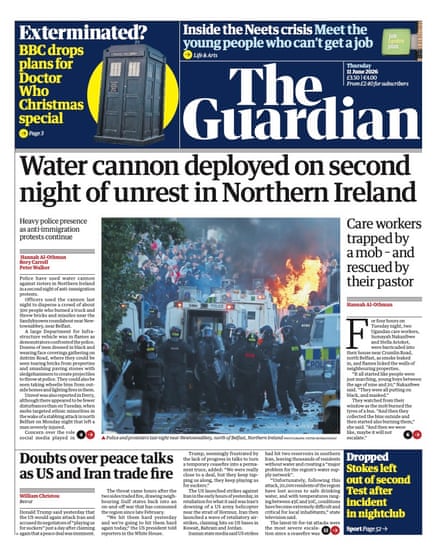
“Water cannon deployed on second night of unrest in Northern Ireland”, is the Guardian’s front page today, while Metro says “Burning hatred no way to bring Stephen justice”. The Telegraph writes “Smugglers guarantee UK entry via Ireland” and the Times says “Single migrant sent back after crossing Irish border”.
Elsewhere, the Mail leads with “Phone ‘kill switch’ to end trade in stolen mobiles”, the FT has “ECB reined in Revolut’s European arm over rapid pace of product innovation”. The i Paper has “Pictured: Russian drone tech boss at Disneyland”.
On the World Cup, the Sun features a “Dear England” letter and the Mirror says “Yes we Kansas”.
Today in Focus: The Latest
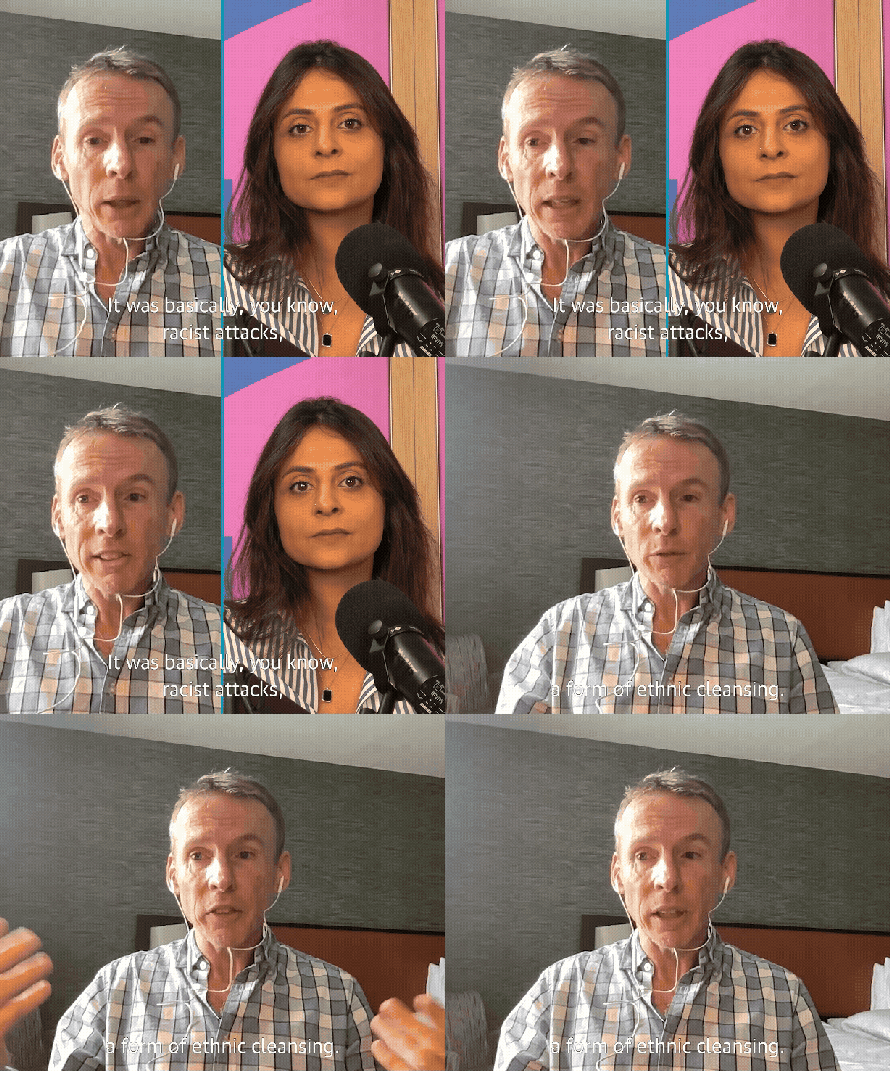
Belfast protests: masked men, torched cars and violent unrest
Violence erupted in Northern Ireland this week in response to a stabbing attack in Belfast that was captured in a graphic video. Crowds, including masked men, burned vehicles and houses, hours after Elon Musk, Tommy Robinson and other agitators encouraged people to take to the streets. To explain more, Nosheen Iqbal speaks to Ireland correspondent Rory Carroll – watch the episode on YouTube here.
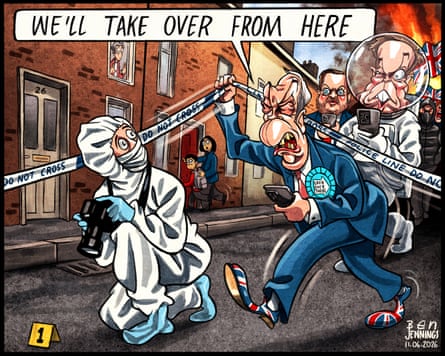
Cartoon of the day | Ben Jennings
The Upside
A bit of good news to remind you that the world’s not all bad
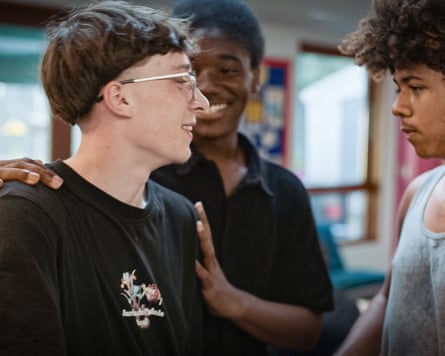
Britain’s young carers are some of the best people in our country. During what is meant to be the most carefree part of their lives, they spend hours every day cleaning, cooking and looking after a loved one, often without a proper break for long periods of time. On average, two children in every school class are carers. The Guardian spent time with some of them in Walthamstow at a community event where they got a rare and well-deserved night off. The resulting film, Is Mum OK?, has been released during Carers Week, a campaign to celebrate unpaid carers across the UK. Watch it on YouTube here.
Sign up here for a weekly roundup of The Upside, sent to you every Sunday
Bored at work?
And finally, the Guardian’s puzzles are here to keep you entertained throughout the day. Until tomorrow.
Disclaimer : This story is auto aggregated by a computer programme and has not been created or edited by DOWNTHENEWS. Publisher: theguardian.com



