
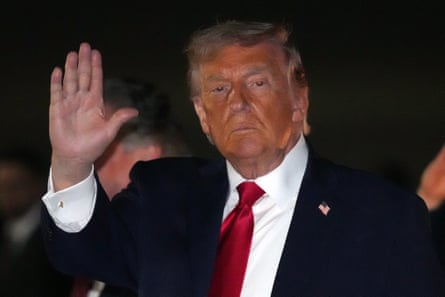
The US launched a new round of airstrikes on Iran into Thursday morning after Donald Trump warned Tehran would “pay the price” for stalled negotiations, prompting Iran to respond with strikes targeting Bahrain, Kuwait and Jordan.
The new US assault across a range of Iranian cities came as efforts to negotiate an end to the war again appeared stuck, with Iran insisting it would maintain its chokehold on the strait of Hormuz. The American attack appeared more intense and wider than the day before, but Iran released no information about what was hit.
Explosions were reported around Iran’s capital, Tehran, as well as the port city of Bandar Abbas and other southern areas along the strait of Hormuz.
Before the strikes, Trump had promised to “hit them hard again” as a two-month-old ceasefire appears close to collapse.
Kuwait closed its airspace because of the Thursday morning attack, without giving details of any damage. Jordan didn’t acknowledge the attack, though the US embassy in Amman warned about it. And Bahrain sounded its missile alert sirens without mentioning possible damage there.
The third back-and-forth strikes this week have tested a shaky two-month ceasefire. The first were attacks between Iran and Israel on Sunday into Monday, followed by the two rounds of fire between the US and Tehran.
The two days of strikes followed the downing of a US Apache helicopter over the strait of Hormuz, which Trump has blamed on Iran.
“The strikes are in response to Iran’s unwarranted and continued aggression,” US Central Command said in a statement.
Trump has accused negotiators in Tehran of “playing us for suckers” – a day after repeating claims that a peace deal was imminent.
“We hit them hard yesterday and we’re going to hit them hard again today,” the US president told reporters at the White House on Wednesday.
Trump added: “We were really close to a deal, but they keep tapping us along, they keep playing us for suckers.”
The president also claimed the US has been taking oil out of Iran: “I’m just announcing today for the first time, but we’ve been taking out millions of barrels of oil, millions of barrels every night.”
Without sharing any other details, he added: “Millions of barrels of oil has come out, and that’s why it’s at $85-$90 a barrel, instead of $250.”
Iranian state media said previous US strikes launched in the early hours of Wednesday had hit two reservoirs in southern Iran, leaving 20,000 residents without water.
Talks to turn the ceasefire into a durable peace have been stalling for weeks, with periodic flare-ups as both sides continued to launch limited strikes and trade blame for violating the truce.
Iran’s foreign ministry spokesperson, Esmail Baqaei, has said the US strikes had jeopardised the ongoing ceasefire negotiations.
According to Fox News, Trump said in a phone interview that he could order new strikes on power plants and bridges because Iran was taking too long to make a deal.
Trump has frequently threatened to resume military action since the ceasefire was established, but has not yet fully followed through.
Regional mediators have been trying to de-escalate tensions. A delegation from Qatar – a key mediator – landed in Tehran on Wednesday to discuss the latest developments, Iranian media reported.
The US military described its initial attacks as a “proportional response” to the downing of the Apache helicopter, saying its two crew members had been rescued.
The US said it had hit Iranian air defences, ground control stations and radar sites. Iran said Qeshm island and the port city of Sirik were attacked, while Iranian media reported explosions in the seaside city of Bandar Abbas.
Two crew members of a tanker were reported missing and another injured after a suspected missile strike by the US military enforcing its blockade of Iran’s shipping routes, according to UK maritime security company Ambrey.
Trump is keen for a peace deal as US midterm elections approach amid rising inflation and plummeting presidential approval ratings. However, significant gaps remain between the two sides.
Iran is seeking the lifting of international sanctions, the unfreezing of billions of dollars in assets, and control over the strait of Hormuz. Trump has said any future peace deal must prevent Iran from developing a nuclear weapon, while Tehran denies that it wants one.
A significant obstacle to a lasting peace deal between Iran and the US has been the fighting between Hezbollah and Israel in Lebanon. Iran has insisted that any ceasefire must include the Lebanese front, while Israel and the US have been eager to separate the two.
Disclaimer : This story is auto aggregated by a computer programme and has not been created or edited by DOWNTHENEWS. Publisher: theguardian.com







