
When the curator of Barbie: The Exhibition landed herself the job in 2024, she asked herself a philosophical question: what is a Barbie doll?
The answer? She’s a cultural icon, according to Danielle Thom, speaking from Glasgow – where the exhibition, which first opened at London’s Design Museum, is now on display before it comes to Melbourne Museum in November.
“The Barbie doll is also something that impacts design,” Thom says. “It designs and shapes the way children play and impacts the design world. Fashion designers and filmmakers have responded to the idea of Barbie through their respective practices.
“I was looking at the doll with these dual design influences, and what came out was a core message: the history of the Barbie doll and the doll’s world – the fashion, houses and accessories: it is a history of mainstream taste in miniature because of that relationship between Barbie and popular culture.”
Thom was asked to curate the exhibition before the release of Greta Gerwig’s Barbie movie in 2023, but having its subject become a cultural phenomenon alongside Christopher Nolan’s Oppenheimer did help generate excitement. One thing she did not account for, however, was how many children would visit the museum for the exhibition, which was designed more for nostalgic adults.
“In the original iteration in London, we created an exhibition for an adult audience – we did market testing that showed that was our market. We realised that despite that research, people were bringing their children. So we had to think on our feet,” Thom said.
“We introduced a trolley full of modern Barbie dolls, and people could borrow a Barbie and bring it to the exhibition and then return it before they left … It’s not just children – adults love to play.”
Melbourne Museum has a history of hosting successful exhibitions about children’s toys and entertainment.
In 2022, the museum held an exhibition displaying over a million Lego bricks and another in 2018 dedicated to the story of Myer’s Christmas windows. One of Melbourne Museum’s highest-attended exhibitions of recent years was inspired by a movie: the Jurassic World exhibition in 2016, which drew more than 422,000 visitors.
For the Barbie exhibition, Melbourne Museum visitors will experience a display that feels “glossy and hard” – just like the plastic doll and dream house. But Thom says the exhibition has been mindful of materials, with “the big graphics of magazines printed on honeycomb paper … [which are] supposed to reflect how Barbies were packaged”.
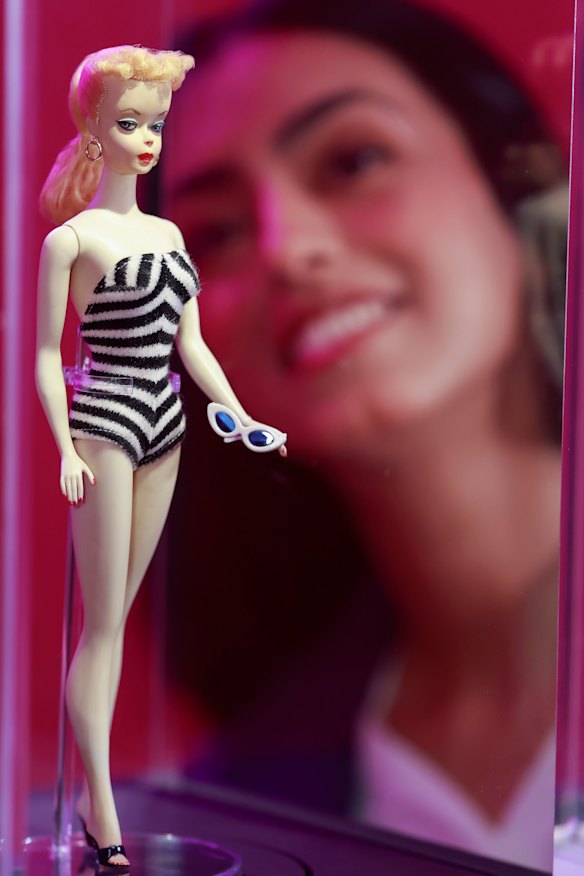
The exhibition will feature more than 250 objects, including 150 dolls and a first-edition Barbie from 1959. The 67-year-old doll is hand-painted and dressed in a black-and-white bathing suit. Thom says similar versions of the doll have sold for up to $40,000.
While the exhibition draws heavily on nostalgia, Thom says one of her favourite parts of the experience is seeing how different generations interact with Barbie.
“You find that when a grandparent, parent and children visit the exhibition, they all have different stories and memories with different Barbies they see in the collection,” she said.
Barbie: The Exhibition is at Melbourne Museum from November 28. Details:
Want more art and design? We’ve got you
 Kayla Olaya is a culture reporter at The Sydney Morning Herald.Connect via email.
From our partners
Disclaimer : This story is auto aggregated by a computer programme and has not been created or edited by DOWNTHENEWS. Publisher: www.smh.com.au