Mackenzie ★★★
The Neilson Nutshell, June 12, until July 18
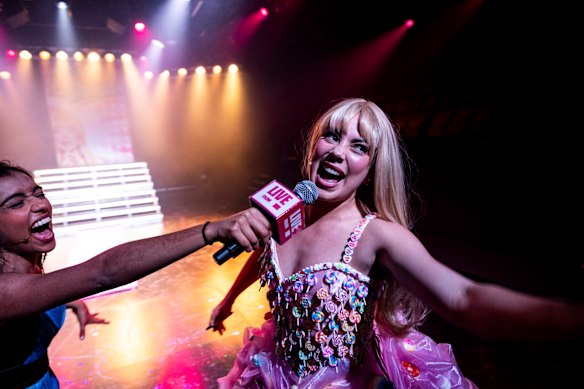
Eleventh-century Scottish wannabe kings and Y2K wannabe child stars have soooo much in common. Right?! Ambitious. Kind of went “wrong” after they got big. Surrounded by potential haters. Both have toxic people close to them: wifey or mum, they’re put under insane pressure to make really dumb, selfish decisions. And yeah, this though: both are DOOMED by the system (cut-throat court or competitive kids’ TV) to a hella dramatic menty b and a career “yikes” that people will be talking about, like, forever.
This is the conceit, and the tweenage tone, of Yve Blake’s relentlessly silly adaptation of Macbeth, her first work since the feel-good smash-hit that was Fangirls. It’s a Bell Shakespeare production with Virginia Gay directing, a play with a few dance numbers and “it’s gonna be me-ay” Britneyesque songs (also by Blake) bubbling in the mix.
Be advised: viewers can expect light references to incest, disfigurement, and one ass-slap by a slimy producer. The Nutshell has perhaps never hosted so much booty-popping or scatological humour. (Betrayal via oven poop was one extremely juvenile touch.)
Eddy Current Suppression Ring ★★★★½
Tumbalong Park, June 12
Melbourne garage rock band Eddy Current Suppression Ring (ECSR) are a testament to how exciting rock music can still be, even when stripped down to its barest elements – bass, drums, electric guitar and a charismatic frontman. Here it’s Brendan Huntley, who prowls the stage like a tiger, eyeing the crowd as if it’s his next meal.
It doesn’t hurt that the band, whose self-titled debut album arrived 20 years ago, has the killer, locked-in rhythm section of bassist Brad Barry and drummer Danny Young, and a shredding, one-man riff factory in the form of guitarist Mikey Young. Each instrument sounds clean, unfussy and powerful, with the sound mix immaculate – not something you often get at an outdoor show.
The key to the band’s success, beyond the obvious repertoire of excellent tunes, is how danceable a lot of the music is – Memory Lane, Wrapped Up, Colour Television and Which Way to Go, all from 2008’s superb Primary Colours, plant weapons-grade guitar hooks over tight drum and bass grooves that recall ’70s Krautrock at its finest.
Sydney Symphony Orchestra: Stravinsky’s The Firebird ★★★★
Concert Hall, Opera House, June 12
Stravinsky’s ballet The Firebird (1910) is probably the most consequential work of Anatoly Liadov’s career. When commissioned by Ballet Russes director Sergei Diaghilev to compose music for a scenario of that name based on Russian folk stories, Liadov failed to meet the deadline, so Diaghilev turned to the relatively unknown Igor Stravinsky, who produced the large-scale score in six months. The rest is history.
This all-Russian program under Polish-Russian conductor Andrey Boreyko brought Liadov and Stravinsky’s The Firebird face to face, albeit separated by Shostakovich in one of his most explosively truculent moods. In the short symphonic poem Kikimora, Opus 63, itself the remnant of an incomplete opera, Boreyko and the SSO revealed Liadov as an expert orchestrator and sensual colourist, with refined instincts for subtle gestures.
After a darkly shaded opening and a haunting cor anglais melody (Alexandre Oguey), the woodwind section ignited the texture with sharp incendiary energy to brew crackling malevolence until the whole edifice suddenly vanishes with sardonic deftness. Cellist Maximilian Hornung chiselled out the four-note motive that begins and dominates Shostakovich’s Cello Concerto No. 1 (1959) as though hewing granite and sustained the first movement with implacable resolution and drive.
Hair ★★½
Theatre Royal, June 12 until July 12
Welcome to the summer of love. It’s 1967, and you’re about to see something you’ve never seen in a theatre before. Blasphemy. Profanity. Flag burning. Onstage nudity. Sex. Drugs. Rock’n’roll. This is Hair.
All good so far, except that it’s not 1967. It’s 2026, and all of the above are available, 24/7, on a screen near you. So how does Gerome Ragni and James Rado’s revolutionary musical, Hair, stand up when it is stripped of the shock factor? Sad to say, not very well, at least in this touring production from the Australian Shakespeare Company.
Hair is a portrait of a tribe of young New Yorkers rejecting the social norms and mores of postwar America in favour of free love and world peace. The story, such as it is, follows one of the tribe’s struggle to decide whether to resist the draft or serve his country in Vietnam. We meet Berger (Maxwell Simon), Woof (Jackson McGovern), a soft-hearted sodomist, and Jeanie (Rosie Meader), a goofy kid who happens to be pregnant. We meet Hud (Tane Williams-Accra) with his magnificent ’fro, and Sheila (Elizabeth Brennan), a valiant activist. And in among these colourful characters walks Claude (Alex Cooper), a dreamer with a draft card.
U>N>I>T>E>D ★★★
Carriageworks, June 11, until June 14
Sydney rarely gets a visit from famed Melbourne dance company Chunky Move, a powerhouse in Australia’s contemporary dance scene. Any keen Sydneysider shouldn’t miss this chance to test the hype first hand.
On opening night of U>N>I>T>E>D, Chunky Move’s six dancers exceeded expectations and then some, exuding a body-and-soul commitment to performing so palpable you could almost touch it. Each dancer projects a biting physical and theatrical confidence, with Jayden Wall’s exhausted, searing finale solo a highlight, his long red hair whipping behind him in sweat-drenched tendrils.
Visually inventive to the point of hypnosis, U>N>I>T>E>D is the latest in a series of cybernetic works exploring “machine mysticism” by artistic director Antony Hamilton. Clad in futuristic garb with tattoo-like face markings, the dancers wear audacious robotic exoskeletons (created by Future Loundry and Creature Technology Co.) which tether to slider tracks that loom ominously across the stage. Like cyborg crabs, the dancers manipulate their multiple mechanical limbs; hovering, twisting, and latching to one another and the tracks, pincers faintly clicking. Lighting by Benjamin Cisterne and Nick Moloney heightens the post-industrial dystopian drama, with red and green lights flashing out of the black like sleepless bionic eyes.
Izzard: The Tragedy of Hamlet ★★★½
Playhouse, Opera House, June 10, until June 21
Eddie Izzard loves a challenge. Her 131 marathons since 2009, raising money for charity, began with completing 43 of them in 51 days, despite no previous distance running. That gives context to her 140-minute version of Hamlet, playing all roles. For most actors, just playing the Dane is challenge enough.
It’s a monstrous achievement in terms of memory and stamina, and as entertainment it seldom flags. In quality of performance, it’s more variable.
Attired in clothes that cunningly imply a period setting without defining it, Izzard appears on a black-box stage with unchanging white light. The only theatrical embellishment to this production, directed by Selina Cadell, is the occasional interplay of two shadows on the backdrop to create the illusion of two interlocutors.
Disclaimer : This story is auto aggregated by a computer programme and has not been created or edited by DOWNTHENEWS. Publisher: www.smh.com.au