
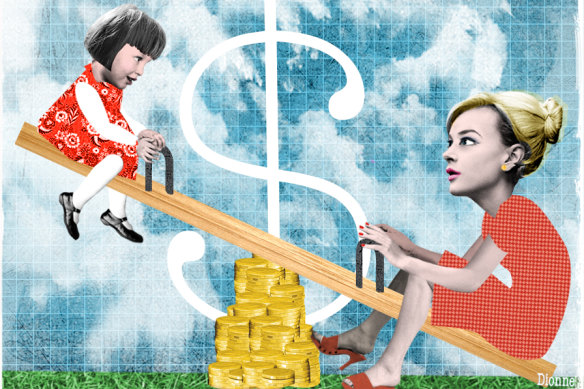
As much as we might like to pretend that you can’t, I’m sorry to say that you absolutely can put a price tag on “priceless” life experiences.
Perhaps the most perfect example of this is when it comes to having children. Of course, you can’t put a numerical value on an experience like holding your baby in your arms for the first time, but tallying up the associated costs with getting to that point and predicting how much you’ll be out of pocket for the many years to come? That, I’m afraid, you absolutely can do.
And for a growing number of Australians, it seems the current price is proving to be much too steep.
In case you missed it (although I truly don’t know how anyone could at this point), Australia’s fertility rate has been in steady decline for decades and is now at an all-time low of 1.48 children born per woman.
If we want our population to stay at the same level it is right now without migration, this rate needs to be much higher – at 2.1. In real terms, that means that in 2024 we had 23,000 fewer babies than we did in 2018. When you think about it like that, it’s easy to see why people are becoming increasingly worried about this.
This isn’t just a problem here, either. Much of Europe, Asia and north and Central America are also seeing the rates of birth drop below where experts and governments say they should be if we want to ensure our quality of life remains the same or improves in the decades to come.
Having one child will set a couple back roughly $13,000 per year, that figure grows to $23,000 when a second child comes along.
While individually unique factors will be at play for each person when it comes to making decisions about their family, in Australia at least, it has become impossible to ignore that one of the main driving factors at play for people thinking about having none, one or some children is the economics of it all.
Having recently given birth to my second child, I can confirm first-hand that this is true. Just as we did before the birth of our first child, my husband and I did a lot of number crunching when it came time to expand our family.
And though it’s easy to assume that because you still have all the paraphernalia from the first time around it won’t cost all that much to add an extra person to the family, there are all the calculations around things like maternity and paternity leave, additional healthcare coverage during and after the pregnancy and, eventually, childcare costs for a second baby. And that’s outside of things like if you need to move to a bigger house.
Because of having gone through this so recently, I can say that I was unsurprised to read that the Australian National University’s Centre for Social Policy Research estimates that while having one child will set a couple back roughly $13,000 per year, that figure grows to $23,000 when a second child comes along.
After 17 years, those figures add up to a total of $391,000. And that’s assuming that from that moment on in life, both of those children become entirely financially independent of their parents, which we know tends to be absolutely untrue in many families.
These numbers, though, are only estimates. And as any parent will tell you, the true cost will vary greatly thanks to things like childcare, healthcare and education requirements and the decisions we make as parents.
What I found to be especially interesting in this study, though, was how the cost of a child will change depending on their stages of life. A child under the age of 5, for example, is expected to cost between $14,000 and $15,000 per year. But this drops to $10,000 a year when they’re between the ages of six and 12, before then going back to the $14,000 to $15,000 figure for 13- to 17-year-olds.
A similar study from the University of NSW arrived at slightly different figures. They estimated that a single-income family will spend between $166,000 and $184,000 raising one child over 17 years, which works out to between $9,764 and $10,823 per year on average.
These numbers, though, are only estimates. And as any parent will tell you, the true cost will vary greatly.
For a dual income family, the cost for that one child grows to between $183,000 and $201,000 – an average of between $10,764 and $11,823 per year.
When you hit two children, the university research says that those figures grow to between $299,000 and $426,000 for a single income family over 17 years (costing an average of between $17,588 and $25,058 annually) and between $335,000 and $462,000 for a dual-income family (an average of between $19,705 and $27,176 per year).
When this is broken down into realistic weekly budget categories including essentials like food, health, transport, education, clothing, personal care and recreation, as well as discretionary spending and rent or mortgage repayments, a double income couple with one child will need $2035 per week. This grows to $2331 per week if that couple has two children.
This is a big problem when you then put those figures in the context of the median annual salary in Australia being $74,100 in 2025. It’s no wonder younger people are so worried about how they’re supposed to make it all work – if they realistically can at all.
According to the ANU’s study, the cost of raising a child hasn’t actually changed all that much over the years when it comes to how much of a family’s income they account for.
What has changed though, is everything else around that – namely the cost of owning or renting a family home. When all the other rising daily expenses are added to that, as well as other factors like people not wanting to derail their careers, concerns over the climate and not wanting to lose their quality of life, it becomes so clear why people are making different decisions.
Where previous generations could make it work with four or five kids in a single income home, it’s understandable why the price of this priceless experience is becoming harder for people to feel excited about.
Victoria Devine is an award-winning retired financial adviser, a bestselling author and host of Australia’s No.1 finance podcast, She’s on the Money. She is also founder and director of Zella Money.
- Advice given in this article is general in nature and is not intended to influence readers’ decisions about investing or financial products. They should always seek their own professional advice that takes into account their personal circumstances before making any financial decisions.
Expert tips on how to save, invest and make the most of your money delivered to your inbox every Sunday. Sign up for our Real Money newsletter.
 Victoria Devine is an award-winning retired financial adviser, best-selling author, and host of Australia’s number one finance podcast, She’s on the Money. Victoria is also the founder and managing director of Zella Money.
From our partners
Disclaimer : This story is auto aggregated by a computer programme and has not been created or edited by DOWNTHENEWS. Publisher: www.smh.com.au


