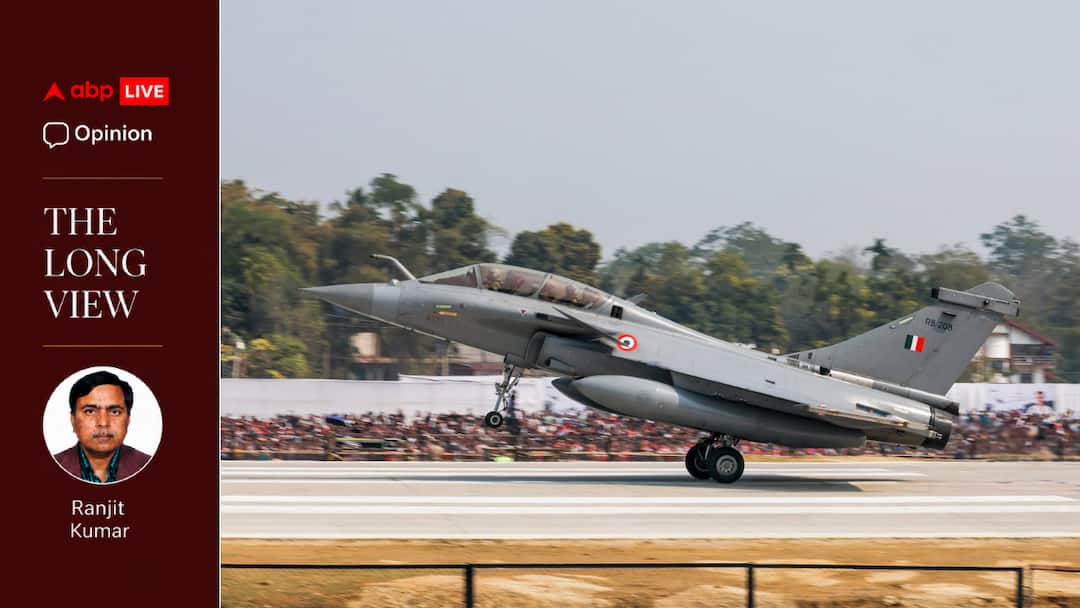
- India pursues 114 additional Rafale jets for its air force.
- Advanced Medium Combat Aircraft development begins via private partners.
- Acquisitions face significant two-decade delays, escalating costs.
- IAF squadron strength remains critical amidst dual threats.
Despite the Indian defence ministry’s silence regarding Russian President Vladimir Putin’s recent offer on the Sukhoi-57 fifth-generation fighter, the government has initiated two significant steps to advance the acquisition of fighter aircraft. The first involves the Rafale jets, with 36 of the proposed 126 already acquired following a 2016 order to French manufacturer Dassault under the Request for proposal( RFP) issued in 2007. The government appears to have revived the Indian Air Force’s 2007 RFP, now rebranded as the 2017-18 tender for Multi Role Fighter Aircraft (MRFA) , aiming to procure an additional 114 Rafales.
The second initiative focuses on the indigenous development of the Advanced Medium Combat Aircraft (AMCA) through a private sector partnership. AMCA has been designed and developed by Aeronautical Development Agency ( ADA) which will transfer its design to an Indian private sector company. A Request for Proposal (RFP) has been issued to three Indian private companies, despite their lack of prior experience in fighter aircraft manufacturing. This move has generated considerable interest within military aviation circles, signalling a potential shift in India’s approach to defence procurement.
Although these actions come years later than desired, the strategic community remains hopeful that they will lead to the timely delivery of new fighters to the Indian Air Force. Originally scheduled for induction in the mid-2010s, these aircraft may now begin delivery, by the middle of the next decade, assuming all execution timelines are strictly adhered to. This delay highlights a two-decade lag in fulfilling commitments to the IAF, with both the previous UPA and current NDA administrations bearing responsibility for the lack of decisive action.
The journey of the Rafale began with the issuance of the first Request for Proposal (RFP) for Medium Multi Role Combat Aircraft (MMRCA) in 2007. Following rigorous trials involving six aircraft types—including the American F-16 and F-18, Swedish Grippen, Russian MiG-35, European Typhoon, and French Rafale—two contenders emerged for negotiations: the Eurofighter Typhoon and the Rafale. Although the Rafale was rated L-2 and the Eurofighter L-1, the then UPA government opted for the Rafale in 2012, deferring the final decision to the incoming government, which took office in May 2014. The Modi administration subsequently ordered a reduced quantity of 36 Rafales, a move that left the Indian Air Force (IAF) dissatisfied due to the urgent need to address the declining squadron strength necessary for a two-front conflict. In 2018, the government attempted to reconfigure the original 126 MMRCA under the 2007 RFP into a new MRFA framework, yet eight years later, a conclusive decision remains elusive. Knowledgeable sources point out that if the decision was taken in 2018, the entire 114 Rafales acquisition would have cost India USD20 billion. Now the proposed deal will cost India four times more than 2012 negotiation price, which was Rs 42,000 crores( USD 10 billion).
ALSO READ: OPINION | Expanding Footprint Of India’s BrahMos
Regarding the fifth-generation Advanced Medium Combat Aircraft (AMCA), the situation is increasingly concerning. The Chinese Air Force has already deployed this class of fighter along its borders with India, with two squadrons of J-35s expected to be transferred to Pakistan by the end of the year. Despite this, there is considerable enthusiasm within Indian media and among strategic analysts about the prospect of the Indian Air Force entering a new era of fifth-generation stealth fighters. However, this optimism often overlooks the stark reality that China has already operationalized two variants of fifth-generation fighters, presenting a significant challenge to the IAF.
The ongoing delays in finalizing the AMCA and the limited procurement of Rafales highlight the critical need for a strategic reassessment to bolster the IAF’s readiness for future conflicts.
The Indian Air Force remains hopeful of receiving timely deliveries of Rafales and Advanced Medium Combat Aircraft (AMCA). However , aviation experts believe that It will be a miracle , if first fully certified flying weapon loaded AMCA starts joining IAF fleet by the middle of next decade. Assuming that the manufacturing company delivers ten AMCA fighter annually , the Air Force will have six squadrons by the middle of forties. By that time, both of India’s adversaries are likely to have upgraded and more capable fifth-generation fighters, such as the J-20 and J-35. In response to increasing demands from air headquarters for additional squadrons of medium multi-role aircraft, the Defence Ministry was compelled to issue a fresh letter of request dubbed in aviation circles as MMRCA 2.0. This follows the earlier procurement of 36 Rafales under the MMRCA (2007 RFP), now rebranded as the MRFA program, which proposed six additional squadrons at an estimated cost of USD 20 billion in 2018. The LoR for present MRFA Rafales are expected to be a slightly upgraded version, transitioning from the current F-3 to the F-4 category, with a significantly increased price tag of approximately Rs 3,25,000 crores (around USD 39 billion) for 114 aircraft, of which 18-24 will be produced in France and the remainder in an Indian private sector facility selected by the Government of India. The prolonged delays in finalizing decisions will not only escalate costs but also raise concerns about the delivery timeline.
ALSO READ: OPINION | To Be In Lithography Club — What It Means To India
The submission of the Letter of Request (LOR) to the French government coincided with the visit of IAF Chief ACM A.P. Singh in the first week of June. The French authorities are expected to respond to this LOR within the next two to three months, with final negotiations on the deal and pricing anticipated to conclude by the end of the current financial year, specifically by March 2027.
Considering the delayed integration of both Rafales and the Advanced Medium Combat Aircraft (AMCA), the Indian Air Force (IAF) anticipates being fully equipped with these aircraft by the late 2030s and 2040s. However, the government has yet to disclose any strategies to address the gap created by the retirement of three squadrons of MiG-29s and three squadrons of Mirage-2000s. The indigenous Light Combat Aircraft (LCA) Mk-2 appears to be the preferred option, but the uncertainty surrounding the availability of US GE-F-414 engines—despite an agreement for 80 percent technology transfer—remains a concern due to the fluctuating stance of the US administration towards its allies.
Even if the Rafale, AMCA, and LCA-2 programs progress as planned, the IAF will still face the pressing requirement to maintain a minimum of 42 fighter squadrons. This necessity is underscored by the increasing challenges posed by the dual threats from China and Pakistan, compelling IAF headquarters to remain vigilant and adequately prepared for any potential conflicts. The brief conflict in May 2025, known as Operation Sindoor, underscored the pressing necessity for advanced fighter aircraft to prepare for potential contingencies.
The urgency for India to enhance its aerial combat capabilities is evident, especially in light of the evolving geopolitical landscape. As adversaries advance their military technologies, the Indian government must prioritize the acquisition of modern fighter aircraft to ensure national security.
(Ranjit Kumar is a senior journalist and strategic affairs analyst )
Before You Go
World Focus: Iran Signals Peace Deal Progress as US Military Build-Up Keeps Pressure Intact
Disclaimer : This story is auto aggregated by a computer programme and has not been created or edited by DOWNTHENEWS. Publisher: abplive.com