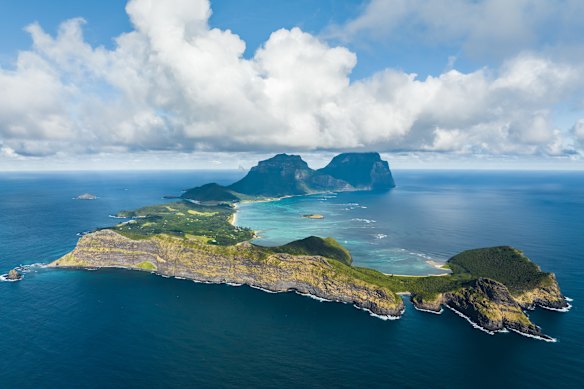

I’d been thinking about visiting Lord Howe Island for years, bookmarking articles, watching documentaries and following its conservation successes. What stopped me from booking a ticket wasn’t interest, but exclusivity. A 400-visitor cap, World Heritage protections and the fact that everything needs to be shipped in, have given Lord Howe a reputation for being both pristine and eye-wateringly expensive.
So when I heard about The Cabin, the island’s newest, more accessible stay on a two-hectare farm, I knew it was finally time to book.
Following a dirt track past two pushbikes, a fire pit and an outdoor shower, I arrive at the sage-green cabin and am immediately glad I waited. Inside, I find the dining table laden with produce from the owners’ small farm next door. Bananas and papaya, spinach and zucchini, eggs from their chooks, alongside local honey, Lord Howe Roasters coffee and a peach gin the owners have had made exclusively for guests.
The Cabin runs on solar power and rainwater, and much of it was built from repurposed island materials. Self-catering adds to the idea of staying lightly, since it means you can spend less on meals, and have more time (and budget) for being outside.
Sign up for the Traveller Deals newsletter
Get exclusive travel deals delivered straight to your inbox. Sign up now.
“We wanted to create something sustainable without giving up comfort,” says co-owner Jessie Owens, a sixth-generation islander, as she shows me around their veggie gardens. “A place that reflects how we live here, connected to each other and the land.”
Connecting to the land really is what you come to Lord Howe Island for. In the afternoon, I cycle 20 minutes to town along a road fringed with kentia palms and curious wood hens, whose numbers have surged since a $15 million rat eradication program was completed in 2019. As I ride, the island’s logic becomes clear. The same constraints that make Lord Howe feel exclusive – limited beds, limited supplies – are also the reason it feels so alive. Few people understand that better than Ian Hutton, the conservationist I’ve ridden into town to meet.
“Lord Howe Island is a microcosm for the world,” Hutton says as we walk along Ned’s Beach, the island’s best-known stretch of sand, hot-stepping around dozens of week-old sooty tern chicks. “It’s just 11 kilometres long, so it’s small enough to make both the problems, and the solutions, to some of the world’s biggest problems, really visible.”
In the wider world, issues like introduced species and climate change can feel too large to grasp, he says, as he leads me through an area of the island recently restored to native forest. On Lord Howe, though, visitors can see those solutions at work, and the scale suddenly feels manageable. That’s why Hutton has spent nearly three decades running volunteer weeding tours, bringing visitors to the island to help restore fragile ecosystems. Limits, he says, aren’t abstract here. They’re practical, enforced, and they work.
These limits are why I don’t see more than five other people sunning themselves at a time on any of the island’s 11 beaches. They’re why, when I head out snorkelling with Marine Adventures, I’m able to watch giant green turtles lazing on the coral just a metre away, without them swimming away in fear. They’re also why, after the near-vertical climb up Mount Gower, I can walk through an extremely rare cloud forest that holds around 85 per cent of the island’s endemic plant species.
Later that night, after a celebratory dinner of kingfish chowder at long-standing island favourite The Anchorage, I run into Hutton again. He invites me for a post-prandial stroll along Ned’s Beach. It’s a full moon, and hundreds of mutton birds and black-winged petrels lift and circle above the sand, their wings catching the light as they perform elaborate mating dances.
Lord Howe is still an exclusive place, there’s no doubt about it. But with wildlife rebounding and stays like The Cabin offering a more accessible way in, there’s a sense this is a moment. Not just to visit, but to pay attention to what careful limits can still achieve.
THE DETAILS
STAY
Nights at The Cabin are from $450 in low season (June to August) to $750 in peak season (November to April), including breakfast provisions, farm produce, drinks including wine and spirits, and transfers to and from town. Email inquiries@thecabin.au; phone +61 447 871 292; see lordhoweisland.info/accommodation/the-cabin/
The writer travelled courtesy of Lord Howe Island. See lordhoweisland.info
 Nina Karnikowski is a travel writer focused on sustainability, and the author of two books including Go Lightly: How to Travel Without Hurting the Planet.Connect via X.
From our partners
Disclaimer : This story is auto aggregated by a computer programme and has not been created or edited by DOWNTHENEWS. Publisher: www.smh.com.au