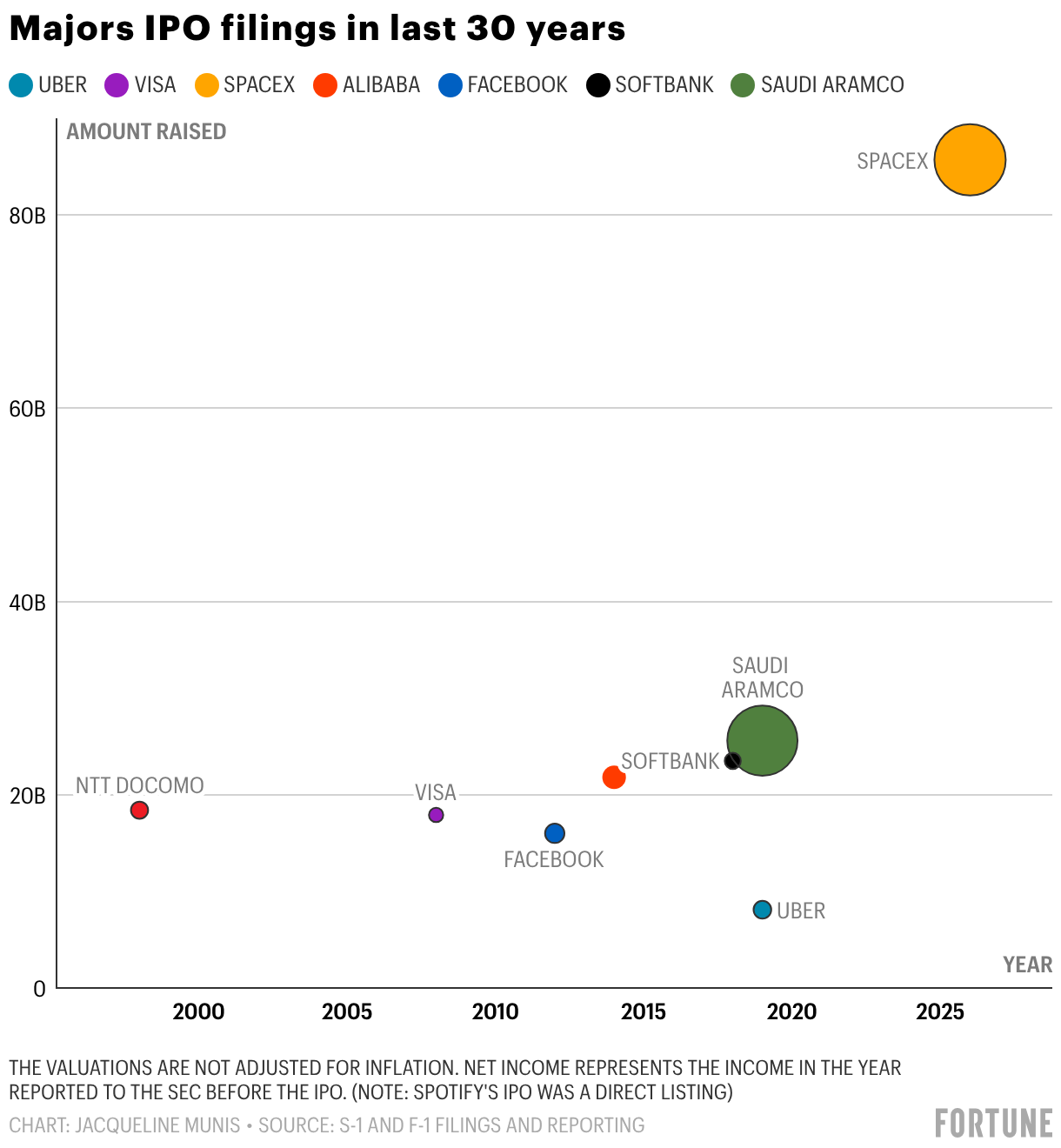
On Friday, the world waited with bated breath to watch how markets would react to SpaceX’s blockbuster $1.75 trillion IPO, which raised $85.7 billion in proceeds.
Now, on its first full day of trading, the company is worth more than $2.4 trillion.
The stock began trading at $150 a share, and as of Monday afternoon it was trading at $186, up 16% after surging 19% in its debut. The price spike is typical of IPOs. Airbnb’s stock price increased 112% on its first day on the Nasdaq in 2020. Similarly, the design platform Figma’s stock skyrocketed 252% on its first day.
“This is marketing 101,” said Eric Hoffmann, chief data officer at compensation consulting firm Farient Advisors, told Fortune earlier this month ahead of the IPO. “They’re driving hype to drive the stock price and the amount of money they can raise.”
The only IPO that has ever come close to SpaceX’s was Saudi Aramco, Saudi Arabia’s national oil company, on December 11, 2019. Listed on the country’s Tadawul exchange, the state-owned enterprise was valued at $1.7 trillion and raised $25.6 billion. Much like SpaceX, its value shot up to more than $2 trillion within days.
Previous IPO record-holders come nowhere close to the rocket-maker’s eye-popping valuation. Before Saudi Aramco, Chinese e-commerce company Alibaba held the record for the largest IPO, which raised $21.8 billion and valued the company at $167.6 billion.
A strong opening doesn’t mean everything. Facebook’s May 2012 IPO was so mired with technical issues, that Nasdaq paid shareholders $26.5 million to settle a class-action lawsuit over its mishandling of the offering.
Investors also balked at the social media company’s $100 billion valuation, as its ad-based business model was still largely unproven. Three months later, the stock was trading at just half of the initial share price. The company was able to turn things around and now boasts a $1.51 trillion market capitalization.
Despite its smooth start, SpaceX will similarly need to prove itself to investors. The IPO has made Elon Musk, already the richest man in the world, a trillionaire on paper, but his company’s path to profitability is even less clear than Facebook’s in 2012.
In its S-1 filing, SpaceX reported $18.7 billion in revenue in 2025, up from $14.1 billion in 2024, but it also reported $4.9 billion in net losses last year.
“While we have experienced significant growth in revenue over the last three years, we cannot predict whether we will maintain this level of growth or when we will achieve profitability again,” the company wrote in the filing.
Still, SpaceX has emerged as the dominant player in the space industry, overtaking legacy giants, despite being founded just 24 years ago.
SpaceX was behind more than half of all rockets launched in 2025 and accounts for 83% of the total mass sent into orbit, but analysts question if its frontrunner status will stick.
“SpaceX is the undisputed global market leader in launch economics and satellite-based connectivity, but the market could become more competitive if the technological capabilities of players such as Blue Origin, Rocket Lab, or Chinese startups improve meaningfully,” wrote Morningstar analysts Nicholas Owens and Suryansh Sharma. They estimated that SpaceX’s actual value is $780 billion, just 44% of its original valuation.
Disclaimer : This story is auto aggregated by a computer programme and has not been created or edited by DOWNTHENEWS. Publisher: fortune.com