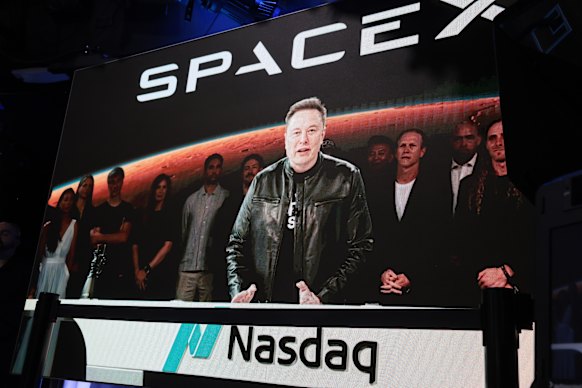
Should SpaceX be valued at more than 10 times that of the other US mega-companies that populate the small universe of companies with a market capitalisation of more than $US1 trillion?
That is a question posed by the extraordinary debut of Elon Musk’s new listing.
Already priced at what appeared a very expensive $US1.75 trillion ($2.48 trillion) in its prospectus, in its first two days of trading SpaceX’s market value has soared 42 per cent. The company is now valued at $US2.52 trillion, making it the sixth most valuable company in the world.
The other ten companies with a market capitalisation above $US1 trillion trade on an average price-to-sales ratio of 11.2 times. SpaceX’s ratio is a mind-boggling 134 times.
Those other companies, it should also be noted, are all profitable.
Amazon, with a market cap of $US2.65 trillion and therefore with a value only slightly higher than SpaceX’s, made $US78 billion in profit last year. The company with the highest price-to-sales ratio among the world’s top 10 companies, Broadcom, with a ratio of almost 25, had earnings of $US64 billion.
SpaceX had net income of $US791 million last year – but lost $US4.3 billion (on sales of $US4.7 billion) in the first quarter of this year after it merged with Musk’s xAI and its spending on artificial intelligence ramped up.
Like most of the AI hyperscalers, SpaceX’s trajectory for the next few years – or potentially a lot more than a few years – is ever-increasing investment in AI and ever-swelling AI-related losses. Its listing was motivated by a desire to get continuing and large-scale access to equity to fund the spending, and the losses.
Initially, at least, it has succeeded. By selling less than 5 per cent of SpaceX’s shares, Musk – who initially aimed to raise $US75 billion – has ended up with more than $US85 billion after the float promoters activated an option to accept overallotments in an IPO that was over-subscribed several times.
That SpaceX was able to raise that much capital on the basis of little more than a Musk fantasy of colonies on Mars and data centres in space says a lot about the world’s first trillionaire and his following, something about the investor fixation with all things AI and something significant about the way the float was structured.
Musk’s followers are devoted, so it’s not surprising that there was a lot of retail investor enthusiasm for the offering, with retail investors taking up about 20 per cent of the relatively small number shares on offer.
The success of the float also owes a lot to its inclusion by index providers in a number of key indices.
Nasdaq created a fast track for big AI floats to include SpaceX in its index, providing an exception to its previous stance that companies needed a year of “seasoning,” or trading on the market, and a minimum public float of 10 per cent of their capital, before they could join the index.
Other index providers – Russell, Morningstar, MSCI – have also fast-tracked SpaceX for inclusion in their indices, although S&P chose not to budge on its requirement that a company produce four consecutive quarters of profits and wait at least 12 months after listing before it can join the S&P 500.
Nasdaq, the market of choice for tech stocks, will include SpaceX in its indices 15 days after its listing, with an index weighting triple the available free float. Other index providers included SpaceX immediately.
Passive funds and exchange-traded funds that essentially match index weightings in their investments will have no option but to acquire SpaceX shares, as will those supposedly “active” funds (sometimes referred to as “index huggers”) that don’t stray too far from the indices used to measure their performance.
That means there will be a guaranteed and substantial source of demand for the shares in the aftermarket which, given the limited number of shares available and the likelihood that there will be a core of Musk loyalists who took up shares in the float and are unlikely to sell at any price, almost ensured SpaceX’s debut would be a spectacular success.
It also ensured that the valuation of SpaceX would bear no resemblance to its fundamentals, although that is a common feature of the way all the AI companies are being treated.
SpaceX, however, was a late starter to the scramble to develop and commercialise AI – xAI is a laggard compared to rivals like Anthropic and OpenAI. It is so far behind that it is selling precious computing power to Google and Anthropic because it can’t yet use it all itself.
That’s a lucrative business – Google will pay it $US920 million a month for 32 months and Anthropic fork out $US1.25 billion a month for about six months – but SpaceX isn’t being valued at more than 100 times its sales for providing infrastructure to its competitors and helping them to forge ahead of its own AI operations in the quest for AI dominance.
Indeed, Musk himself, having claimed an addressable market of $US28.55 trillion for SpaceX’s businesses (which include its very profitable Starlink satellite business and its loss-making rockets and social media enterprises), has said 93 per cent of that market is AI-related. SpaceX has to be a major AI player if it is to justify its valuation.
Its valuation is being driven more by the imbalance of supply and demand in the initial pre-and-post initial public offering phase, an imbalance that may be addressed later this year.
There are about 911 million shares held by SpaceX insiders – worth about $US175 billion at current prices – that technically could be released for sale after the company’s second-quarter financial report is issued. There’s a further 1.3 billion that would be freed up after its full-year report.
While it’s unlikely that SpaceX’s insiders will be dumping large proportions of their holdings at the first available moment, that does mean there will be some more of the existing shares available to the market later this year, along with the possibility – given the rate at which SpaceX is chewing up capital and the scale of Musk’s ambitions – that the trillionaire will tap the market again in the not-too-distant future. That prospect could weigh on its share price in the future.
With its appetite for capital having outgrown the capacity of private markets to supply it, and debt funding expensive and risk-enhancing, SpaceX – shortly to be joined on the bourse by Anthropic and OpenAI — now has a larger and always-open conduit for the capital it will need.
Musk, who now has a listed entity with a market cap-to-sales ratio about 10 times that of his other listed company, Tesla, may also be tempted to merge the two (which already have significant trading relationships) to create one listed mega-vehicle with a market cap, at current prices, of about $US4 trillion.
Scale, larger underlying cashflows from non-AI activities and a bigger index weighting can, when it comes to raising huge lumps of capital, be helpful.
Musk has shown with SpaceX that he has a unique ability to sell and capitalise a shifting vision of his companies’ futures. SpaceX’s market debut testifies to that, in spades.
The Business Briefing newsletter delivers major stories, exclusive coverage and expert opinion. Sign up to get it every weekday morning.
From our partners
Disclaimer : This story is auto aggregated by a computer programme and has not been created or edited by DOWNTHENEWS. Publisher: www.smh.com.au