
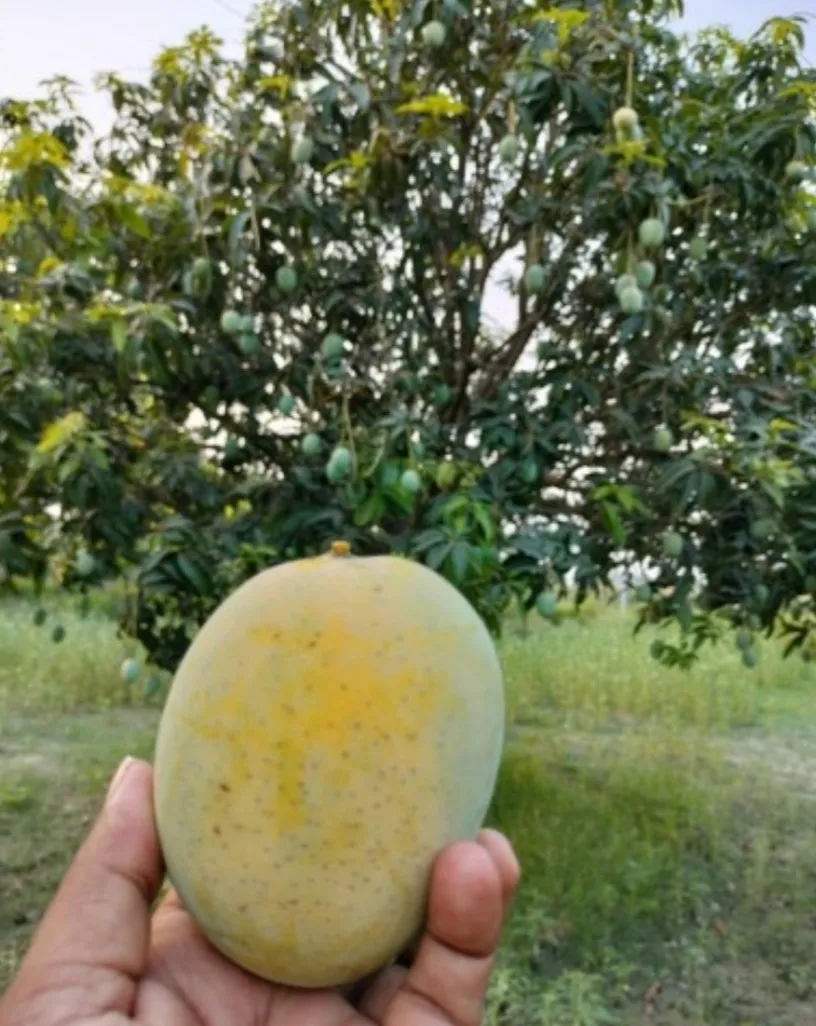
In Bengal, mangoes are not merely fruit. They are memory, migration, resilience, and paradox. Among the countless cultivars that dot the state’s landscape, none embody this spirit more vividly than the Dofala — the twice-bearing mango that bends time itself, flowering and fruiting beyond the summer season and offering its bounty when markets are starved and farmers most in need of hope.
Custodians of a legacy
At 70, Anukul Mondal of Maa Anaapurna Nursery in Radhanagar, Nadia, stands as one of the few custodians of this legacy. His nursery has quietly safeguarded rare Dofala varieties — Bhastara, Shuktara, Sohini, and Nayantara — each name carrying its own story.
Mondal speaks of them with unmistakable pride, as though they were members of his family.
Their fruits ripen when markets are short of mangoes, fetching premium prices. Farmers often describe them as “gold mines”.
“The demand for Dofala is growing — it’s our orchard’s gift to mango lovers across India,” he says, his voice tinged with satisfaction.
For growers like Mondal, digital platforms have expanded their reach. YouTube storytelling and mobile orders now connect orchards to distant buyers.
The story of their survival is entwined with history. After Partition, families migrating from eastern Bengal carried with them not just belongings but a deep love for mangoes. Their passion ensured that hundreds of cultivars were conserved across the state.
The Dofala, too, found protection through this affection. Today, growers fortunate enough to nurture these varieties reap handsome returns from off-season harvests.
Orchards as museums
In Murshidabad’s Raiganj, Abdul Manan Mondol tends his orchard like a curator in a fragrant museum. At 55, with soil under his nails and quiet pride in his voice, he walks among trees labelled Kalibhog, Badshahbhog, Krishnakali, Ameena, and Ras-ki-Gulistan — names that hint at flavour, history, and family stories.
Yet what moves him most are the Dofala mangoes: six native types he has nurtured for years, each one a living piece of local heritage.
He remembers his astonishment at seeing mangoes after the rains.
“We never thought mangoes could grow in October. Now, these trees give us hope when the market is empty. Even when the rains spoil other crops, these mangoes remind us that nature has its own rhythm,” he says.
Cultural resonance
Dofala trees produce harvests in multiple flushes — often two or more times a year — extending the mango bounty into the off-season.
This trait makes them invaluable in West Bengal’s diverse mango landscape, where over 200 indigenous varieties persist despite threats of erosion.
Farmers in districts such as Murshidabad, Nadia, North 24 Parganas, Hooghly, and Malda cherish Dofala for its reliability. Research from Bidhan Chandra Krishi Viswavidyalaya (BCKV) highlights how these off-season bearers bridge gaps in supply, supporting both household needs and local markets.
The Dofala mango is woven into Bengal’s cultural fabric. In kitchens, its fibrous flesh finds purpose in tok dal, where tangy mango enriches lentils, or in aam chutney and amsatta (mango leather), staples of summer preservation.
Unlike Himsagar, prized for its fibreless flesh and export value, or Langra, celebrated for its velvety pulp, Dofala varieties often carry more fibre and a tangier profile. Yet their resilience and timing make them indispensable.
/filters:format(webp)/english-betterindia/media/media_files/2026/06/13/a-farmer-with-dofala-mango-tree-2026-06-13-17-01-47.jpg)
Festivals and fairs have amplified their cultural significance. At the National Mango Fest in Thiruvananthapuram in 2011, a Dofala cultivar called Surer Dofala won recognition, introducing wider audiences to Bengal’s off-season marvel.
Cultivated mainly in Murshidabad, Malda, and Nadia districts, Surer Dofala is known for its sweet-tangy flavour, relatively low fibre content, and suitability as a table fruit.
“I am told the Chief Minister tasted it,” recalls grower Haldar, a proud owner of six Dofala varieties.
“The Surer Dofala mango flowers twice a year — first during the cool stretch from December to February, and again with the late monsoon in August and September. Though the second flush yields fewer fruits, we look forward to the October-November harvest. It coincides with the festive season, when demand is high and prices are good,” says Haldar of Uttar Simlapal village in Hooghly.
Known locally for his yet-unnamed papaya variety, he tends 3.5 bighas that produce an astonishing 75,000 kilograms of fruit annually.
Distinct varieties and traits
West Bengal’s Dofala family boasts a rich line-up, each variety carrying unique characteristics documented in horticultural studies.
Key cultivars include:
-
Dutta Dofala, prized for its yield potential and promise in hybridisation
-
Surer Dofala (or Sur Dofala), noted for early bearing even from young grafts
-
Swarnamoi Dofala, known for its golden hues
-
Tora Dofala
-
Chine Dofala
-
Dofala Gol, a round-fruited regular bearer among 115 studied varieties
Other recognised cultivars include:
-
Lagno
-
Debdas
-
Lalfuli
-
Kalo Vastara
-
Shada Vastara
These varieties display oblong or elliptical leaf shapes that aid identification.
Morphological studies cluster them into distinct groups. Oblong-leaved types such as Dutta Dofala and Surer Dofala contrast with elliptical types like Chine Dofala, reflecting significant diversity within this off-season group.
The fruits are often fibrous — or “aans” in Bengali — making them stringy when ripe but ideal for chutneys and pickles when raw.
In some trials, Chine Dofala showed about 36 per cent dissimilarity from Dutta Dofala across 26 morphological characters, indicating rich genetic divergence.
Yet adoption remains slow. Many cultivars are confined to traditional orchards, and their higher fibre content makes them less popular as table varieties. Still, they continue to occupy cherished places in Bengal’s kitchens and niche markets.
State horticulture programmes and sapling schemes are beginning to support their revival, but the future depends on heritage-conscious farmers and consumer demand for diversity.
Science catches up
For decades, Bengal’s Dofala mangoes flourished quietly in scattered orchards, yet remained largely absent from formal study.
That silence began to lift with the work of Dr Shuvadeep Halder, whose doctoral research documented 30 distinct off-season cultivars across the state’s mango-growing districts, following an earlier M.Sc. survey of 17 such types.
His surveys reframed these varieties not as curiosities but as treasures, underscoring their potential for future breeding programmes.
“My journey into this fascinating world began during my M.Sc. research, when I documented 17 off-season mango cultivars. This sparked a deeper exploration during my PhD, as I traversed West Bengal’s key mango-growing districts — Hooghly, Nadia, North 24 Parganas, Murshidabad, and Purba Bardhaman. There, I discovered 30 distinct Dofala cultivars, each with its own story, flavour, and legacy,” says Dr Halder, Assistant Professor (Horticulture) at the ICAR-accredited School of Agriculture and Allied Sciences, The Neotia University.
Among the 30 are noteworthy recent entrants: Catimon from Vietnam, Thai All-time from Thailand, and Bari-11 from Bangladesh.
Their presence highlights how Bengal’s mango landscape continues to evolve, with traditional farmer-selected landraces now standing alongside international introductions.
“The diversity within these mangoes is striking. Some trees spread wide, while others remain compact. Leaves vary in shape, and fruits differ in size and colour. Dutta Dofala, for instance, blushes red under the sun, thanks to anthocyanin pigments in its peel. This variability reflects mango’s long history of adaptation, cross-pollination, and farmer-led selection,” says Dr Halder.
What makes them extraordinary, however, is their unusual fruiting behaviour.
Unlike conventional varieties, Dofala trees can flower multiple times a year. On a single tree, blossoms, tiny green fruits, and ripe mangoes may appear simultaneously — a living mosaic of abundance that farmers witness with awe.
Yet nature maintains its balance.
/filters:format(webp)/english-betterindia/media/media_files/2026/06/13/a-bunch-hanging-from-the-branches-2026-06-13-17-02-40.jpg)
Researchers at Bidhan Chandra Krishi Viswavidyalaya recommend Dutta and Chine Dofala as parents for breeding higher-yielding off-season varieties.
Genetic studies reveal promising diversity. Chine Dofala shows notable divergence from Dutta and Debdas, making this trio strong candidates for hybridisation.
Long-term evaluations, pest and climate resilience studies, and hybridisation using diverse parental lines are now seen as essential next steps.
Grassroots innovation
Kushal Ghosh of Murshidabad embodies the spirit of grassroots science.
A proud custodian of several Dofala varieties rescued from uprooted orchards across Malda, Murshidabad, Hooghly, and North 24 Parganas, his multi-grafted trees — some carrying as many as 165 cultivars — function as living laboratories.
By freely sharing scions, he counters genetic erosion and helps ensure that diversity endures.
At 77, stoutly built and indefatigable, Ghosh has devoted himself to conserving nearly 200 local mango varieties across his 36-bigha (around 12-acre) orchard-cum-nursery, which serves as a grassroots germplasm bank.
His mission extends beyond safeguarding Murshidabad’s heritage mangoes.
Determined to create new hybrids, he employs age-old techniques — using plant extracts and colour cues — to crossbreed varieties.
The result is 13 distinctive hybrids, each with its own lineage and story. Among them are:
-
Totasinha (male Totapuri × female Asinha)
-
Belchampa (male Mulamjam × female Champa)
-
Lango (male Langda × female Bombayia)
-
Champarani (male Rani × female Belchampa)
-
Chausasundari (male Chausa × female Badosindhu)
-
Belatur (male Kohitoor × female Belchampa)
Though produced in limited numbers, these hybrids are in high demand, with individual seedlings fetching around ₹450.
Fragile future, hidden gem
The future of these mangoes is fragile.
Most survive only in farmer-maintained orchards, vulnerable to neglect and genetic erosion. Paddy conversions and consumer drift towards uniform hybrids threaten their survival.
Yet conservation efforts are underway. Universities are preserving select cultivars, and farmers continue to graft, share, and innovate.
For now, the Dofala mango remains Bengal’s hidden gem: an orchard’s secret, a farmer’s pride, and a reminder that nature, when listened to, always has more to give.
Its paradoxical bearing — flowers, young fruit, and ripe mangoes coexisting — offers not just sustenance but symbolism.
In a land where history and agriculture intertwine, the Dofala stands as proof that resilience can be sweet, tangy, and golden all at once.
Disclaimer : This story is auto aggregated by a computer programme and has not been created or edited by DOWNTHENEWS. Publisher: thebetterindia.com



