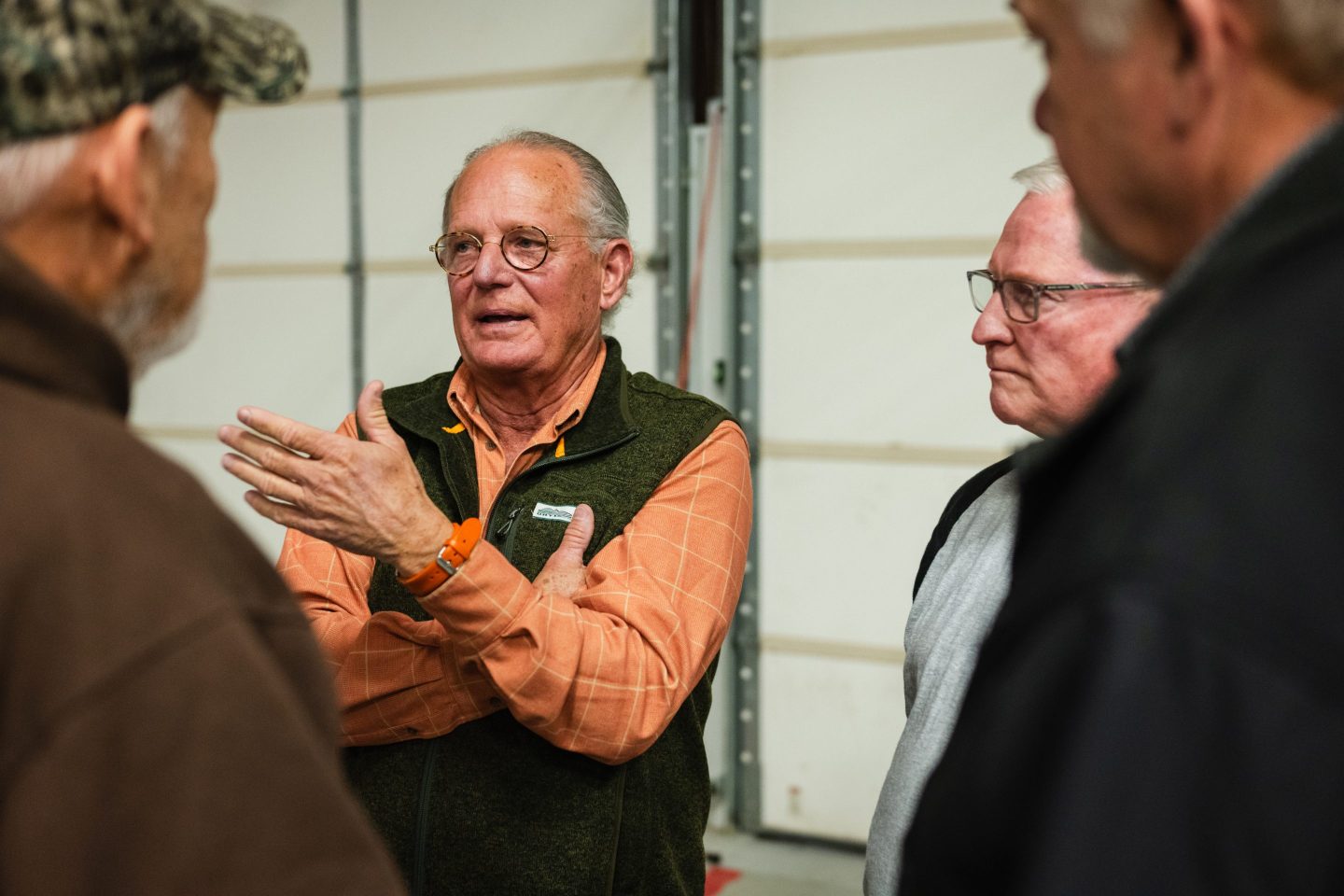
The lives of Jim Jaska, the 80-year-old mayor of Ross, Texas, and Mayor Charles Wilson, 65, of the nearby town of Lacy Lakeview, have long been deeply intertwined. Wilson’s mother worked alongside Jaska for years in the local public schools. Their ancestors are buried in the same cemetery in Ross.
Jaska was even Wilson’s football and baseball coach at Connally Junior High. “Hard worker, decent athlete, good kid,” he said of his former student, who went on to serve overseas in the CIA before returning home.
But now the two men, who both grew up in these central Texas towns outside of Waco, find themselves on opposite sides of the fierce debate around AI data centers that is roiling their communities as well as much of the nation. Last summer, Infrakey, a newly established AI data center developer, purchased a 520-acre plot of unincorporated farmland next to Ross for a proposed $10 billion AI data center campus with a power capacity of nearly 1 gigawatt—enough to power a midsize city.
Jaska and Wilson see the project very differently. For their neighboring communities, one rural and one suburban, the data center represents both an enormous opportunity and a profound risk.
That’s because Texas municipal law has created a stark divide between the two towns. Ross, with a population of just 200 and no taxing authority, sits right next to the site of the project’s industrial footprint, with some residents directly bordering the parcel. Lacy Lakeview—seven miles south but legally positioned to claim the land—is moving to annex the site of the data center, and stands to collect up to $50 million a year in taxes. This has created growing tensions between the neighboring communities over who gets the benefits, who absorbs the consequences, and who ultimately gets a say.
The project is part of a much larger trend: Across Texas and other states in the South and Midwest, rural communities are finding themselves caught in the path of the AI infrastructure boom as developers race to secure land, power, water, and transmission access for massive new data center campuses to train and run AI models. The result is a wave of local conflicts over resources, governance, and environmental consequences from projects that can reshape entire regions. Hyperscalers and AI companies are spending hundreds of billions—and analysts speculate there could be more than $1 trillion in spending over the coming few years—on AI infrastructure as they compete to build the computing capacity needed to train and run increasingly powerful AI models.
The build-out has become a strategic priority not only for Silicon Valley but also for Washington. The Trump administration has repeatedly emphasized the importance of expanding U.S. energy production and accelerating data center construction as part of a broader effort to maintain American leadership in artificial intelligence amid growing competition with China.
But backlash is growing to these projects across the nation. Even in Texas, one of the states that has aggressively pushed for AI data center development, political support is becoming more complicated. As complaints have mounted in the state’s rural communities, Republican Governor Greg Abbott has called for tighter oversight of data center development and has urged lawmakers to reconsider some financial incentives that critics argue disproportionately benefit large technology companies.
In communities from Arizona to Louisiana to Michigan, residents and local officials are wrestling with the same question: When projects backed by some of the world’s richest and most influential companies arrive in their backyards, how can residents and local officials—outmatched in resources, lawyers, and lobbying power—hope to get a fair shake?
And it turns out, the burdens and benefits can fall unequally. Jaska and other residents of Ross, as well as several other communities around the perimeter of the site, are coming to terms with a shocking political reality: The people most directly affected by the proposed AI campus may ultimately have the least say over it. While Ross is right next to the proposed AI data center, the farming town—so tiny that it has no police, fire, or sewer services—has no way to stop or shape it.
Instead, much of the political maneuvering around the project has centered on Wilson’s town, the much larger Lacy Lakeview, a suburban municipality of 7,500. In December 2025, Lacy Lakeview approved a memorandum of understanding (MOU) between the city and Infrakey for what the company called the “Lacy Lakeview Data District,” in which Lacy Lakeview would pursue annexation of the property, support permitting and municipal coordination, and potentially grant Infrakey and affiliated utility entities long-term rights to operate power, cooling, water, and other infrastructure systems under a public-private development model.
The MOU established Infrakey as the city’s exclusive development partner for 12 months while the two sides explored feasibility, financing, and other issues, though the arrangement is nonbinding and does not commit the city to final approvals.
Officials in Lacy Lakeview see partnering with the proposed development, which stakeholders say they hope can be completed in the next two years, as a potential economic windfall, made possible by some unusual Texas land-use rules around unincorporated county land.
Justin Hamel—The Waco Bridge
Looking to protect longtime neighbors
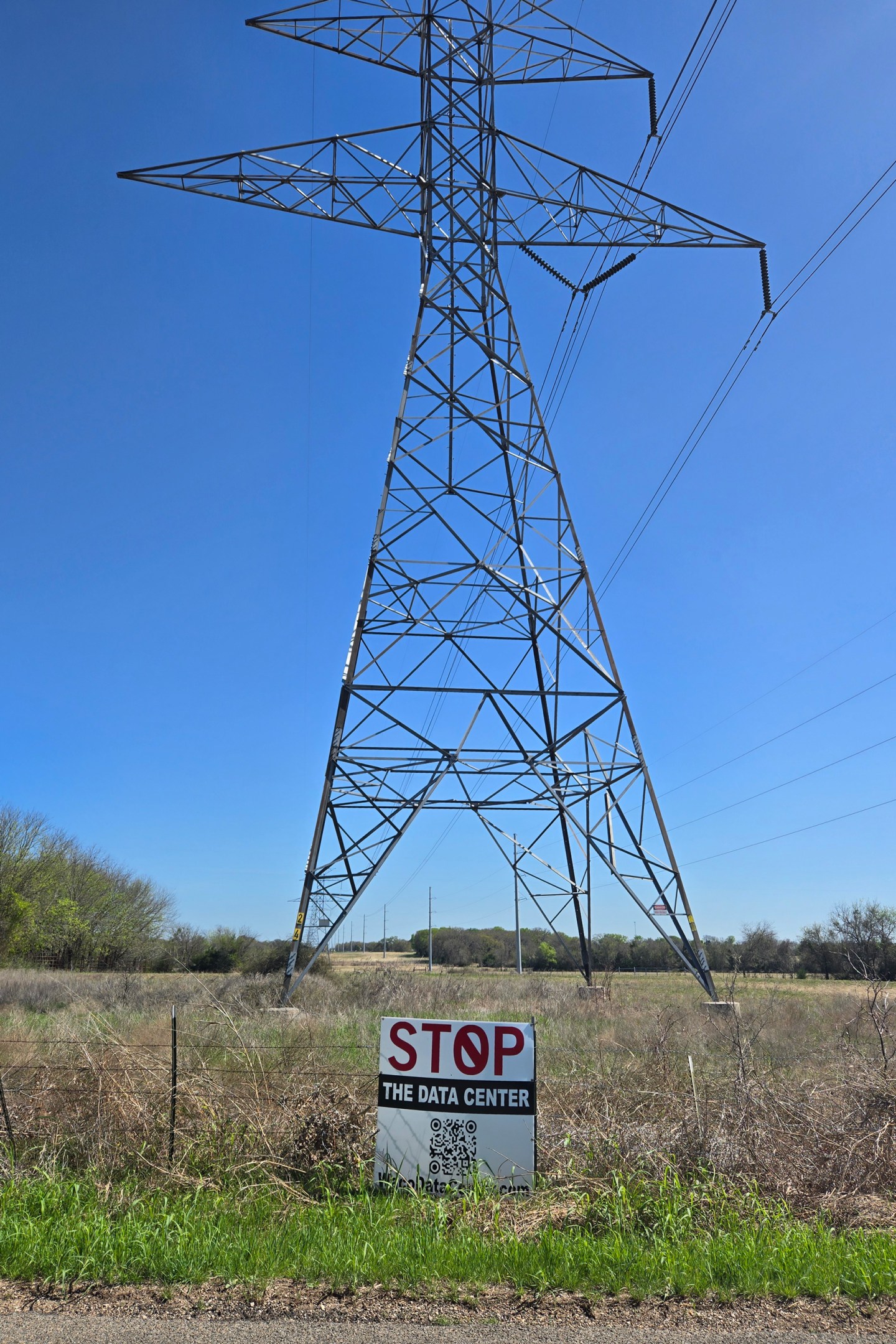
On a sunny day in March, Jaska stood outside a gate leading to the plot in question: 520 acres of lush, green farmland, complete with cows grazing in the distance. (Before the data center project breaks ground, the new owners are still leasing the land to local farmers.) Across the street a row of homes display “NO data centers” lawn signs.
Jaska and members of his family have leased this farmland adjacent to Ross’s city limits for more than half a century. As a child, Jaska helped ranch and work the fields there himself. Today, his cousin still runs cattle on the property, while his oldest son farms some 300 acres.
“I started raking and baling hay there when I was 10 years old,” said Jaska, who has served as Ross’s mayor and unofficial historian for the past four decades and will be hanging up his public service hat this November.
Jaska insists that he doesn’t oppose data centers on principle: “I just think there would be better places to put them,” he said, adding that while he understands where Wilson and Lacy Lakeview are coming from—“they need the tax dollars,” he said—they need to understand the “uncomfortable” position he is in, representing so many neighbors and friends living and farming near the data center site.
There are roughly 200 homes scattered near the perimeter of the property, both in Ross and nearby Elm Mott, on parcels ranging from a few acres to 40-acre tracts. Many residents, Jaska said, chose to live there for the area’s rural character, only to now face the possibility of a massive AI data center looming over their property. Jaska also expressed concern about the impact of construction traffic, saying thousands of trucks could end up traveling along small local and county roads that were never designed to handle that level of heavy industrial use.

Sharon Goldman
One of those neighbors is Sara Mynarcik. The 68-year-old is leading a vocal opposition effort against the Infrakey project. She inherited 79 acres of farmland in Ross from her parents, directly adjacent to the proposed data center site, where her son and his family now live and raise cattle. “He provides a lot of beef for people in the community,” she said.
She’s worried that paving over farmland could dramatically increase runoff into nearby White Rock Creek, which cuts through her property and neighboring land. On a golf cart ride with her 9-year-old grandson—and closely followed by her 13-year-old grandson on an ATV—Mynarcik pointed to low-lying areas she said sit within FEMA flood zones.
“We’re talking about concrete and asphalt, 21 buildings each the size of a Home Depot,” she said. “The runoff will be tremendous.”
A sewer problem meets the AI boom
So how did Lacy Lakeview end up as the beneficiary of a proposed AI data center project miles away from its own downtown? It all began with a wastewater crisis.
A year ago, Wilson recalled, “we discovered that our 15-inch sewer main was basically full.” Engineers estimated it could cost roughly $18 million to expand the city’s sewer capacity—a staggering figure for a working-class community that had only recently approved a $9.5 million bond to repair a fraction of its crumbling roads and underlying infrastructure. Faced with limited financial options, city leaders were searching urgently for solutions and had begun reaching out to state and county officials for help.
“One of the staffers gave Infrakey our number,” Wilson said.
It turned out Infrakey was exploring the use of treated wastewater to cool massive racks of servers at the proposed AI campus—part of a broader push within the data center industry to reduce reliance on fresh water supplies.
“It seemed like a natural first place for them to stop was the city closest to them who had a sewer problem,” Wilson said. “They could provide a solution that would allow them to use the effluent for cooling.”
Sujeeth Draksharam, an engineer and spokesperson for Infrakey, confirmed this assessment. He said the company had been scouting potential sites since 2022, before the generative AI boom sent demand for data-center-ready land soaring. The company’s founders, who came from a real estate background, believed they could get ahead of the market through speculative development, he explained—acquiring strategically located land near transmission infrastructure. “I think they saw the trend of what was coming,” Draksharam said.
As concerns mounted nationally over the massive water demands of AI infrastructure, Infrakey said it began pursuing a “sewer mining” strategy—treating municipal wastewater for reuse. The company also promised to deploy “closed-loop” cooling technology intended to improve water efficiency and reduce runoff. But project documents and public statements still contemplated the use of several million gallons of water per day.
Draksharam said Infrakey viewed the arrangement as both an environmental improvement of the project and an economic opportunity for Lacy Lakeview: Instead of paying to dispose of wastewater, he said, the city could potentially generate revenue by supplying treated wastewater to the proposed campus.
But for Lacy Lakeview to capture the property and other tax revenue from the data center that could help pay for major sewer and infrastructure upgrades, the city would likely need to annex the unincorporated land of the proposed data center site—even though it’s about seven miles away. Because of an existing water and sewer agreement with Waco, Lacy Lakeview may need Waco’s written permission to annex property outside its current city limits, in addition to physically connecting the site to Lacy Lakeview—which would require a three-mile corridor 1,000 feet wide through another private property, which the owners would have to agree to being annexed.
Wilson acknowledged the process would likely be complex and could face legal hurdles. “It would take some time and some effort,” Wilson said. “But it’s not impossible.”
As the opposition pushes back, a city council must decide
Even in Lacy Lakeview, not everyone is as convinced as Wilson that the deal will be a win-win. At least one local official represents a potential challenge to the project: Amy Gage decided to run for Lacy Lakeview’s city council to protest the data center plan, and in May was sworn in.
Gage said she was concerned that the city council did not appear to be listening to the residents of Ross and others near the Infrakey site. “But I really started paying attention when this MOU was voted on that says we [could be] committing to a 50-year term—that’s extreme,” she said. “So I’m asking council members, ‘What environmentalists are you meeting with? Who’s going to oversee this? What research have you done? Have you gone to a data center?’”
Jonathan Olvera, another Lacy Lakeview city council member, says that he, for one, is still undecided about the Infrakey project and insists that the closing of Lacy Lakeview’s deal with the developer is not a foregone conclusion.
A longtime real estate broker and a part-time host for American Dream TV, the 39-year-old father of two first heard about the multibillion Infrakey project in July of last year, soon after being sworn in. “I was pretty naive,” he said of becoming a city council member for the first time, joking that he learned most of what it was like to be in local government by watching the TV show Parks and Recreation.
“People assume it’s a done deal, that we don’t care about Ross, that we just want to line our pockets,” he said. But the MOU with Infrakey, he insisted, was just for the city council to be “able to kick the tires.”
“I’ve been studying, looking into it, and looking at both sides, because obviously what you hear is the positive financial gain for us,” he explained. “Reportedly there [could be] $50 million to add to [our] city budget. That’s not something you can just instantly say, ‘No, we won’t check it out.’”
Gage emphasized that she is not against Lacy Lakeview working to find solutions to its infrastructure problems. “My fear is that the mayor sees this as a godsend and an answer to all their problems,” she said. “But I’m afraid what we’re doing is trading one group of problems for an entirely different set that are going to be a lot more prominent long-term for our children and our grandchildren.”
What’s being proposed, she argued, is unethical and unfair to neighbors in Ross and other nearby communities. “If this was happening to any of the sitting council members, the mayor, or the city manager, in their backyard, I can only imagine how they would feel,” she said.
Is this a ‘real deal’?
Underlying all this debate is the fundamental question of whether the AI data center is likely to be built. Not everyone in the region is convinced the project is as viable—or as far along—as its backers suggest.
Pat Curry, the Texas state representative for the greater Waco area, including Lacy Lakeview and Ross, said he believes the project may be more of a speculative fundraising and land-development effort than a fully committed hyperscale AI data center project with customers, financing, and infrastructure firmly in place.
He spoke plainly to Fortune about his skepticism: “Everything that’s happened in this case appears to be a setup, if you will, to raise money,” he said. “Nothing about it has felt real from from day one.”
Draksharam, the Infrakey representative, rejected Curry’s suggestion that the project is merely speculative, pointing to the company’s investments in power deposits, engineering work, and site development. The company said it is in an exclusive due diligence phase with a hyperscale customer and expects to be able to disclose more details soon, arguing that those negotiations demonstrate the project is progressing toward execution.
Curry also criticized what he described as a lack of transparency surrounding the project, arguing that local officials initially presented the development as though key infrastructure arrangements were already in place even though many details remained unresolved. He said Infrakey had not followed the more traditional economic-development vetting channels commonly used for major projects in the region before publicly promoting the proposal and seeking investors.
In response, Draksharam said that he came away from early meetings with Curry believing the lawmaker was generally supportive of the proposal and its potential economic benefits. He said that position later appeared to change, which he attributed, at least in part, to evolving local politics and growing opposition to data center development. “I think the politics kicked in,” he said, pointing to the fact that Curry, a Republican, will face a Democratic challenger this November.Two mayors, one $10 billion AI data center, and a growing divide in small-town Texas
Either way, Curry advised Ross residents to continue speaking up, suggesting that they, like other anti-data-center movements around the country, could still defeat the project: “I’ve told them, don’t underestimate the fact that people are working really hard to obviously do something here—they bought the land, and they’re trying to put a very complicated puzzle together.”
Curry says he is “not anti-data-center”—but of this project he said, “It’s been a bush-league deal from day one.”
Sharon Goldman
Two towns, two visions of the future
Wilson is now arguing for making a deal with the data center developer, but he says he understands the project’s neighbors’ fears more than they may realize. About 15 years ago, part of his own family’s 80-acre farm was taken through eminent domain to widen a nearby highway—a project he opposed at the time.
Today, he says, he can no longer hear the cicadas, bullfrogs, and crickets from his back porch—they’re drowned out by the sound of highway traffic. “What I remembered most about the farm when I was serving overseas is gone, thanks to economic development and what people call progress,” he said.
But there’s an essential difference in this situation, he argues: The land is likely to be developed either way. Under Texas law, unincorporated landowners have broad latitude over what can be built on private property. Without engagement from Lacy Lakeview, a far more disruptive and environmentally damaging use could emerge, Wilson said: “They could put a 50,000-head pig farm on that thing.”
And if a data center moves ahead without town involvement, a company like Infrakey could simply build private infrastructure for itself—power lines, water systems, fiber connections—leaving the surrounding communities with little influence and few long-term benefits like the sewer plan. Working with the municipality, those same infrastructure investments could eventually help support roads, utilities, fire departments, and other benefits across the broader region, Wilson said: “What you see is an opportunity for this whole area to be able to have a future for development that it has never had before.”
Jaska says his former student, Mayor Wilson—“I know him as Chuck,” he said—has been trying to convince him that the Infrakey project is a done deal, and that Jaska may as well accept it and try to benefit from it. “He says this is all going to go in, so we might as well all get our part,” Jaska said. “We could split it up: ‘You get 5 million in tax dollars,’ you know, that kind of thing.”
But Jaska remains unimpressed. “I don’t do business that way,” he said. “They say you might as well have your hands held out and get some benefits. But I’m not going to treat my neighbors that way.”
For his part, Wilson said his comments to “Coach Jaska” were intended to be helpful: “I simply gave him my assessment that the project appeared to be ready to begin later this year, and that the door remained open to participate in future phases.”
For Jaska, the Infrakey data center dispute comes down to a question of fairness, and a failure to “love thy neighbor.” Why should one town bear the noise, traffic, and industrialization, while another reaps the economic rewards?
Wilson agreed that it’s about love—but a different kind. “It’s tough love,” he said. “Letting this thing go forward without a municipal partner is doing Ross no favors.”
Fighting that inevitability is futile, Wilson explained, and the sooner his neighbors in Ross—including his former coach—realize that, the better. “It’s going to bring change they don’t want and that they would never choose,” he said. “But that change is going to come.”
Disclaimer : This story is auto aggregated by a computer programme and has not been created or edited by DOWNTHENEWS. Publisher: fortune.com