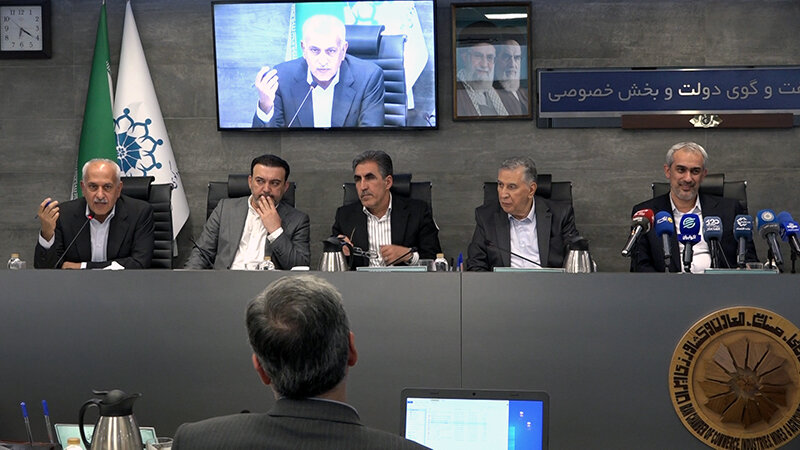
TEHRAN- At the latest meeting of the Government–Private Sector Dialogue Council, participants discussed the launch of a government-led process, in cooperation with the private sector, to identify and revise regulations that hinder production and trade.
Economic stakeholders also stressed the need for continued government support for businesses until the end of the emergency period.
During the 136th meeting of the Council, participants examined measures that could strengthen the resilience of the national economy, particularly under difficult circumstances, and emphasized the importance of maintaining support for businesses throughout the emergency period.
According to the Minister of Economic Affairs and Finance, the process of identifying and reforming regulations that obstruct production and trade has been placed on the government’s agenda.
At the beginning of the meeting, Samad Hassanzadeh, Head of the Iran Chamber of Commerce, Industries, Mines, and Agriculture (ICCIMA) and Secretary of the Dialogue Council, reflected on the conditions experienced since the outbreak of the war.
He stated that the nation and the government had worked together, relying on shared policies and ideals, making significant sacrifices to reach the present stage.
He emphasized that the end of the war would mark the beginning of a new chapter of national prosperity and that the private sector would continue to pursue development accordingly.
Economic war has begun
Ali Madanizadeh, Minister of Economy and Chairman of the Council, honored the memory of those who lost their lives during the Ramadan War and noted that over the past three months the government had sought to minimize the war’s impact on Iran’s economy and remove obstacles facing production and businesses.
He stated that although the military conflict may have ended with the recent agreement, an economic war has only just begun, and the government intends to continue its efforts with this perspective in mind.
Madanizadeh also expressed hope that the stock market would remain strong and continue its positive performance.
Five-party agreement to improve business environment
Keyvan Kashfi, a member of the Iran Chamber’s Board of Directors and Deputy Secretary of the Dialogue Council, stressed the importance of holding regular and, when necessary, extraordinary meetings.
He announced that a five-party memorandum of understanding (MoU) had been prepared to improve coordination among institutions involved in economic regulations and thereby facilitate the business environment.
According to Kashfi, the draft MoU has been prepared by the Ministry of Economic Affairs and Finance, the Presidential Legal Affairs Office, the Ministry of Interior, the Government Board Office, and the Iran Chamber of Commerce. The document is currently undergoing review, approval, and signature procedures.
He said the agreement would strengthen coordination, coherence, and cooperation in efforts to improve the business climate and is expected to be signed at an upcoming Council meeting.
Settlement of importers’ claims
The meeting also revisited demands raised by importers of essential goods. Morteza Zamanian, Deputy Minister of Economy, outlined the agreements and actions already taken regarding these claims.
He explained that determining the mechanism for settling the debts, conducting final reviews, and examining relevant regulations had delayed payments. However, he stated that settlement would take place in the near future.
Private-sector representatives emphasized the urgent need to settle outstanding claims, warning that delays were undermining confidence and motivation among economic actors.
In response, the Minister of Economy said the obligations would be settled as soon as possible and noted that the President had already issued the necessary instructions. He added that state-owned banks would be instructed not to take action against individuals on the relevant list until their claims were resolved, and discussions would also be held with the Central Bank regarding private banks.
Trade and import challenges
Kashfi also highlighted continuing challenges in importing goods through southern ports despite efforts to develop northern routes and new trade corridors.
Ahmadreza Farshchian, Chairman of the Iran Chamber’s Import Management Committee, identified two major issues: financing transportation cost differentials for essential goods and securing acceptance of these resources by the Tax Administration. It was agreed that the matter would be followed up by Customs authorities.
Madanizadeh further announced the launch of a process to identify and reform regulations and directives that hinder production and trade, inviting the Iran Chamber to contribute its views.
He also noted that a direct-transport project was under consideration to reduce trade and shipping times.
Evaluating wartime support policies
Another major topic was the effectiveness of government support measures during and after the war.
Kashfi reported that surveys of private-sector satisfaction with support policies revealed very low levels of approval. Subsequent analysis identified several weaknesses, including poor coordination between policy issuance and implementation, inadequate communication with provincial authorities, weak monitoring systems, confidentiality surrounding some measures, shortcomings in digital systems, and an excessive focus on industrial producers while neglecting sectors such as information and communication technology, distribution networks, and logistics services.
He stressed the need for a dedicated economic command structure during crises and argued that the end of military conflict does not necessarily mean the end of emergency conditions.
Participants proposed the formation of a committee to review existing support packages and develop a unified, comprehensive, and practical support framework that would remain in effect throughout the emergency period.
Representatives of the cooperative sector also called for greater attention to cooperatives within support programs and emphasized the importance of effective implementation.
In closing, Minister Madanizadeh noted that the support measures had been designed rapidly based on lessons from the 12-day war and implemented within less than a week. He stated that the report prepared by the Council’s Secretariat on wartime and post-war support measures would be reviewed within a week and that feasible recommendations would be adopted.
He added that the Ministry of Economy had established a working group involving insurance companies, tax authorities, banks, and other institutions to improve coordination and help compensate businesses that suffered losses during the conflict.
MA
Disclaimer : This story is auto aggregated by a computer programme and has not been created or edited by DOWNTHENEWS. Publisher: tehrantimes.com