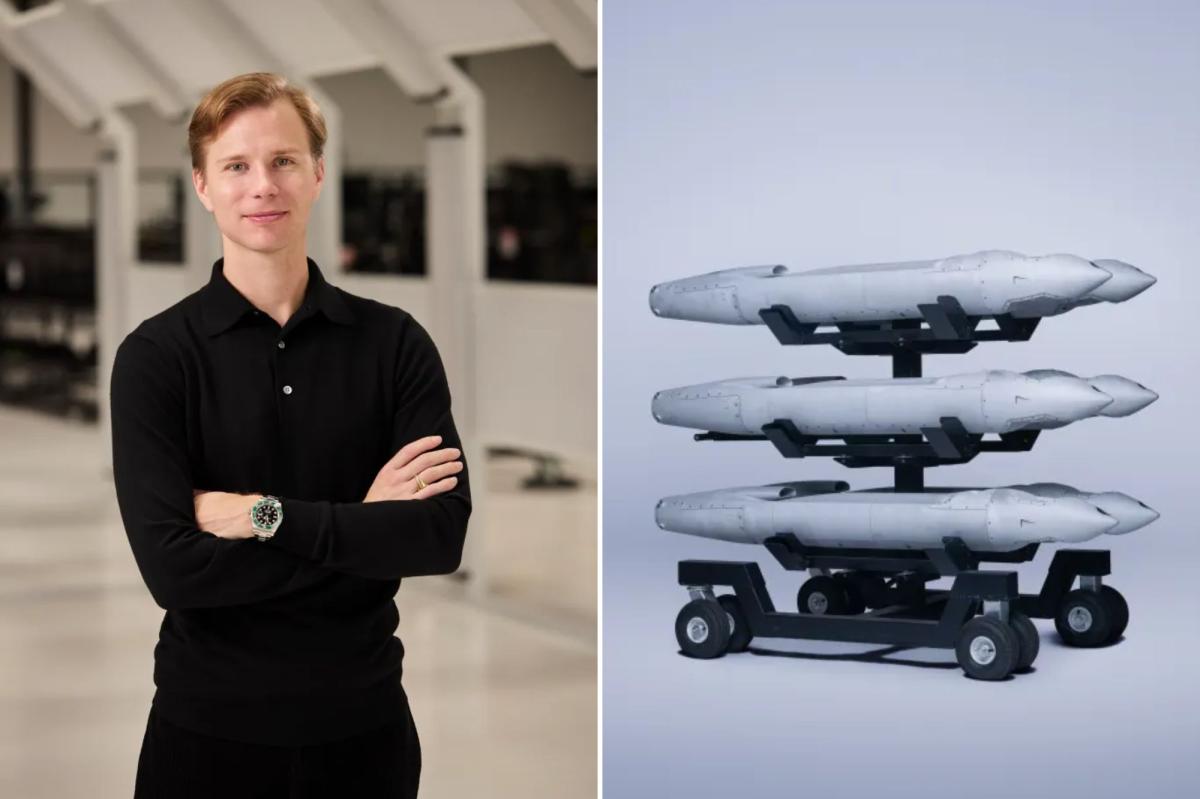
Divergent Technologies, the company best known for 3D-printing parts for everything from Bugatti supercars to Tomahawk missiles, is opening a massive factory in Long Beach, Calif., equipped with a new kind of industrial metal printer capable of producing more than 30,000 missile airframes a year.
The newly-unveiled Monolith One 3D printers are explicitly designed for high-volume, quick production of large parts. Situated in a new 430,000-square-foot factory, which can fit 64 Monolith Ones, this capability will allow a dramatic eightfold increase in output.
When the printers are fully online, the Long Beach site will be able to produce 60,000 warhead casings — in addition to the 30,000 missile airframes — and employ more than 1,000 people.
The move comes as the US pushes to replace depleted weapons stockpiles after years of conflict between Russia and Ukraine and, most recently, tensions in the Middle East. While the war with Iran appears to have wound down, Pentagon officials have made clear that replenishing inventories remains a priority.
“What is clear is that defense industry leaders recognize the need for greater production capacity across a range of systems. The ability to manufacture tens of thousands of missile airframes or warhead casings annually from a single facility represents a meaningful contribution to that broader defense industrial base,” Lukas Czinger, Divergent co-founder told The Post.
“What’s particularly significant is that this output is being generated from a flexible manufacturing platform. Historically, achieving high production volumes would require substantial investments in tooling, infrastructure and long lead-time supply chains,” he added. “We’re able to produce complex structures at scale while maintaining the flexibility to shift production as requirements evolve.”
That effort has put companies like Divergent on Washington’s radar. The company hosted Defense Secretary Pete Hegseth in January as part of his “Arsenal of Freedom” tour, which spotlighted efforts to rebuild America’s defense sector and re-shore our manufacturing.
For Divergent, it’s the latest expansion from a company that has spent the past decade developing technology to 3D-print complex metal structures.
The company’s DAPS (Digital Additive Production System) platform has already been used to build parts for major defense programs as well as lightweight components for supercars like McLaren and its very own Czinger supercar. Divergent also works with defense contractors including Lockheed Martin, RTX and General Atomics.
Unlike traditional defense supply chains, which often take months or years to deliver new hardware, Divergent says DAPS can collapse timelines into weeks or days by handling design, printing and assembly in one integrated system.
And Czinger notes the ability to be nimble is increasingly important.
“With DAPS, the same factory can manufacture different metal products simply by changing the design and production input … it dramatically reduces the manufacturing constraints associated with introducing new products or increasing output,” Czinger said. “As a result, we can respond to changing demand far more quickly than traditional manufacturing models that rely on dedicated production lines.”
The company has raised more than $1 billion since father-son duo Kevin and Lukas Czinger launched it in 2014. Most recently, Divergent was valued at $2.3 billion following a $290 million funding round last year.
The expansion is already underway, with the additional printers expected to come online over the next two years.
“This flexibility is increasingly important for missile systems, unmanned systems and other defense applications where requirements can evolve rapidly,” Czinger added. “Rather than building a factory around a single product, we’ve built a manufacturing platform that can be redirected as customer needs change, enabling faster scaling and greater responsiveness when demand surges.”
Disclaimer : This story is auto aggregated by a computer programme and has not been created or edited by DOWNTHENEWS. Publisher: nypost.com