
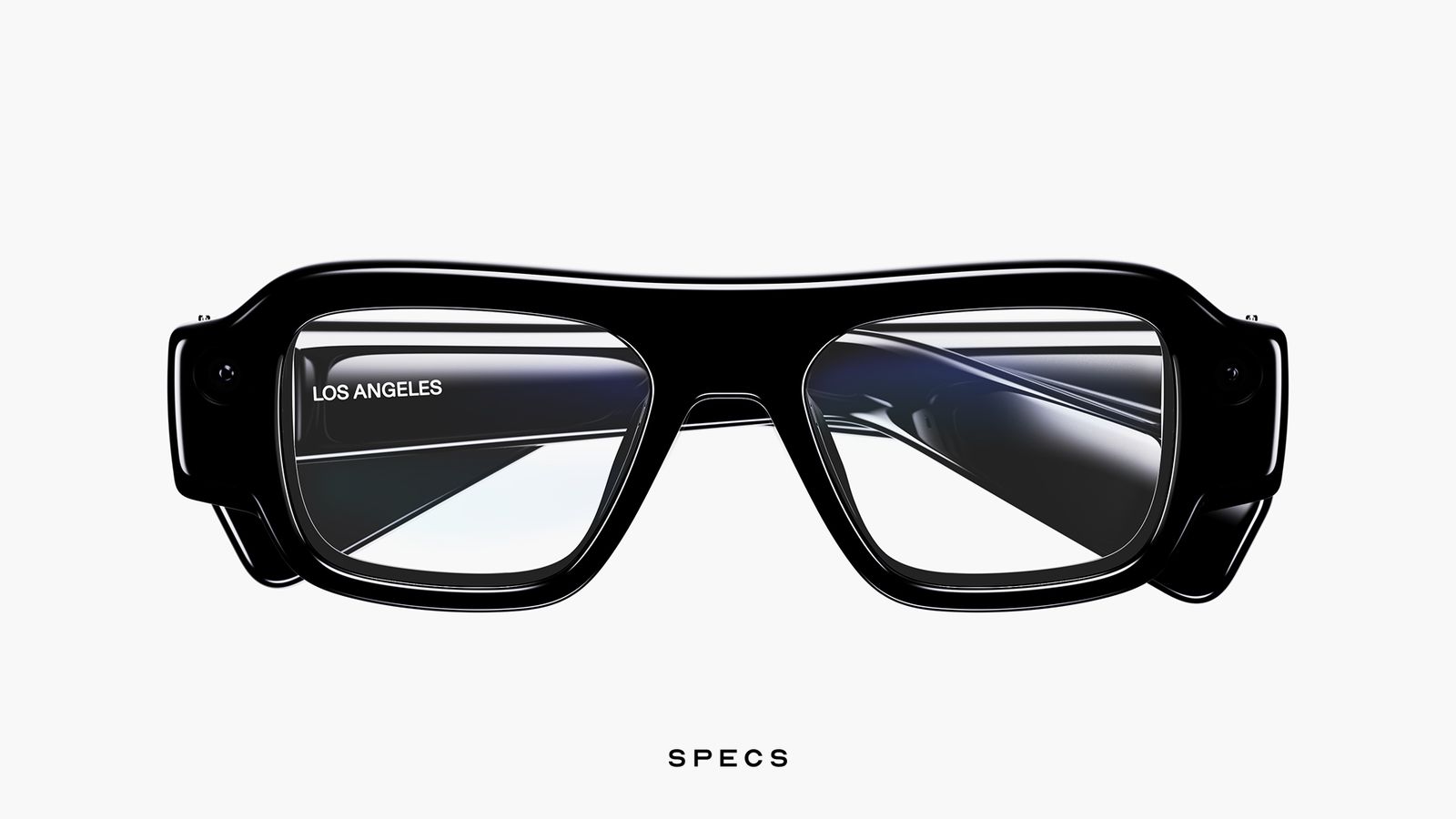
Snap—maker of the popular social app Snapchat—has a new pair of augmented-reality smart glasses called Specs. For real this time.
Snap CEO Evan Spiegel revealed the new glasses at an event during the Augmented World Expo (AWE) tech conference in Long Beach, California. As Snap frames it, this isn’t a prototype or developer device—it’s the first actual consumer version of the Specs AR glasses, unlike the previous generation exclusively sold to developers and creators.
The Specs cost $2,195. You can preorder them now with a refundable $220 deposit. Snap says it expects the devices to ship this fall in the US, UK, and France.
Snap has not yet said which apps or features will be available on the new Specs. The company’s focus for these glasses is less on content capture and more on the AR experiences displayed on the screen, placed with the right depth and low latency to feel like a moving part of the environment. Snap has shown off lots of experiential features in its previous demo units, like fingerpainting in the air, following map directions, or manipulating a 3D model of a globe. The company says this unit will have some of the same features, including private display screens, Bluetooth capability, web browsing, AI-powered visual assistance, and a “wide variety” of AR experiences that understand the room and the objects around the wearer. Other than that, Snap won’t yet say what these Specs can do. That depends on whether developers buy in to build on the platform.
“Specs will become meaningful because of the lenses you build,” Spiegel said onstage at AWE.
New Specs
Snap’s Specs are chonky, with big rims, honking arms, and thick temple tips. They look something like Meta’s beefy Ray-Ban Display glasses, albeit with more rounded corners. The Specs also have an AR display that covers a 51-degree field of view in the center of your vision, unlike the Display’s bottom screen.
The look is a much more refined version of Snap’s boxy AR Spectacles the company has made available to developers since 2024. They’re also fairly tasteful for a company that doesn’t have fashion partnerships like Meta and Essilor Luxottica or Google’s collaboration with Warby Parker and Gentle Monster.
“Some might actually say that oversized glasses are on trend at the moment,” Spiegel said to WIRED in an interview ahead of AWE. “For us, it’s less about following fashion trends and more about delivering truly standout capability.”
The frames come in two forms: one with 47-mm lenses weighing 132 grams and another with 52-mm lenses at 136 grams. That puts both of them at less than a third of a pound, which is half the weight of Snap’s developer demo AR Spectacles. The Specs get four hours of mixed-use battery life, though you can throw them in the case to charge them up another four times before having to plug the case in.

The lenses are liquid crystal on silicon microdisplays. When the AR elements play on-screen, they can occupy a 51-degree field of view in the center of your vision. The frames support prescription inserts, which can be swapped out for different users.
Within the frame itself are two unspecified Qualcomm Snapdragon processors, one dedicated to computer-vision tasks analyzing the real world around the wearer, the other dedicated to powering immersive experiences in the lenses. The cameras also track the wearer’s hand movements and the spatial environment. They’re in some ways similar to Xreal’s upcoming Project Aura smart glasses, which offer a full Android XR experience in a pair of glasses—except there’s no tethered battery pack in Snap’s version.
When the cameras are on, an indicator light appears dead center to ensure other people can tell the device is recording. (People have managed to disable those indicators on Meta glasses, so it’s likely only a matter of time here as well.)
Snap says you can also control what data is saved and deleted, and processing is done on the device. That means the Specs don’t need any companion app, compute puck, wristband, or other device to work. It’s all in the glasses.
ARound the World

A decade ago, Snap released its first Spectacles, round-framed lenses with mounted cameras that shot circular, wide-angle video. They were fun, cheap-ish, and had a very straightforward premise: capture videos you could then share on Snapchat. Despite the initial hype, they did not sell very well. Snap tried again in 2018 with the second iteration of Spectacles and again in 2019 with the Spectacles 3. The company has branched out into other hardware, too, including the Pixy Drone, a cute flying camera—which Snap quickly killed off due to overheating batteries.
Throughout all of that, Spiegel says Snap’s focus has been augmented reality. For him, focusing on social software felt like a natural progression to making hardware for people to use out in the real world.
“Really we started working on the hardware out of necessity,” Spiegel says, “because there wasn’t anyone else pursuing that vision for computing.”
In 2021, Snap announced its foray into augmented-reality headsets with the Spectacles AR. It released a subscription-only developer version in 2024. Snap has also pursued AR developer services, like its Lens Studio and partnerships with companies like Pokémon Go creator Niantic to develop apps and experiences that merge AR with the outside world.
High Price

Functional AR glasses have long been the white whale of the product category.
Spiegel and other Snap representatives who spoke with WIRED brought up their desire to avoid deploying a device that ends up like Apple’s Vision Pro headset, which was a technological wonder but entirely too expensive, bulky, and off-putting to be successful.
“To offer Specs at $2,195 was a Herculean effort for our team,” Spiegel says. “We really did want to be able to launch this device at a price that made sense for a lot of folks and especially our passionate developer community.”
It’s too early to tell if Specs will be a Vision Pro moment for Snap, but it will have to contend with the other behemoths in the smart glasses space. Meta has the market dominance, albeit with growing pushback as it sneakily introduces features like facial recognition. Google has agreements with companies like Samsung and Qualcomm to build out its own Android XR platform meant to pull in third-party developers en masse. And Apple, nursing its wounds from the Vision Pro, is rumored to be working on smart glasses.
Meta often copies Snap’s homework, implementing features over the years Snap came up with first to engage its users. In some ways, Snap is now following in Meta’s footsteps with smart glasses. (You could argue that Snap had the idea first, but Meta had the resources to pull it off.) Meta CEO Mark Zuckerberg has said he envisions a future where anyone not wearing smart glasses will be at a “significant cognitive disadvantage.” As I’ve argued, having a feed of updates beamed into your eyeballs at all times might indeed give you access to more information, but it’s also going to make lots of people act like real goobers in everyday social situations.
Spiegel says he wants to do things differently—what Snap has been doing all along with Snapchat; letting people interact with each other in a social space. He has a vision of collaborating with colleagues in a 3D space, or parents playing AR games with their glasses-clad kids in the backyard.
“We’ve all got these devices that we look down at and away from each other,” Spiegel says. “Specs is really the first computer that encourages you to look up and to use it and engage with other people in the world around you.”
Engage with other people wearing those $2,195 glasses, of course.
Disclaimer : This story is auto aggregated by a computer programme and has not been created or edited by DOWNTHENEWS. Publisher: wired.com




