
Republicans have expressed tentative skepticism of the agreement Donald Trump has reached with Iran, and urged the White House to release more information.
The memorandum of understanding (MOU) announced on Sunday to end the war in Iran, set for a ceremonial signing on Friday in Geneva, is centered around reopening the strait of Hormuz and lifting the United States’s naval blockade in the region, along with financial incentives for Iran if it meets certain benchmarks. Both Trump and JD Vance, the US vice-president, have digitally signed the document, along with Iran’s parliamentary speaker Mohammad-Bagher Ghalibaf on Tehran’s behalf, a senior US official confirmed.
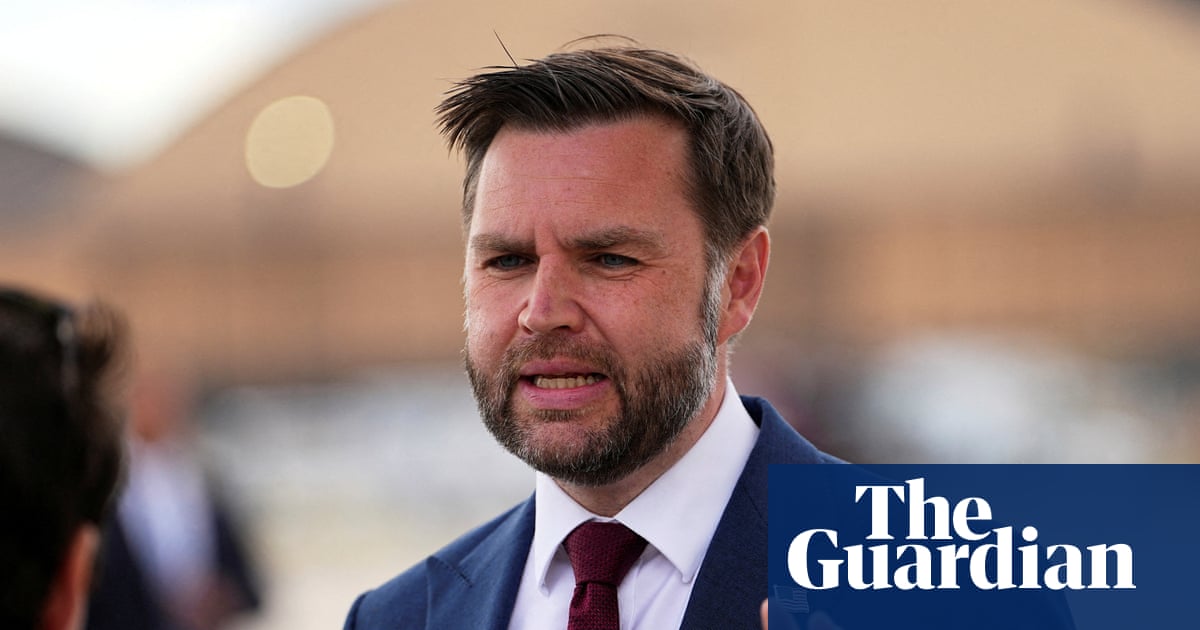
In an interview with CNN on Monday, Vance called it “a very general document” with specifics of the deal to be worked out during further negotiations.
“The MOU … is about a page,” Vance said. “On a number of issues, we are going to have to figure this stuff out during the technical negotiation phase.”
He also clarified in an interview with NBC News that the MOU is “about a page and a half” long – slightly longer than he had initially described – and confirmed that international nuclear inspectors from the International Atomic Energy Agency (IAEA) would be allowed back into Iran under its terms.
“One of the core parts of the agreement is that the IAEA and the United States are going to help Iran destroy the highly enriched stockpile, and that’s something that’s spelled out very clearly,” Vance said.
His comments came as many Senate Republicans who returned to Washington on Monday said there were still many unanswered questions about the deal and they need thorough briefings before it was finalized.
“I just don’t know enough about it,” Republican John Thune told reporters in the Capitol. “Even the people who follow this stuff closely up here don’t know that much about it.”
Congressional leaders and intelligence committees generally receive higher-level intelligence briefings before rank-and-file members, and they are notified of major developments before they are announced. But Thune, who is the Senate majority leader, said he had not been personally briefed on the deal.
“I think that my understanding of what it entails – and, again, not having seen anything … I think the issues are going to be compliance, and how are you going to enforce that,” Thune said.
Thune’s concerns were echoed by several other Republican senators. “If it’s a secret deal then how can I take it seriously?” asked Thom Tillis of North Carolina.
Democrats have also joined the call for more information, with US Senate minority leader Chuck Schumer demanding Trump “release the details publicly, brief Congress immediately, and end this war for good”.
Trump has not yet explained how his agreement will address Iran’s nuclear program, including who will be in charge of verifying that Iran is in compliance and who will destroy or remove highly enriched uranium believed to be buried under nuclear sites that were badly damaged by US strikes last summer. Vance said such questions would be addressed during a 60-day technical negotiation phase, adding that he expected IAEA access to happen “very quickly” given the “broad agreement” on the issue.
The MOU also includes the possibility of releasing Iran’s frozen funds, sanctions relief and a $300bn fund to help rebuild Iran if Tehran meets certain benchmarks, US officials told reporters on Monday. But the document has not been released.
Thune said he wants to know more about the conditions on the financial incentives for Iran. He said the deal would be a “good one” if the incentives are conditioned upon Iran winding down its nuclear program and getting rid of the enriched uranium, “preventing them from having a nuclear capability in the future”.
Iran agreed to sharply curtail its nuclear program in a deal signed in 2015 with the Obama administration. Trump withdrew the US from that accord during his first term as president. That agreement allowed Iran to regain billions of dollars in frozen assets, which Trump has frequently derided as sending “pallets of cash” to Iran.
Senator Lindsey Graham, a close ally of Trump and a longtime hawk on Iran, expressed scepticism over the emerging agreement, saying he wants to see the memorandum that the two countries have agreed on, and Congress will need to review and vote on it.
“The way Iran describes it, it’s awful. The way we describe it, it makes sense to me,” Graham said. “Let’s look at it and see what it actually is.”
But the current skepticism on Capitol Hill and among staunchly pro-Israel Republicans did not emerge overnight. When details of the framework first leaked in late May, senior Republicans launched a rare public rebuke of Trump, warning that the reported terms included major concessions that would strengthen Tehran and undermine Israel.
“We are at a moment that will define President Trump’s legacy,” Senator Roger Wicker of Mississippi, who chairs the Armed services committee, wrote in a letter. “His instincts have been to finish the job he started in Iran, but he is being ill-advised to pursue a deal that would not be worth the paper it is written on.
“Our commander-in-chief needs to allow America’s skilled armed forces to finish the destruction of Iran’s conventional military capabilities and reopen the strait.”
The criticism was amplified by staunchly pro-Israel Mike Pompeo, who served as Trump’s secretary of state during his first term, and declared the emerging framework “not remotely America First,” saying it amounted to paying Iran’s Revolutionary Guard to build a weapons program and terrorize the world.
The broadside prompted a profanity-laden response from the White House’s communications director, Steven Cheung, who told Pompeo to “shut his stupid mouth”.
Graham warned at the time that a ceasefire deal on the reported terms would be a “nightmare for Israel” and risked shifting the regional balance of power in Tehran’s favour.
Vance responded to Graham’s most recent diatribe on Monday, saying in an interview with ABC that he would “caution Lindsey Graham and anybody else not to believe the hardliner propaganda in Iran, but to believe what’s actually in the agreement.”
The Associated Press contributed reporting
Disclaimer : This story is auto aggregated by a computer programme and has not been created or edited by DOWNTHENEWS. Publisher: theguardian.com




