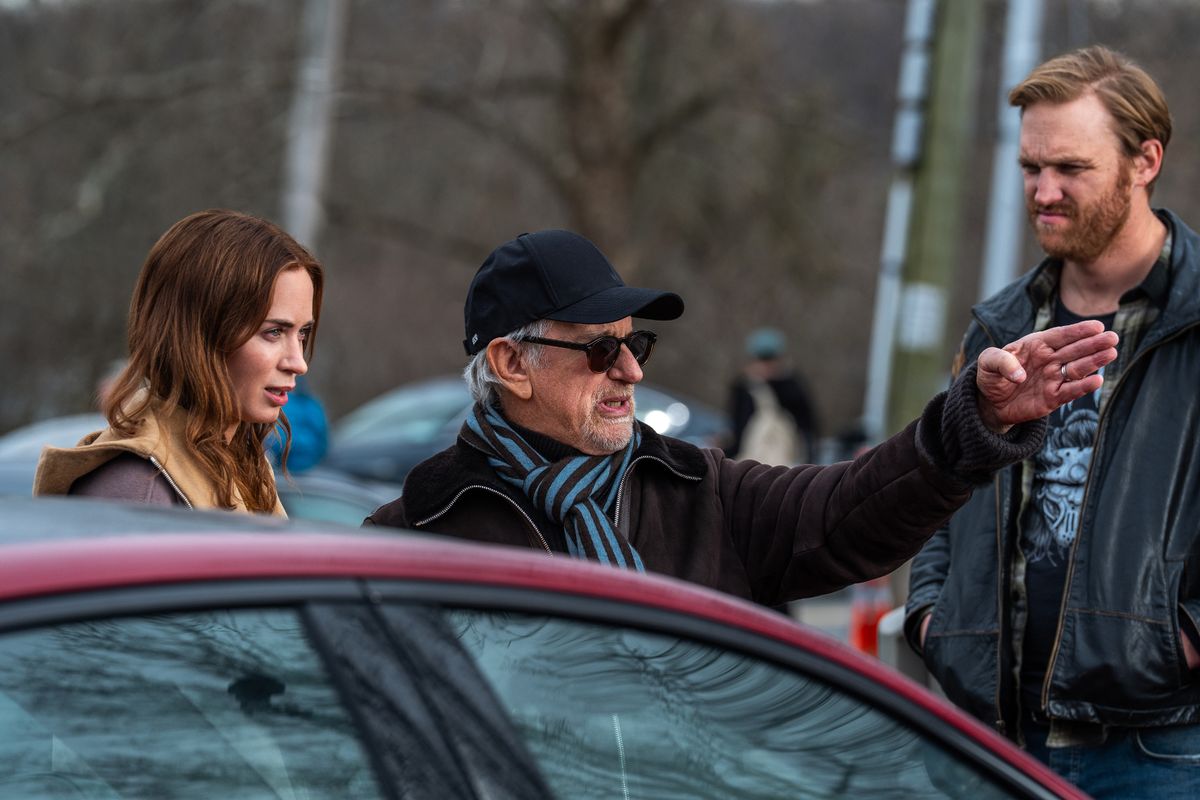
As three times Oscar winner Steven Spielberg’s latest film Disclosure Day rakes in £70 million worldwide in its first week, the master moviemaker has something of his own to divulge. While the notion of alien life has long provided him with a rich source of material, ever since his introduction to the wonders of the cosmos, as a boy he has strongly suspected we are not alone.
He says: “It made me start to imagine what could lie beyond the stars, what could be circling the stars, you know, and what civilisations like the one here could exist in the cosmos.” Born in Cincinnati, Ohio in 1946, his mum, Leah Adler, was a concert pianist, and restaurateur, who nurtured her son’s artistic streak, while his dad, Arnold Spielberg, was an electrical engineer and computer pioneer, with a pragmatic attitude to life.
Spielberg, who has three younger sisters, Anne, Nancy, and Sue – two of whom are in the movie business – moved around frequently because of his dad’s job, uprooting from New Jersey to Arizona and eventually California. Nineteen when his parents divorced – an ordeal that influenced his exploration of fractured families in much of his movie work – Spielberg had a tough time growing up.
He experienced anti-semetic bullying and struggled at school, because of undiagnosed dyslexia. He found an outlet in movie making – producing his first film, Escape to Nowhere, a 40 minute World War Two film shot on 8mm, and starring his school pals, aged 14.
But his awareness of planets and possible civilisations beyond earth was awakened way before then, thanks to an extraordinary experience with his dad. He says: “My dad talked about it constantly, about the night when he woke me up at 3 o’clock in the morning and brought me out to a park in New Jersey and got a picnic blanket.
“There were about 100 or 200 people on picnic blankets in the middle of the night and it was a meteor shower. [They happen] a couple of times a year and I had never seen one. It’s not like a light show, it’s not like the sky is exploding with meteors but, like, once every 30 seconds, a big light shoots across the sky and for a five-year-old kid it kind of introduced me to the sky.”
Entranced by the sheer magic of what he saw, he says: “It made me less afraid of the unknown. It made me more curious about it, than scared of it and it also made me start to imagine what could lie beyond the stars, what could be circling the stars, you know, and what civilisations like the one here could exist in the cosmos.”
Now 79, in a career spanning more than 5 decades, Spielberg has been honoured with copious awards, including two Oscars for Schindler’s List (1994) – one for best picture and the other for best director – and another best director gong for Saving Private Ryan (1999).
His filmography of more than 30 movies includes classics like Jurassic Park (1994) Raiders of the Lost Arc (1981) Jaws (1975) Lincoln (2012) Close Encounters of the Third Kind (1977) and ET (1982).
While he is seen as a sci-fi aficionado, he says: “After Close Encounters and after ET I kind of got into other subjects. I love biographies and I like history and I like the future and I like the past. I don’t direct a lot of contemporary movies.” But he returns to his fascination with space in Disclosure Day, starring Emily Blunt and Josh O’Connor – a sci-fi movie about a journalist seeking to expose the truth about UFOs and alien life.
Speaking on the Arts Hour, he says: “I kind of felt, believe it or not, that my science fiction trilogy was incomplete – it was lacking a third act. And I really was curious about continuing my exploration of the possibility of life visiting this planet, especially in our lifetimes.”
He felt inspired to write Disclosure Day after watching the build-up of UFO sightings, supported by photographic evidence – thanks to the advent of smartphones with cameras. He says: “In 2017 there was a New York Times story about a navy jet pilot who photographed something called a tic-tac [a kind of UFO] and it was on his targeting apparatus, called the FLIR, forward facing infrared camera – and it broke in the New York Times. It was a big, big deal.
“A lot of things started breaking in the papers because, with the advent of the smartphone, people started to back up eye witness testimony with video proof, or at least video support for what they had seen. We used to call these UFO flaps [sightings clustered within a specific area and time frame] back in the 50s, 60s, and 70s, but it became more than a flap around 2017. And then in 2023, I started working on a story that I just sat down and started writing, called Disclosure Day.”
Explaining the process of creating the story, which is already a box office smash, Spielberg, who is worth around £5.3 billion, says he is always compelled to write when he has a message to convey. He says: “I started with the concept. Whenever I write something, I have something to say. So, I figured out my themes. I figured out what I wanted to say, which took me into the third act.
“Then, once I figured out what I wanted the story to arrive at, then I went back to figure out who the characters were going to be, who could deliver the message and deliver the story. And the characters all sort of fell into place for me.”
Married to actress Kate Capshaw, 72, with whom he shares a blended family of seven children, Spielberg, who has various homes but lives mainly in Manhattan, continues: “It’s a pursuit story. It’s a pursuit to stop the truth from being unleashed on the world and it’s a pursuit to bring the truth to the world. “
The storyline sees the heroes of the piece trying to expose the government’s cover-up of extraterrestrial secrets. Spielberg says: “You have these two opposing forces. One group are our heroes on the run and another group, for me, is called a deep state contracting company, that has control of this archive with the history of every encounter on video from the old days of kinescope to 16/8 mm video, Betamax….it’s all there.
“They are just trying to figure out how to disclose this to the world and that is why the film starts asking the audience to put on their seatbelt and a shoulder harness, because it’s not going to let up once it starts.”
Despite his incredible success, Spielberg admits to first night nerves when his films are released. He says: “I get nervous about everything. The main thing – I get nervous about delivering a really good story. That’s where I put all my attention.
“When I’m directing, I get about 5 hours sleep a night. I make up for it on the weekends, but I don’t sleep a lot because it is a multi tasking kind of a job. And I get my best ideas in the middle of the night, which is why I have a tough time sleeping.”
Fans who worry that all this stress could become too demanding for a moviemaker of Spielberg’s age can relax. This is a man with a spring in his step, whose creative energy seems to know no bounds. He adds: “You’ve got to keep a lot of balls in the air and it never gets easier, it always gets harder and I think it gets harder as I get older. But that’s the fun of it.”
*The full interview can be heard on The Arts Hour on the BBC World Service, available on BBC Sounds
Disclaimer : This story is auto aggregated by a computer programme and has not been created or edited by DOWNTHENEWS. Publisher: mirror.co.uk