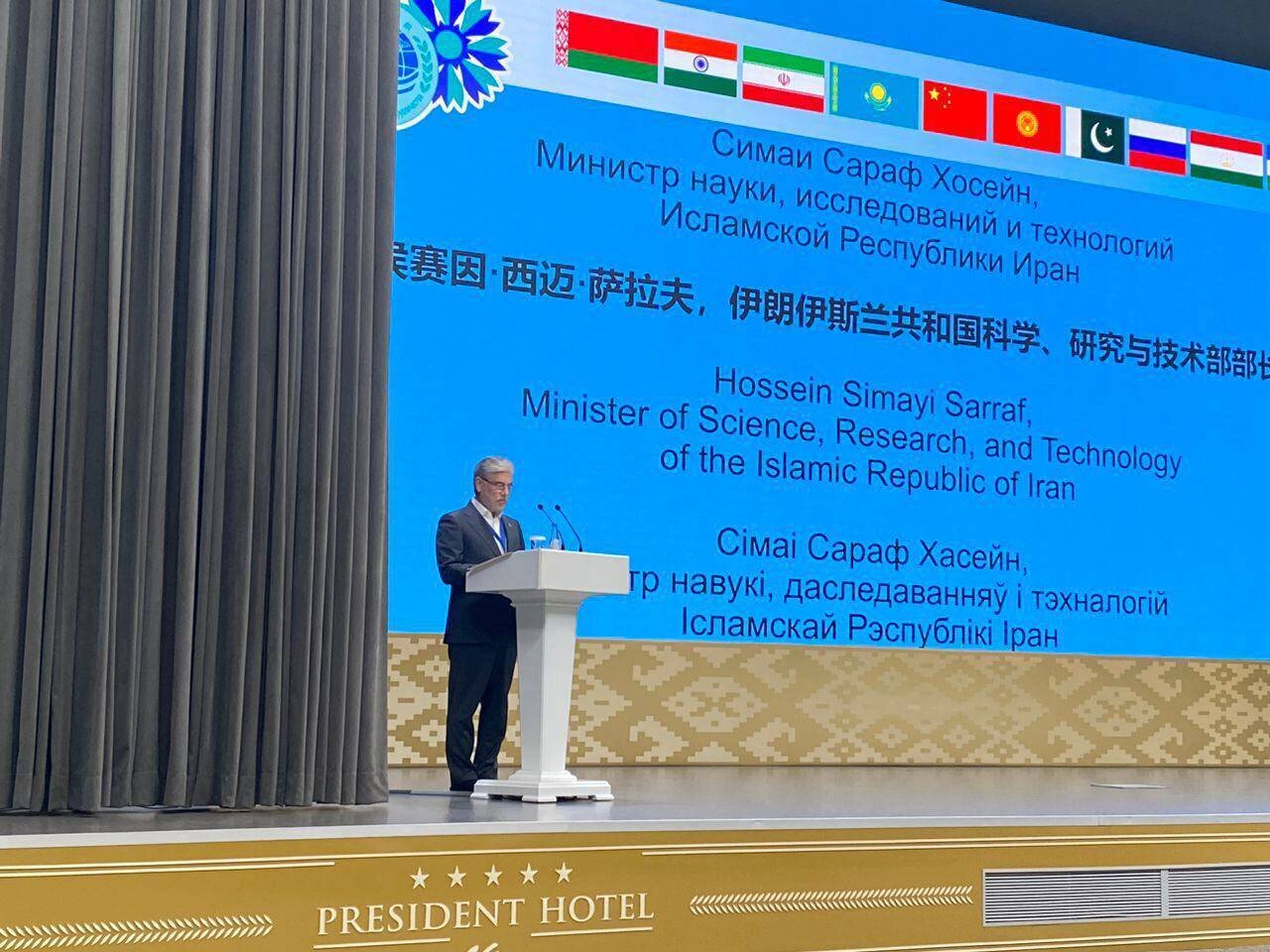
TEHRAN – Minister of Science, Research and Technology, Hossein Simaei-Sarraf, has put forward three proposals to enhance academic, research, and technological collaborations among the universities of the Shanghai Cooperation Organization (SCO) member states.
“Universities are custodians of shaping the future of societies. Today, they are faced with different challenges like revising curricula, making research projects applicable, making theses and research studies more useful to the societies. SCO can serve as a platform for member states to boost their academic capacities through an executive and problem-based network,” IRNA quoted Simaei-Sarraf as saying.
The official made the remarks while addressing the tenth meeting of the Shanghai Cooperation Organization (SCO) Education Ministers, which took place in Minsk, Belarus, on June 16 and 17. A delegation led by the science minister attended the meeting.
To promote scientific cooperation among member states, the science minister offered three proposals. The first one focused on ‘exchanging elites and scholars’. Accordingly, Iran is ready to grant 100 scholarships to post-graduate and Ph.D. students, and 10 more to post-doctoral researchers of SCO member states to do research on the real problems in the region under the supervision of professors.
The establishment of the ‘Shanghai technological and innovative universities network’ with the help of leading universities and technology parks was the second offered suggestion. According to Simaei-Sarraf, this network would provide the ground for commercializing scientific achievements and strengthening connections between universities and industry. He also announced Iran’s readiness to host its secretariat.
The ‘development of a collaborative research consortia in smart management of natural resources, particularly water, artificial intelligence, and modern pharmaceutical technologies’ was the third proposal, which is expected to be an effective strategy to improve the scientific capacities of SCO member states.
The science minister went on to say that the universities are not merely the centers of education, but they should be the standard bearers of rationality, entrepreneurship, hope, and international scientific cooperation.
The top universities of Iran, with all their laboratory capacities, growth centers, and scientific capabilities, will be there to implement these programs in cooperation with the universities of the SCO member states.
In his first speech at the tenth meeting, Simaei-Sarraf said that attacking universities is a crossing of red lines, highlighting that many universities and educational centers in the country were targeted by the United States and Israel during the recent war.
When a university is targeted, in fact, one of the most authentic centers of culture and civilization is attacked, and the harm is directed at the entire scientific community of the world, msrt.ir quoted Simaei-Sarraf as saying.
Elaborating on the US-Israeli military attacks on Iran, destruction, and assassinations of Iranian universities and scientists in the past year, he emphasized that universities should be safe havens for thought, dialogue, and hope, rather than victims of conflicts.
The official raised a question, asking participants, “Will the international community allow the most authentic centers of civilization to fall victim to violence?”, and urged the global scientific community and international organizations to adopt a clearer, more responsible, and decisive stance in defending the security of universities, scientists, and scientific centers.
Silence in the face of these aggressions will lead to constant violence against science and civilization, he added.
Referring to transboundary challenges such as climate change, water and energy crisis, food security, and developments in artificial intelligence (AI), he stressed that cohesive scientific cooperation is critical for the future of mankind.
The official went on to highlight the unique, civilizational and academic capacities of the SCO member states in AI, basic sciences, advanced materials, and public health, and emphasized the need to transform these diverse advantages into a network of cooperation, noting the universities’ success in the future will not only be measured by the production of pure knowledge, but their impacts on the quality of people’s lives.
The official went on to propose that SCO become a successful model of problem-based convergence in which knowledge is a bridge between nations and a factor for sustainable development, prosperity, and building a safer and more humane future.
Hosting more than 30 representatives of SCO member states, including ministers of education and their deputies, university rectors, and officials from relevant agencies, the tenth meeting aimed to enhance multilateral scientific and technological cooperation among SCO member states.
Belarusian Education Minister, Andrey Ivanets, held a meeting with Simaei-Sarraf. The official hoped the meeting would lay the ground for the expansion of scientific and technological cooperation between the two countries.
The Iranian minister, for his part, highlighted the strategic standing of the SCO and called for the enhancement of collaborations among member states in the technology sector to meet the shared needs of each nation.
MT/MG
Disclaimer : This story is auto aggregated by a computer programme and has not been created or edited by DOWNTHENEWS. Publisher: tehrantimes.com