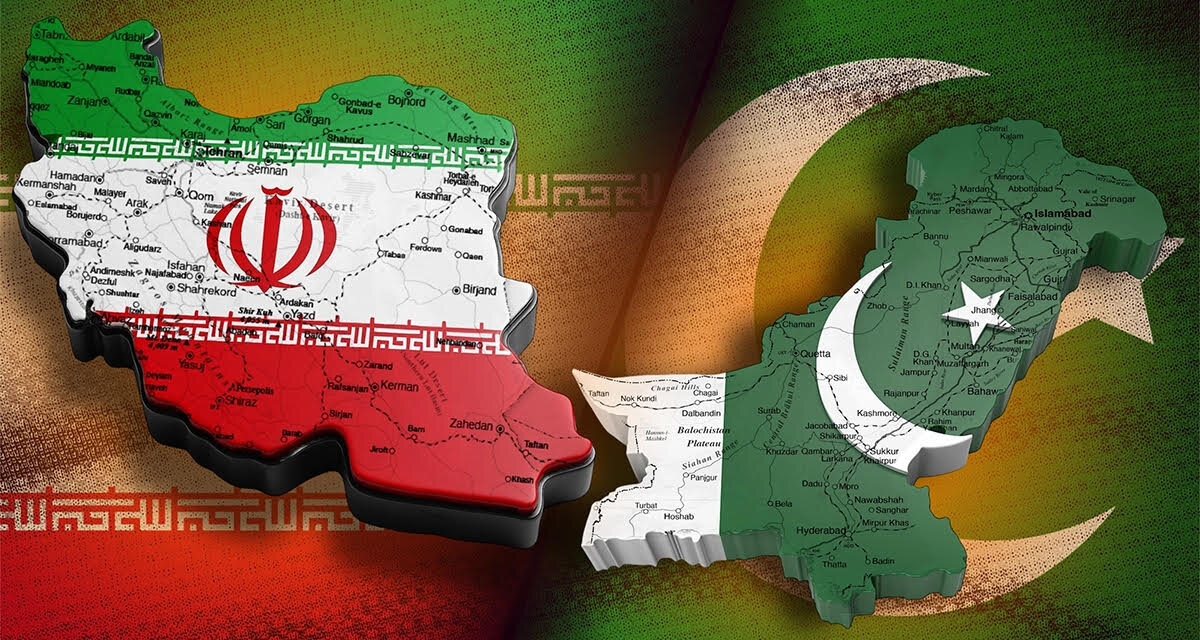
TEHRAN- Mehdi Heydari, Deputy Minister of Economic Affairs and Finance and Head of the Organization for Investment, Economic and Technical Assistance of Iran, held bilateral meetings on the sidelines of the 51st Annual Meeting of the Board of Executive Directors of the Islamic Development Bank (IsDB) in Baku with the Deputy Minister of Economy of Pakistan.
According to IRNA from the Ministry of Economic Affairs and Finance, Mehdi Heydari, Deputy Minister of Economic Affairs and Finance and Head of the Organization for Investment, Economic and Technical Assistance of Iran, in a meeting with Sajid Manzoor Asadi, Deputy Minister of Economy of Pakistan, while thanking for the support and effective measures of the Pakistani government in the recent developments in the region, emphasized that the relations between the two countries are strategic and this issue should also be significantly reflected in the economic relations between the two sides.
Referring to the numerous programs and issues on the agenda with the Pakistani side, Heydari added: The most important issue in increasing economic cooperation is the existence of banking platforms. Despite recent developments and the possibility of further openings, our bilateral economic relations should not be affected by external factors.
He pointed to the suitable capacity of Chabahar for investment and the presence of Pakistani nationals, the measures taken to create a joint free zone, and the provision of a platform for the presence of entrepreneurs.
Sajid Manzoor Asadi, referring to the brotherly and historical relations between the two countries, emphasized that the Pakistani government has always been a supporter and companion of the Islamic Republic of Iran.
He pointed to the capacity of border markets between the two countries and various areas of cooperation and said that issues should be pursued within a coherent framework.
He also announced the holding of the meeting of the Joint Economic Cooperation Committee and agreements between the parties, and declared Pakistan’s readiness to advance agreed-upon issues.
Heydari further emphasized the necessity of utilizing all available capacities, including the joint investment company, and said that the agreed axes will be formulated in the form of an executive agenda and presented to the Pakistani side.
Considering the capacity of Iranian contractor companies and the possibility of exporting technical and engineering services, he emphasized the government’s readiness to provide sovereign guarantees to support Iranian companies for presence in Pakistan’s economic projects.
The Pakistani side, while welcoming this proposal, raised the holding of a virtual meeting with qualified Iranian companies, and it was decided that the capacities of commodity trade and investment, including in border areas, will be one of the priorities of the cooperation program between the two countries.
In last December, Iranian and Pakistani business representatives agreed to pursue the creation of a joint trade committee and work towards boosting bilateral trade to $10 billion, during a meeting in Karachi aimed at strengthening private-sector cooperation and facilitating cross-border commerce.
The discussions were held between Iran’s consul general in Karachi, Akbar Issa Zadeh, the Federation of Pakistan Chambers of Commerce and Industry (FPCCI), and a delegation from Iran’s Qazvin Chamber of Commerce, according to Iranian state media.
The meeting focused on expanding commercial ties, identifying opportunities for joint investment in key sectors and addressing challenges hindering the growth of economic relations between the two neighboring countries.
FPCCI President Atif Ikram Sheikh, along with senior federation officials and sectoral representatives, underlined the importance of sustained efforts to raise bilateral trade volumes, stressing that both sides should capitalize on existing economic potential to reach the $10 billion target.
Participants discussed practical measures to deepen cooperation between the private sectors of Iran and Pakistan, with particular emphasis on increasing joint investments and strengthening industrial and economic partnerships.
Business leaders highlighted the need for continued support for entrepreneurs, streamlined legal and administrative procedures, and improved trade facilitation mechanisms to accelerate commercial exchanges.
Chambers of commerce were described as key drivers of economic relations, with participants reaffirming their readiness to actively follow up on joint projects and translate commitments into concrete outcomes.
The meeting also included separate talks between FPCCI officials and members of the Qazvin Chamber of Commerce and Industries, who are visiting Karachi to stage an exhibition showcasing the province’s manufacturing, commercial and export capabilities.
Private-sector representatives from both countries reviewed existing obstacles to trade and investment and stressed the need to establish a joint commercial committee to advance cooperation in strategic areas such as agriculture, petrochemicals, liquefied petroleum gas and energy.
Exchanges of business delegations and closer institutional cooperation between the chambers of commerce were identified as priorities for enhancing private-sector engagement and easing investment flows.
Participants said closer coordination between private-sector initiatives and economic diplomacy would be essential to sustaining momentum in Iran–Pakistan trade ties, adding that further meetings would be needed to develop and implement operational plans to achieve shared goals.
EF/MA
Disclaimer : This story is auto aggregated by a computer programme and has not been created or edited by DOWNTHENEWS. Publisher: tehrantimes.com