Compared to the country’s beer festivals, Germany’s wine fests are lesser-known gems offering a more relaxed cultural experience, writes The Local editor, Paul Krantz.
I recently had the pleasure of experiencing my first German wine festival. Specifically, I dropped by Würzburg’s Weindorf, an annual gathering where local winemakers set up tents in the Franconian city’s central square and serve some of their finest wines and fare.
Around the world Germany is known for its beer festivals, but the nation’s rich wine-making culture and related festivals often go overlooked.
For those who prefer a glass of white, red or sparkling to a Maß of Helles, the choice here is obvious. But what surprised me, a confessed beer-lover, about my initial wine festival experience was how relaxed and accessible it was to all.
Whether you’re a wine connoisseur, or simply looking for a fun new experience, here are four reasons to get yourself to a German wine festival this year – as well as a few you can still catch.
A calmer festival environment
Germans, and especially Bavarians, insist that beer festivals here are family-friendly environments. (Anyone else remember when the state of Bavaria outlawed cannabis at Oktoberfest, because it was a “family festival”?)
For the record, I would generally agree. I’m always pleasantly surprised to see families at these festivals, but it should also be acknowledged they can sometimes get quite rowdy. On the whole, an Oktoberfest beer tent after 6pm is no place for a child.
In comparison, wine festivals offer a more relaxed – and dare I say a touch more sophisticated – atmosphere.
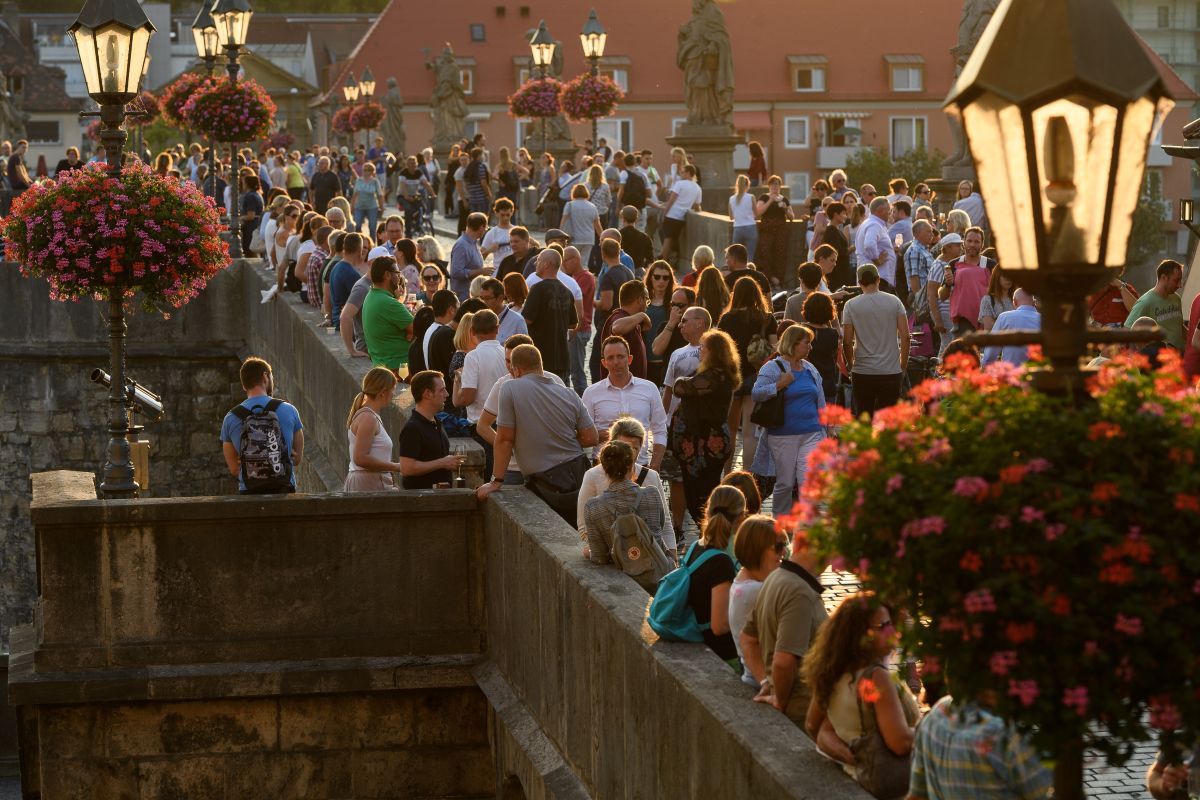
Compared to the loud, crowded and often overwhelming experience of squeezing into a beer tent, the ‘wine village’ in Würzburg felt more like a festive farmer’s market – just one soaked in the region’s wines.
Seated around the various wine-makers’ kiosks were all kinds of different groups: couples, friends, families, pensioners and bachelorette parties. Some people seemed to be locals stopping by for a single glass of wine whilst out on a walk with their dogs, whereas other groups were clearly prepared to settle in for a long day.
Of course some wine fests will get a bit wilder than others. But if you’re looking for a more easy-going affair, rather than an evening that ends with people standing on the tables and hollering classic rock song lyrics, a wine fest is probably the better option.
People gather on the Old Main Bridge in Würzburg at sunset. Photo: picture alliance/dpa | Daniel Peter
Discover the best local wines
This should be obvious, but one key reason to visit a wine fest is to discover some amazing German wines. Even better, you can expect to try plenty of those from the local region.
So not just German wines, but specifically Franken wines if you’re in Würzburg or Bamberg, for example – or Rheingau, Mosel, Nahe or Baden wines if you’re in those regions.
READ ALSO : Eight German wines you have to try
If you live in or near a wine-making hub, this makes for a great opportunity to find your personal local favourite. If you’re travelling, it’s a chance to get to know what’s good from the region you’re visiting.
Oh, and by the way, drinking local has a number of positive benefits: the wine itself is fresher and reflects the character of the region in a way that mass-produced wines can’t. You’re also participating in more sustainable commerce by supporting smaller businesses, and cutting out the need for larger-scale manufacturing and global shipping processes.
So yes, you can feel good about ordering one more glass.
It’s surprisingly affordable
Alcohol in Germany is generally cheap, but beer prices at the festivals can be shockingly high. Not so at the wine fests, in my experience.
READ ALSO: How does the cost of alcohol in Germany compare to the rest of the EU?
At this year’s Weindorf glasses were going for around €5. These were 0.25 litre glasses. (And every kiosk I saw was pouring well above the line).
That’s a bargain compared with the roughly seven euros I’d expect to pay for a 0.1 litre glass at a wine bar in Berlin or Munich.
And if you come with a small group you can save a bit more by buying in bulk: Magnum bottles seemed to be a popular choice at tables where groups were gathered.
It’s not only about the wine
While wine is, naturally, the primary focus at a wine festival, there are also plenty of other drinks (and foods!) to be found here.
For those who don’t drink alcohol, every wine tent I saw had a non-alcoholic wine on offer.
Or, for those who simply prefer something else, you can find an assortment of other seasonal drinks to try. I particularly enjoyed the Erdbeerbowle, essentially a strawberry spritz that tasted like a refreshing strawberry soda but apparently with the strength of sparkling wine. (Here’s a recipe if you want to try it at home.)
Should you want something to help hold you down after a couple glasses, there’s plenty of hearty German fare to be had.
And to top it all off, what is a wine fest if not an invitation to visit another of Germany’s many charming cities that you haven’t yet had a chance to explore?
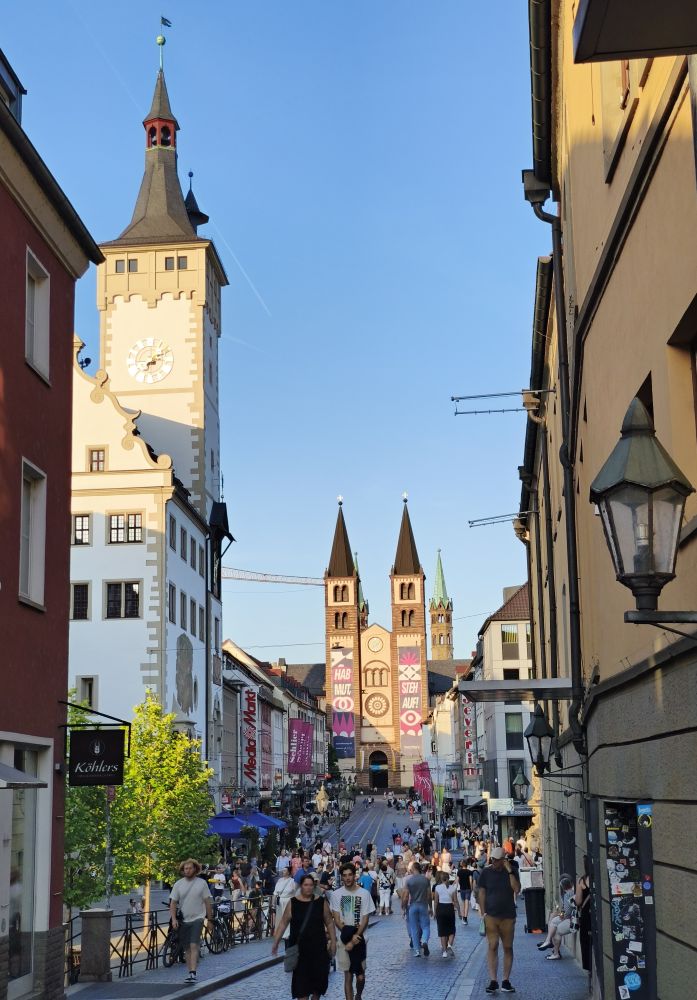
View of a pedestrian street in Würzburg. Photo by Paul Krantz.
With that in mind, here are some of the country’s bigger wine fests still to come this year, in case you want to start making future plans for a weekend trip.
On the calendar:
I attended Würzburg’s ‘Wine Villlage’ festival which ended on June 10th this year, but there are many more similar events to be found in the wine capital of Franconia. A couple of the bigger ones include Wein am Stein from July 9th to the 26th, or the city’s ‘Wine Parade’ from August 27th to September 6th. You can find more of Würzburg’s wine events listed here.
The Freiburger Weinfest takes place around the south-western city’s cathedral from July 2nd to the 7th this summer.
And in the Ahr Valley, the Burgunderfest in Bad Neuenahr-Ahrweiler, always falls on the last Saturday in July (this year on the 25th).
Rheingau Wine Week in Wiesbaden (August 14th to 23rd) is known for turning the city’s main market square into the “longest wine bar in the world”.
Stuttgart has its own ‘Wine Village’ from August 20th to September 5th.
Lastly, despite being called a “sausage market”, Bad Dürkheim’s Wurstmarkt is said to be the largest wine festival in the world – taking place on the second and third weekends in September (11th-15th and 18th to 21st).
Disclaimer : This story is auto aggregated by a computer programme and has not been created or edited by DOWNTHENEWS. Publisher: thelocal.de