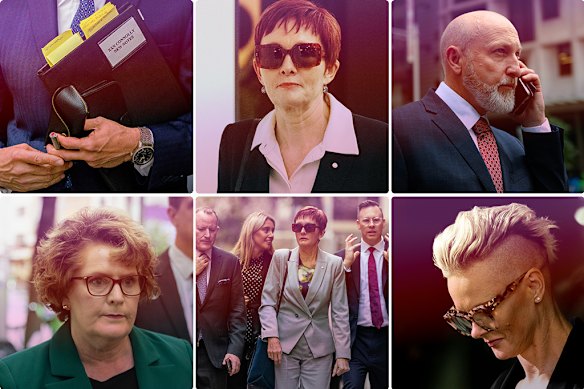
It was the public showdown where big netball mum energy faced a glacial force. A scrappy, profane gaggle of local government staff met the methodical legal eagles scrubbing away at the dishes after a picnic. The Pink Ladies who tried to take over Parramatta versus the Independent Commission Against Corruption.
What has unfurled over six weeks at the ICAC is more than a tale of friendship and forged signatures and 40th birthday celebrations in matching pink shirts. The allegations raised at the commission – that three women known as the Pink Ladies of Parramatta plotted, in effect, to take over the council’s staff by stacking it with their friends and cronies, with the chief executive placing herself above elected officials by withholding information and spying on one of them – go to the very heart of trust and transparency in local government.
They delve into the murky world that exists in the highest echelons of the lowest level of government, where council bosses traded staff and information, and jostled for power.
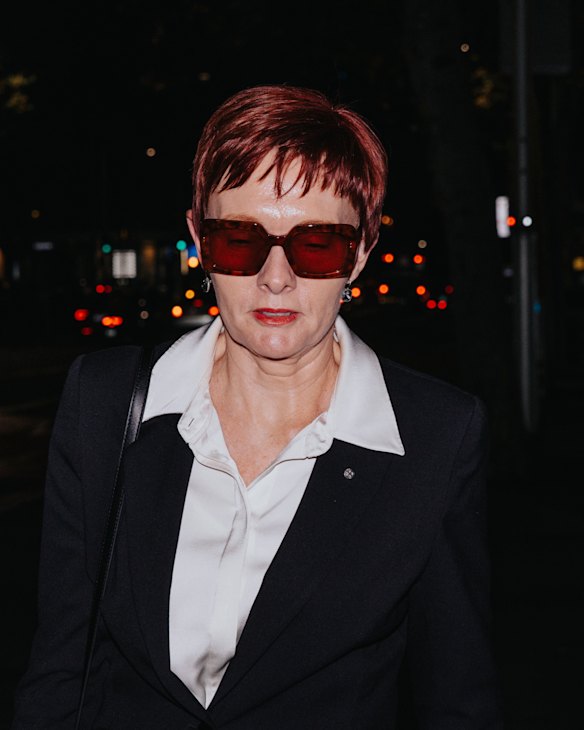
Some of the themes have been universal. When does a colleague become a work friend, and when does a work friend become a close personal friend?
Some have been specific. At what point does giving a mate some feedback on a CV morph into slipping them the questions in advance, and improperly filling in a disclosure form become subversion of the recruitment process to corruptly benefit associates?
The Pink Ladies had a plan. It all came undone.
The Witches of Eastwick
Three targets are in the ICAC’s sights: Roxanne Thornton, a group manager in the office of the lord mayor and chief executive; Angela Jones-Blayney, an executive director for “city engagement and experience”; and Gail Connolly, the sacked chief executive and Pink Lady No.1.
Behind their backs, they were called many things. Blanche from The Golden Girls. Umbridge from Harry Potter. The Witches of Eastwick, with the blonde Thornton cast as Michelle Pfeiffer, redhead Connolly as Susan Sarandon and Jones-Blayney happy to take on the third role: “I love Cher.”
In group chats they preferred to think of themselves as Pink Ops, or Pops, a term that later turned into the Pink Ladies. It was in these messages, the ICAC alleges, that their ambitions were laid bare.
Jones-Blayney told Connolly in 2022: “We need to land Parramatta so we can bring them all over with us to create a fabulous new entity!” After Connolly won the job in late March 2023, there was much gushing and effusive praise. Connolly sent a message to Thornton and Jones-Blayney saying there had been three “resignations” in three weeks. In July, she told them: “Hopefully by the end of next week I will have two pink ladies about to come on board at Parra!”
The ICAC alleges that Connolly abused her power to have staff leave the organisation on huge payouts while having the system manipulated to have her friends employed. The evidence also lays bare the impacts on the council and community, and exposed the power dynamics at play in local government.
Connolly’s network extended to MPs, senior officials and highly paid executives at other councils. While none are accused of wrongdoing, the commission picked apart Connolly’s connections to explore whether she had an undue advantage even before she signed the $512,000-a-year contract at Parramatta.
Connolly is a lifelong council bureaucrat. She worked at the City of Sydney in the 1990s and again from 2010 to 2012, along with stints at Campbelltown and Gold Coast councils. After being chief executive of Ryde and Georges River councils, Connolly briefly worked as a consultant for the state planning department and council watchdog, the Office of Local Government, where she helped produce a report that changed the rules about councillor misconduct – rules that would ultimately be used against her during cross-examination.
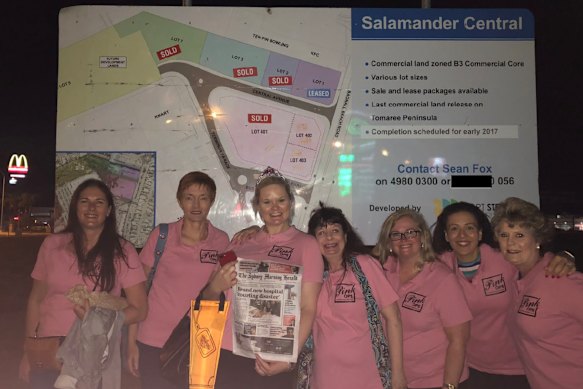
The Pink Ladies were born at the City of Ryde. The social group came about, Connolly told the inquiry, in reaction to sexist exclusion from the secretive operations of a group of male council staff under the previous general manager. “Someone at Ryde, I can’t remember, who used to work there said, ‘well … if the men can have Black Ops then the women can have Pink Ops’.”
The group was firmly established by the time seven of them gathered in November 2018 for Thornton’s 40th birthday. They had T-shirts made bearing a Pink Ops logo that described them as “founding members”.
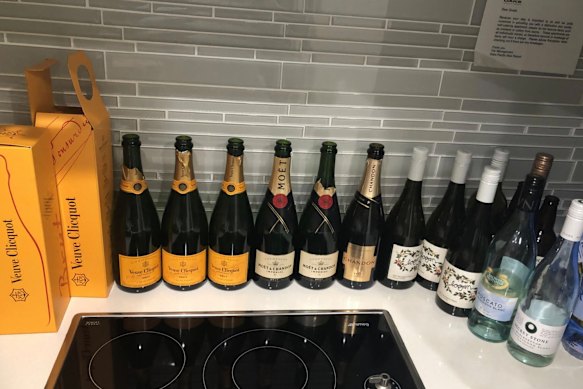
In their WhatsApp group chat, the Pink Ops exchanged thousands of messages about work, jobs, gossip and weekends away with Veuve Clicquot.
Even in this circle, two confidantes were trusted above the others.
Connolly and Jones-Blayney first worked together at the City of Sydney in the 1990s. They were reunited at Ryde; Connolly was the boss and Jones-Blayney managed customer service, then media and communications, and briefly acted as chief operations officer under Connolly.
Thornton had just won a promotion at Ryde when Connolly arrived. The pair worked closely together, one manager apart, and it evolved into a “mentorship-type relationship”, Thornton said.
Connolly and Thornton later worked closely at Georges River Council, particularly during the COVID-19 pandemic, when they were both considered essential staff. When Connolly’s contract for the top job at Parramatta came along, she turned to Thornton to act as a witness.
This was fine for a digital signature, but the council wanted to see that wet ink had been put to paper. In March 2023, Connolly was confronted with a deadline. The offer had been made, the contract was in hand, but the council was due to debate a rescission motion. Having a signed document would end the matter, which Connolly characterised as a political move to embarrass then-lord mayor Donna Davis.
The only problem was Thornton and Connolly were not in the same room.
Text messages suggest how Connolly dealt with it. “Just wrote your signature,” she texted Thornton, along with a photo, in evidence aired at the inquiry.
“F—, that’s pretty good,” Thornton replied.
Connolly testified that Thornton witnessed her signature via FaceTime and that it had become a common post-COVID practice in local government for signatures to be witnessed by such means. She said she had printed out Thornton’s electronic signature and written over the top of it; after the hearing’s lunch break and confronted with discrepancies between Thornton’s electronic signature and the contract, she then said she traced over it using a light box.
Under questioning and cross-examination, Connolly was adamant she had Thornton’s permission.
Arthur Moses, SC, acting for the council, accused Connolly of starting her deception before the job and continuing until she sat before him in the witness box. Moses said she had shifted her evidence because she had been caught out in a lie. Connolly denied this. “I don’t agree it was deception.”
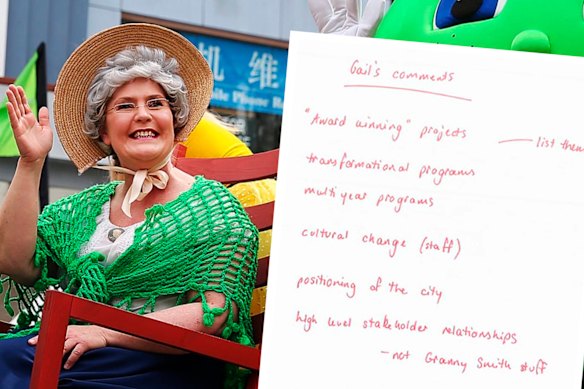
As well as polishing each other’s egos, the Pink Ladies buffed up their CVs. When it came time to bring Jones-Blayney to Parramatta, Thornton did the rewriting and reworking to include “Gail’s comments”: list the award-winning projects and focus on transformational programs and high-level relationships. “Not Granny Smith stuff,” the Pink Lady said, a reference to Jones-Blayney’s work producing the Eastwood festival dedicated to celebrating the creation of the famous apple variety, where she also appeared as the character.
Connolly also handed over a helpful compilation of documents on the sidelines of her daughter’s netball match; she told the inquiry it was publicly available information and that she had done the same for other prospective council employees. What she did not do for other candidates was provide the interview questions in advance: only Jones-Blayney got those.
For Thornton, the ICAC alleges Connolly helped her friend twice. First, after a redundancy, the position of chief governance and risk officer was created without the requirement for a tertiary qualification, making Thornton suddenly eligible. Connolly reviewed the position description and Thornton’s résumé.
Before starting that role, Thornton was designing organisational structures for Connolly. Included in the structure was a job Thornton later held running the office of the lord mayor and chief executive. Again, it helped that she had the interview questions in advance.
There was also the curious case of Pink Lady No. 4, Michelle Carter, who was not named by the ICAC as a target of the inquiry. For her job, Jones-Blayney had Carter write the position description for the role to which she was directly appointed.
Chief Commissioner John Hatzistergos asked Jones-Blayney if she was embarrassed about this. “I saw it as a peer review and at that stage I wasn’t even 100 per cent sure if she would be interested [in the job],” she answered.
‘Let the games begin’
From the first moments of Connolly’s employment, there was tension. A senior executive had reported the “irregular negotiation practices” that led to her contract being signed to the ICAC. Staff began to disappear.
Bernadette Cavanagh, the council’s HR boss, was confronted by Connolly over a refusal to provide confidential information before she had signed a contract. Shortly afterwards, Connolly asked: “Do you want a redundancy?”
“If it’s only going to happen in three months, just do it now,” Cavanagh, not accused of any wrongdoing, recounted telling Connolly.
It’s alleged this was not a true redundancy: Cavanagh’s position was soon filled. But Connolly offered a $350,771.31 payout to exit the organisation immediately, with a strong confidentiality clause.
It was the first of many payouts under Connolly’s watch: millions of ratepayer dollars were used to have staff leave under secret terms. Some were because Connolly did not like them, others came after a series of “investigations” that the council had run into staff members’ Teams messages.
Shannon Kliendienst, a council manager also not accused of any wrongdoing, was brought into Connolly’s office with screenshots of messages her staff had sent on Teams about Jones-Blayney. Connolly gave her the choice between resigning and being terminated.
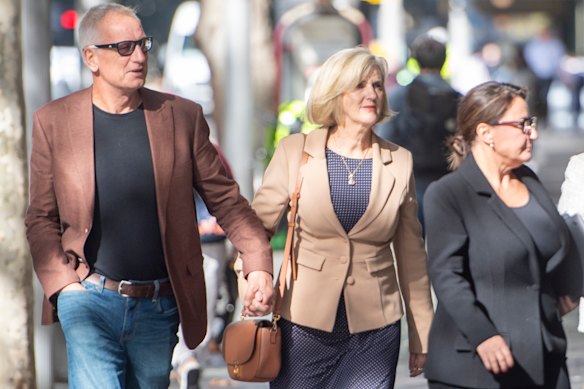
The messages Connolly had found were not incidental. They were part of a string of what she said were 30 to 40 investigations into staff misconduct running at any time. Connolly frequently ordered the searching of emails without a clear reason, the council’s former head of IT, John Crawford, told the commission.
After the Herald reported on plans for the council to pay millions of dollars sponsoring the Parramatta Eels, Connolly had the emails of all 1200 council staff – and councillors – searched. No leak was found.
Connolly had a particular interest in one councillor who, she told the inquiry at various points, asked too many questions, was the subject of numerous code of conduct complaints and freedom-of-information requests. Kellie Darley, an independent elected in 2021, had questioned the wisdom of a council paying to sponsor a commercial sports club, and became a frequent target of Connolly’s investigations.
Connolly ordered the searching of her phone records and emails to ascertain whether she had been speaking with any of the staff who’d left the organisation with payouts, and to see whether she had been leaking confidential information to the Herald. She had not.
Things ratcheted up further when Justin Mulder, the council’s chief of staff, left with a payout and secrecy clause. Mulder soon announced he was running with Darley on a platform of “restoring integrity to council”. Connolly perceived the duo as a threat, he told the commission.
Nine days out from the September 2024 local council elections, at 11.08pm, councillors and two journalists received an anonymous email from someone claiming to be a former council employee. They alleged that Mulder had committed “timesheet fraud and systematic corruption” by signing off the timesheets for a council delivery driver who had worked at the council for more than four decades.
“Are you familiar with this email?” counsel assisting Joanna Davidson, SC, asked Connolly on the second day of her evidence.
“Yes, I am.”
“Do you know who sent it?”
“I did.”
Connolly said it was sent because she had been concerned the complaints about fraud “had not been progressed” and that the driver had been behaving in a way that was threatening the employment of Thornton and current HR boss Brendan Clifton.
She worked with other councillors against Darley, too. The Liberal Party’s Georgina Valjak, Labor’s Patricia Prociv and former Our Local Community councillor Michelle Garrard all provided information about Darley or expressed support for Connolly’s methods (none returned requests for comment). In one text exchange, Garrard sent photos to Connolly, appearing to show her opening posted mail addressed to Darley. Inside was a list of staff who had been made redundant or had their positions terminated. Darley never received the letter.
Mulder was not elected, but the council’s dynamic shifted against Connolly. And it was when the ICAC came calling that it started to fall apart. She was sacked in October after a fiery late-night council meeting, while Thornton and Jones-Blayney remain on the books but on leave.
When Davidson outlined the accusations on May 11, even those close to the council were surprised at the detail.
For weeks Davidson was exacting in her questioning and ratcheted up the tension. But it was when Thornton was in the crosshairs of Moses that she broke.
Thornton had put on a brave face for the cameras every morning, but spent the final minutes of her evidence in tears.
“I’ve played the game, you know, I’ve, I’ve admitted to everything, but this public shaming … I mean, you should all be f—ing ashamed of yourselves, you know? You just keep kicking me,” she said.
Jones-Blayney came armed with blame to share. She told the inquiry she arrived at Parramatta to a revolving door of councillor complaints and serious issues concerning budget blowouts, secondary employment, procurement procedures and performance management.
She was shown messages that said: “Pink Ladies play the long game” and that it was a marathon, not a sprint.
“I say that to everyone about everything,” Jones-Blayney answered.
Connolly was in for a marathon.
Pink Lady No.1
There are 23.2 kilometres from the red-encrusted PHIVE building that houses Parramatta Council chambers to the grey marble and glass of the ICAC headquarters in Elizabeth Street. But the longest stretch must feel like the last steps from the door of the hearing room all the way to the witness stand.
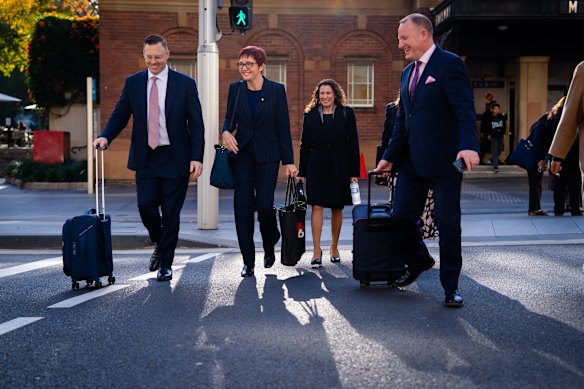
Connolly walked down Castlereagh Street at 9.53am on June 4 ready for her close-up, but it was not until 11.13am that she was affirmed and began her public evidence.
For five days, Davidson was deliberate and polite. Moses, acting for the council, dispensed with the pleasantries.
He began with a one-two punch: “Have you heard of the expression ‘hypocrisy is the audacity to preach integrity from a den of corruption’?” Connolly said she had not.
“On reflection after sitting here now for nearly six days … do you accept that when you were the chief executive officer of the City of Parramatta Council, you lectured councillors and employees on the need for them to discharge their duties with integrity, whilst yourself failing to act with integrity? Do you accept that now?” Connolly did not accept this.
As Moses’ inquisition continued late on Tuesday, he accused Connolly of withholding information that the councillors were not only entitled to but needed to ensure she was doing her $500,000-a-year job properly.
“You’re not willing to accept the proposition that you ultimately are accountable to the councillors. They are not accountable to you. You refuse to understand that, don’t you?”
“No, I disagree.”
Late on Wednesday, the public inquiry adjourned with the warning that further hearings may be necessary. But not without a final re-examination from Davidson trying to pin down how Connolly’s niece ended up working at Parramatta.
In the end, even Davidson’s patience wore thin: “You’re simply making up your evidence on this subject as you go along.” Connolly, as ever, did not agree.
With Ellie Busby and Cindy Yin
Start the day with a summary of the day’s most important and interesting stories, analysis and insights. Sign up for our Morning Edition newsletter.
Disclaimer : This story is auto aggregated by a computer programme and has not been created or edited by DOWNTHENEWS. Publisher: www.smh.com.au