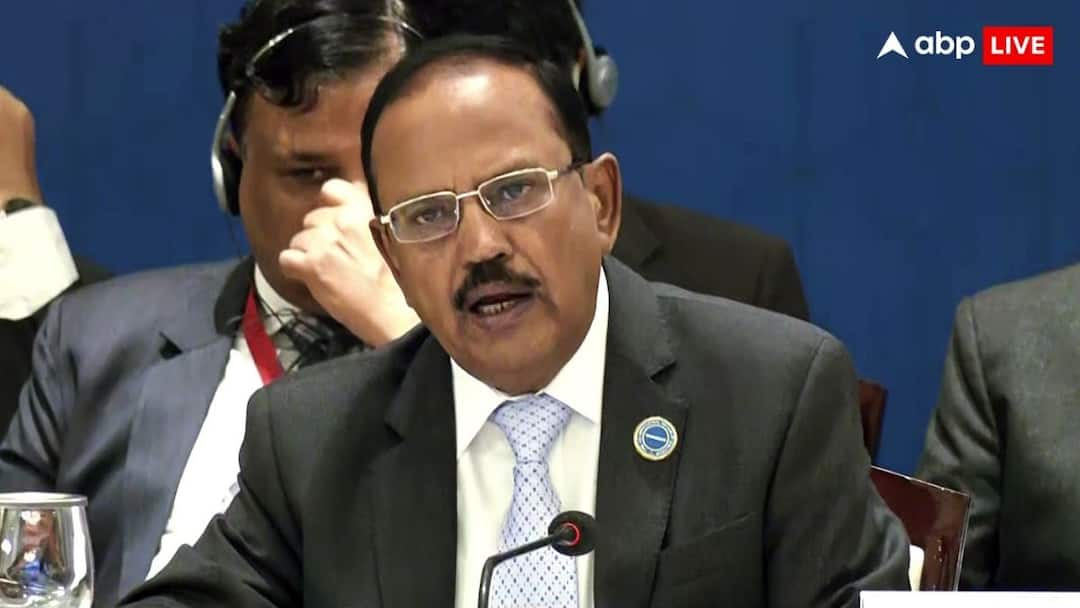
India will host the BRICS National Security Advisers’ Meeting on June 22-23, with National Security Adviser Ajit Doval chairing the discussions, the Ministry of External Affairs (MEA) announced on Saturday.
The meeting will bring together National Security Advisers and heads of delegation from BRICS member nations to deliberate on the theme, “Non-traditional security challenges confronting the world today.”
Also Read: ‘What PM Has Said Is Right’: Tharoor Backs Modi Over Trump Meet; BJP Says MP Has ‘Exposed’ Rahul
Global Security Threats Will Be Discussed
Participants are expected to exchange views on the evolving nature of global security threats, including the growing impact of emerging technologies on national and international security.
India will host the BRICS National Security Advisers’ Meeting on 22-23 June 2026. The meeting will be chaired by Ajit Doval, National Security Adviser of India.
During the meeting, the National Security Advisers/Heads of Delegation of BRICS Member Countries will exchange views…
— ANI (@ANI) June 20, 2026
According to the MEA, the delegates will also review the outcomes of recent BRICS Joint Working Group meetings on counter-terrorism and the security implications of Information and Communication Technologies (ICTs).
India Assumes BRICS Chair For 4th Time
The gathering comes as India assumes the BRICS Chairship for the fourth time, following its previous stints in 2012, 2016 and 2021. New Delhi’s presidency in 2026 is being guided by the theme “Building for Resilience, Innovation, Cooperation and Sustainability,” reflecting the people-centric and humanity-first vision outlined by Prime Minister Narendra Modi at the 2025 Rio Summit.
BRICS currently comprises 11 emerging economies — Brazil, Russia, India, China, South Africa, Egypt, Ethiopia, Iran, Saudi Arabia, United Arab Emirates and Indonesia. The grouping serves as a key platform for cooperation on global and regional issues, ranging from security and governance to economic development.
Also Read: ‘There Is Only One Shiv Sena, Headed By Eknath Shinde’: Amit Shah Amid ‘Operation Tiger’ Buzz
The BRICS agenda has expanded significantly beyond its original economic focus and now rests on three broad pillars: political and security cooperation, economic and financial collaboration, and cultural and people-to-people exchanges. The bloc’s cooperation framework covers a wide spectrum of issues, including counter-terrorism, climate action, food and energy security, global trade, telecommunications, agriculture, labour, and reform of international financial institutions.
Disclaimer : This story is auto aggregated by a computer programme and has not been created or edited by DOWNTHENEWS. Publisher: abplive.com