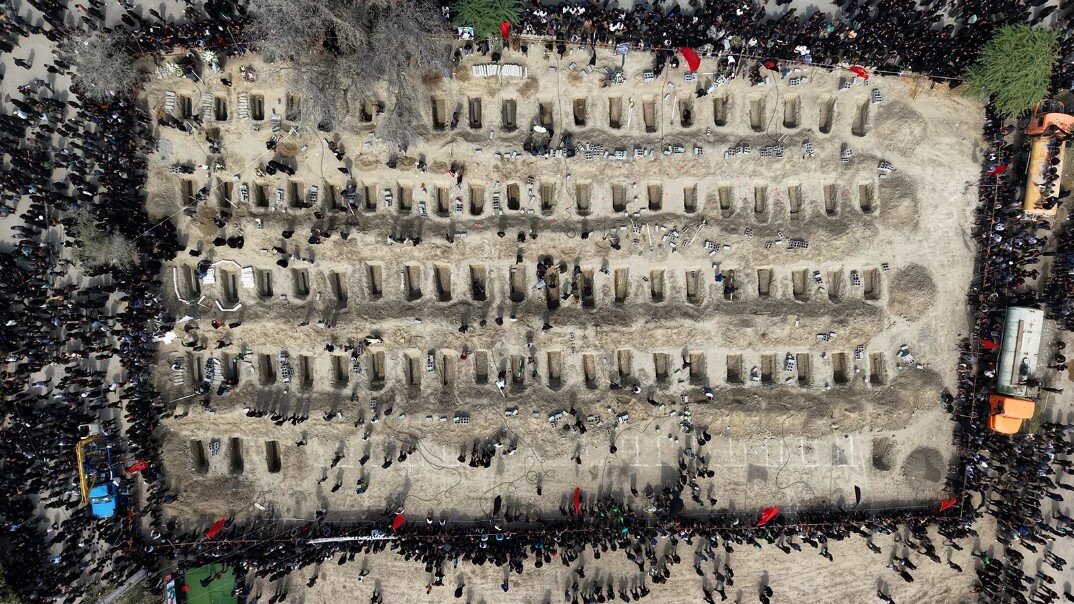
TEHRAN- Morteza Akhondi, a distinguished photographer from Iran’s Hormozgan province, has secured the first-place prize in the Editorial/Press category at the prestigious Golden Shot Photography Awards 2026.
The internationally acclaimed competition awarded Akhondi the Gold Award for his aerial photograph capturing the funeral and burial procession of 168 martyred students and teachers in Minab, Fars reported on Friday.
The image, lauded for its powerful visual narrative and creative composition, has resonated deeply with global audiences and captivated the international jury, the report added.
The award-winning photograph provides a bird’s-eye view of a historic and tragic moment, documenting the final farewell to the young victims of a widely condemned crime committed by the US and the Zionist regime.
In the small city of Minab, the loss of so many young lives was a heavy burden for the community. To honor the victims, a large area of land was turned into a cemetery, with graves dug in neat, endless rows.
This striking imagery is what makes Akhondi’s photograph remarkable. The aerial view shows the haunting arrangement of these small graves, each symbolizing a life lost too soon. Surrounding this solemn site, the entire city gathered in grief, their shared sorrow creating a powerful contrast to the orderly rows of students being laid to rest.
In this category Akhondi was followed by Bartosz Matenko from Poland and Mohammed Muhtasib from Saudi Arabia, who secured second and third places, respectively.
The caption accompanying the photograph on the official awards website underscores the gravity of the subject: “Minab – 168 Students. The resting place of children whose only ‘fault’ was being children… Innocent, they were silenced, and history will never forget the crime.”
The jury also granted an honorable mention to another Iranian photographer, Ali Nejatbakhsh in this category. His recognized series titled “Solidarity” provides a harrowing visual record of the aftermath of an Israeli missile strike on June 13, 2025.
The images document the desperate hours following the destruction of a residential building on Patrice Lumumba Street in Tehran—the home of Ahmadreza Zolfaghari, a faculty member of nuclear engineering. Through these frames, the resilience of firefighters, rescue teams, and municipal crews is immortalized as they labored under unstable conditions and temporary lighting to clear debris and search for survivors amidst the ruins.
The tragedy in Minab, depicted in Akhondi’s winning work, remains one of the most harrowing episodes of recent history, marked by the cold-blooded massacre of 168 innocent students and teachers.
On February 28, the Shajareh Tayyebeh elementary school in Minab, Hormozgan province, became the site of a catastrophic massacre during the initial waves of aggression launched by the United States and the Zionist regime against Iran.
The strike occurred as students—children aged between 7 and 12—were beginning their morning lessons. A precision missile strike caused the immediate collapse of the school building, trapping students and teachers beneath mountains of rubble. Official reports confirmed a final death toll of 168 victims, with at least 95 others sustaining severe injuries, marking one of the most harrowing atrocities of the conflict’s opening day.
While US and Zionist authorities initially attempted to distance themselves from the carnage as images of the ruins flooded social media, rigorous forensic and digital investigations have since exposed the truth. An extensive analysis by Al Jazeera’s digital investigations unit, utilizing over a decade of satellite imagery and ground-level video, confirmed that the school was a distinct civilian facility, isolated from any military installations for at least ten years. Furthermore, satellite data revealed that the school was “triple-tapped”—hit by three separate, deliberate strikes—proving the attack was not a mistake, but a calculated targeting of children.
This conclusion has been echoed by the international community’s most reputable news outlets. Investigations by The New York Times, BBC Verify, CBC, and NPR have all independently concluded that the United States was responsible for the strike. These findings have sparked global outrage and raised fundamental questions regarding the “intelligence” used to justify the bombing, as the pattern of the attack suggests the direct targeting of an educational institution. The Minab school tragedy now stands as a somber testament to the immense human cost of this aggression and a primary focal point for international demands for accountability.
SAB/
Disclaimer : This story is auto aggregated by a computer programme and has not been created or edited by DOWNTHENEWS. Publisher: tehrantimes.com