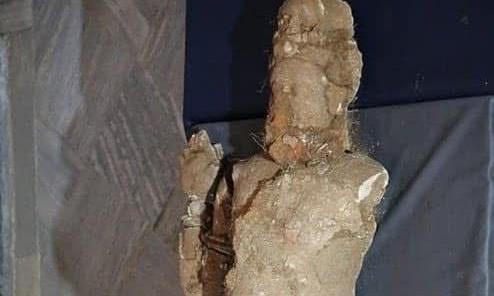
Hyderabad: With lower legs missing, face partially damaged and broken left arm, a life-size stucco Bodhisattva that was discovered in 2019 awaits restoration after seven years after discovery during excavations at the ancient Phanigiri Buddhist site in Suryapet.
The sculpture, dated to the third and fourth centuries of the Common Era (CE), is considered as the one of the largest stucco Buddhist sculptures in the country. It is believed to depict a Bodhisattva associated with the Jataka Chakra tradition of Buddhism.
Measuring approximately 1.73 metres in height, the sculpture was found lying face down on the north-eastern side of the Buddhist complex. It reflects the spread of Mahayana Buddhism in the Deccan region and showcases the advanced sculptural traditions of ancient Telangana.
Following excavation, the heritage department shifted the sculpture to Hyderabad for conservation. Currently, the sculpture is housed in the Centenary Museum, Gunfoundry, and is under the chemical works.
Speaking to Deccan Chronicle, an official said that the sculpture was in a fragile condition. During the excavation around 18 broken pieces were recovered from the sculpture. “The sculpture’s lower legs below the knees are missing, face is partially damaged and a broken left arm,” officials said.
Officials said the department was looking for the experts to undertake the conservation work and in discussions with the Archaeological Survey of India. Talks were recently held with experts from Japan for conservation works. For technical expertise officials also reached out to Chatrapati Shivaji Maharaj Vasthu Sangrahalaya in Mumbai.
Historians noted that if the sculpture is restored and displayed in the museum, it would become another priceless addition to Telangana archaeological and cultural heritage.
Disclaimer : This story is auto aggregated by a computer programme and has not been created or edited by DOWNTHENEWS. Publisher: deccanchronicle.com