Michael Koziol assembles an impressive chorus of critics portraying the Memorandum of Understanding on Iran as a surrender, a betrayal of military gains and shockingly weak (“Winners and losers in Trump’s deal with Iran”, June 20). They may be right but one question goes largely unasked: what happens when Iran fails to comply, as it has before? A close look shows the $US300 billion reconstruction fund is contingent on a final deal, which Iran has not yet earned. Further, the sanctions relief beyond oil is phased and conditional, not handed over upfront, and the uranium Iran retains is all that was left after the devastating US strikes. All told, it is hardly the capitulation critics describe. Iran’s record deserves more attention: a regime that has never sustained compliance and a leadership increasingly too fractured to enforce it. The greatest risk to the peace plan lies in Lebanon. Hezbollah continues firing rockets. Israel cannot be expected to absorb those attacks indefinitely and Tehran knows it. A single Israeli response could provide Iran with the pretext to abandon all so-called commitments. The agreement also sends an unfortunate message to any terrorist organisation that taking a hostage, like the Strait of Hormuz, can yield rewards. John Kempler, Rose Bay
As Michael Koziol notes, “distrust of the Iranian regime runs deep” in the US. Indeed, that distrust, coupled with a lack of interest and understanding that has defined US relations with so many countries that pose no threat to its interests, including Cuba, Vietnam, Iraq and Afghanistan, is the cause of many appalling and tragic decisions made by successive US governments in the past 80 years. If, instead of military intervention, sanctions and proxy wars, the US supported economic development, the countries seen as threats would probably evolve towards moderate governments. Economic security marginalises extremists in the long run. It’s that very sharing of economic success in the postwar era across the West that undermined the extremes of right and left. Colin Hesse, Nowra
Some countries wait for conflicts to resolve themselves. Pakistan does not. It stepped in when the US and Iran needed a way forward (“How the US-Iran deal came down to the wire”, June 20). Pakistan took on the role of facilitator when few others would. The Islamabad Memorandum of Understanding followed an agreement that pulled two old enemies towards negotiation. Why is Pakistan doing this? It has a border with Iran and deep cultural links. It also has ongoing communication with the United States. That combination allows Pakistan to speak straight to both without playing games. Work of this kind seldom earns credit while it is under way. It operates in the background, on patience and trust, not on loud declarations. It has proved that determined mediation can deliver palpable results. But does this guarantee lasting peace? Hardly, since deep problems remain. Nevertheless, Pakistan has shown that a committed negotiator can shift the direction of a conflict. Yumna Zahid Ali, Karachi (Pakistan)
There are no winners in the Iran war but America may end up being the biggest loser. It’s estimated that more than 2000 Iranians have died, including hundreds of women and children. Iran has also suffered massive structural damage. However, the US has inflicted serious damage on itself, including irreparable harm to its reputation and enormous economic loss. It is possible that some good may result from this illegal war, namely an end of the reigns of both Benjamin Netanyahu and Trump. Netanyahu faces an election in August, and the US midterm elections are due in November. Both leaders have outstayed their welcome at home and abroad. We live in hope. Graham Lum, North Rocks
Immoral lesson
Jacqueline Maley’s report on Donald Trump’s financially rewarding 80th birthday bash, including a cage fight on the lawns of the White House, while Vice President JD Vance was busy scraping together a deal to end the Iran war, refers to it as a “Trump-era parable” (“The cage fight as a Trump-era parable”, June 21). Whereas a parable is a tale involving human characters that conveys a moral lesson, a fable is story that features talking animals or inanimate objects and ends with a specific moral. I would thus suggest that a more appropriate categorisation would be to refer to this story and many others involving Trump as farables – that is, stories involving humans behaving like animals who lack any morality whatsoever. Mary Carde, Parrearra (Qld)
Alternative facts
I have been waiting for someone to pick up on Pauline Hanson’s selective statements at the Press Club but I can’t wait any longer (“Pauline Hanson spoke for 90 minutes. We fact-checked her key claims”, June 20). First, she said, “don’t expect a divisive Welcome to Country from me”. Only an Indigenous person gives a Welcome to Country, so that’s a non-starter anyway. Second, she had a long rant against government subsidies for the renewables sector but made no mention of all the subsidies paid to the fossil fuel industry for decades. Third, she confected outrage at the proportion of people surveyed who spoke a language other than English at home. The operative word here is “home”. Many migrants speak their first language at home as they wish their children to grow up bilingual. This does not mean they cannot speak English, all it means is that the children can communicate with relatives in their parents’ country of origin. It also opens up career options in the Foreign Affairs Department or the diplomatic corps or any number of other areas. Hanson needs to look a bit deeper at her subject matter. Ann Clydsdale, Bathurst
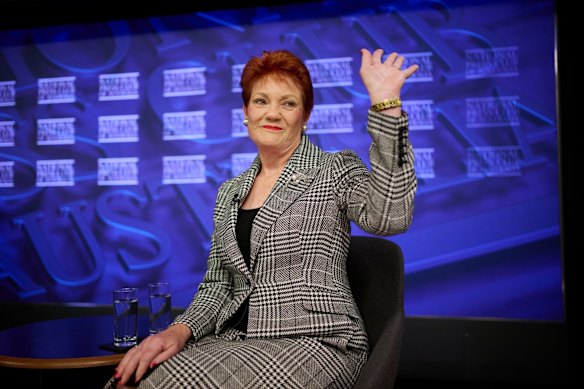
My biggest disappointment with the coverage of Hanson is not the constraint of politically correct language but why journalists at the National Press Club have not followed up the excellent question posed by The Guardian. Surely just one other journalist could have asked Hanson to address the allegation of misuse of public funding by her daughter and her party. They allowed Hanson’s name-calling to be the story, not her abject failure to explain. Susan Tregeagle, Yarralumla
Your editorial condemning Hanson’s treatment of the media highlights her inability to rationally consider criticism (“Hypocrisy of Hanson’s vow to be accountable”, June 20). If One Nation ever came to power, it’s obvious that the policies she outlined in her Press Club speech would require the creation of an authoritarian regime. This makes it imperative for the media to relentlessly warn the Australian public of the frightening implications of a One Nation government. Alan Morris, Eastlakes
I totally agree with your editorial that Hanson and her party have to be held accountable for their policies and statements, whether it’s attacking the media or various ethnic and religious groups. They should not be allowed to spread misinformation and cause division, and must be seriously challenged. Unfortunately this would require the various media organisations to be in agreement but they are not all on the same page. Con Vaitsas, Ashbury
Malcolm Knox has pointed out that during senate estimates, in his querying of funding of Indigenous artists by Creative Australia, One Nation’s Malcolm Roberts had his figures wrong by a wide margin (“Hanson is right about political correctness. It stops us calling her stupid”, June 20). This is typical of One Nation. Hanson herself frequently makes claims that are demonstrably false. In America, Trump does the same yet his followers ignore his errors and still support him. As Knox says: “If you want to use your brains or the process of logical deduction in explaining, or understanding, the rise of One Nation, you have already missed the point.” Sadly, it’s clear that truth and logic are casualties of modern-day politics. Peter Nash, Fairlight
There are many types of intelligence, some more obvious than others. Some types should perhaps be called cunning, common sense or even street smarts. IQ tests have their uses but if not coupled with adequate social intelligence a person is less effective in interacting with others and achieving their goals. With this in mind, it’s unlikely that Hanson will be able to assemble the depth of talent she needs in the two years before the next election. Her record shows that very few politicians elected under her banner truly respect her leadership and values, and they don’t hang around long. Peter Kamenyitzky, Copacabana
The political debate on climate change has become both absurd and alarming (“How Hanson has us doing climate wars time warp”, June 20). No one would walk into the National Press Club and declare tobacco good for our health. So how is it acceptable, or even possible, for political leaders to spread lies about climate change? Tobacco harms people. Likewise fossil fuels, which heat the planet and drive more intense fires, floods, droughts and deadly heatwaves. Both are scientific facts. Culture‑war theatrics won’t shield Australians from the extremes ahead. Isabelle Henry, Ascot Vale (Vic)
Voter dissatisfaction with the major parties may well be a major reason for rising support for One Nation (“Pauline Hanson is picking up support but won’t fix our one true problem”, June 20) but another, often overlooked factor is voter ignorance caused by the predominance of social media as a source of news. When the print media (and, to a lesser degree, radio and television) were the main sources of news, people were accustomed to reading more than a headline or an introductory paragraph. These days, however, the norm has become cleverly crafted clickbait, out-of-context quotes from politicians and snippets of AI-generated “news”. None of it does anything to properly inform the electorate about those who wish to govern its country. Phil Rodwell, Redfern
In 1775 Dr Samuel Johnson coined the famous aphorism “Patriotism is the last refuge of a scoundrel”. Hanson demonstrated at the National Press Club last week that nowadays it can be the first – upfront and proudly. Alex Mattea, Kingston
Flicking through the pages of Saturday’s Herald, I was disturbed by images of Hanson on pages 14, 33, 34 and 36, as well as a cartoon likeness on page 3 of the business section. Dare I ask why Hanson and her cavalcade of cacophonous cretins are given so much oxygen? Peter Hayes, Port Macquarie
Hanson claims to be “disgusted” by the GetUp stunt at the Press Club. Funny, she didn’t seem to be at all worried by her disgusting burqa stunts at Parliament House. Paul Duncan, Leura
Who’s to blame
Now that Ukraine has attacked the Russian oil industry, driving Russia to buy oil products on the international market to replace its lost refinery capacity, don’t blame PM Anthony Albanese when the diesel price goes up (“Albanese defends $400m in fuel relief”, June 21). Despite the false claims by the Liberals and One Nation, the fuel price rises over the past year or two have all been the result of wars beyond the government’s control. Put the blame where it belongs: Putin and Trump. Alan Stanley, Upper Corindi
Ocean blues
The shark-infested island of Reunion has reduced the number of attacks by culling dangerous adult sharks caught on smart drum lines but it has also implemented other mitigation practices (Letters, June 20). Swimming and surfing in any open water location is banned, swimming is restricted to fully netted beaches or protected lagoons, and surfing is only allowed in designated, AI-enabled drone-monitoring and anti-shark netted zones. Recently, authorities have pushed the message that swimming after rain, near river mouths and at dawn or dusk carry a greater risk, all of which restricted my ocean swims this past summer. However, only when we implement all Reunion’s measures can we protect our ocean swimming and surfing culture. Sadly, I fear this may be too limiting for many people who love the ocean. Jenni Burgess, Westleigh
Helen Pitt’s beautiful description of her love of ocean swimming will resonate with many (“Finding peace where sharks swim”, June 20). She reminds us that the risk of shark attack is not just about loss of life and limb but also a reduction in the joy “Dr Pacific” dispenses year-round to the 6 million people in NSW living near the ocean. The NSW government needs to better support the patients of the good doctor. Graeme Stewart, Avalon
Housing solution
Prefab housing offers some potential to improve housing supply but these buildings do not just magically appear. They still need all the labour and materials that onsite construction require (“Government goes big on pre-made homes to solve housing crisis”, June 21). The lead time is shorter, wastage and labour costs are slightly reduced, and the quality should be better, assuming components are built in a controlled factory environment. Costs are reduced because less time is lost to inclement weather and less time is spent on site. In my many years as a building designer, trying to get prefab into the mainstream, prices have been no more than 10 per cent lower than conventional construction but are more often the same. At the moment there are too few manufacturers able to achieve the kind of change envisaged. Major investment is required, however; good, site-responsive design and low-energy performance must not be sacrificed on the altar of scale and supposed affordability. To do so would be to lumber the next generation with a costly time bomb. Prefab has the potential to make much better buildings than the old brick veneer archetype but it won’t happen without adherence to an upgraded National Construct Code. Dick Clarke, Elanora Heights

Migration and housing
There is no doubt the housing crisis is complex but I am struggling to understand the Coalition’s position of matching housing construction to migration levels. Last year we built 172,000 new homes, with net migration reported at 301,000 – a big gap. But more than one person lives in each new house; indeed, the standard modelling figure assumes 2.4 persons per house. So, to meet the Coalition’s target we needed to have built only 125,000 new homes last year. That being the case, how is migration causing the housing crisis? Please explain. Ray Thompson, Randwick
- To submit a letter to the Sydney Morning Herald, email letters@smh.com.au. Click here for tips on how to submit letters.
- The Opinion newsletter is a weekly wrap of views that will challenge, champion and inform. Sign up here.
Disclaimer : This story is auto aggregated by a computer programme and has not been created or edited by DOWNTHENEWS. Publisher: www.smh.com.au